In Brazil, stargazers escape cities in search of 'astro-tourism' / Photo: MAURO PIMENTEL - AFP

Awestruck by the oranges and blues of the Jewel Box star cluster, part of the Southern Cross constellation, Pedro Froes manages to get out a few words: "It's incredible."
Froes is viewing the stars from a telescope in Desengano State Park, a rural patch of Brazil largely spared from light pollution, located some 260 kilometers (160 miles) north of Rio de Janeiro.
Desengano is Latin America's first "International Dark Sky Park," as designated by the global light pollution tracker DarkSky. And Froes is one of the park's growing number of "astro-tourists," drawn there by its isolation from cities and the light they spew into the night sky.
"From here you can see 3,000 stars a year with the naked eye, without the help of an instrument," says astronomer Daniel Mello, from the Valongo Observatory at the Federal University of Rio de Janeiro.
"In cities like Rio or Sao Paulo, at most, you can see 200 a year."
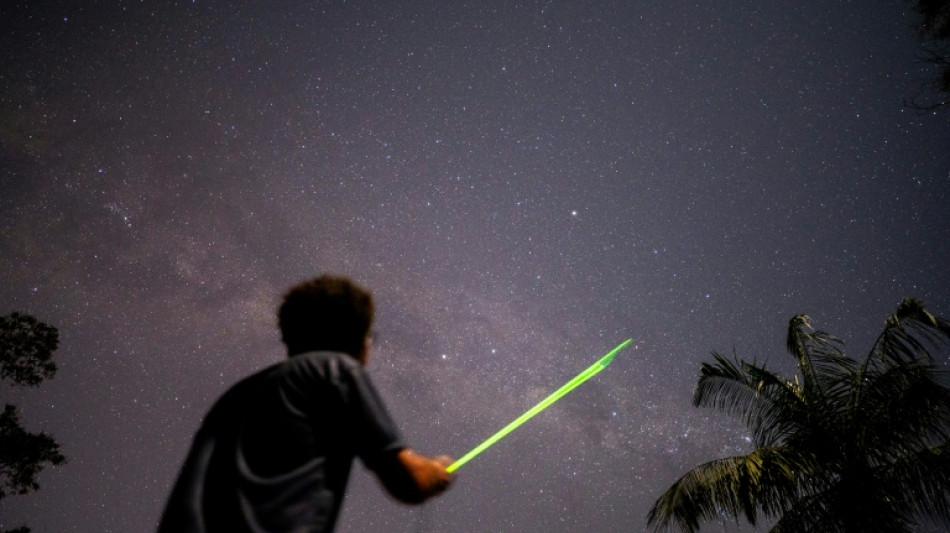
In the front garden of the park's headquarters, located in the small town of Santa Maria Madalena, Mello conducts a public observation session in front of about 20 people, pointing with a laser to the Southern Cross, Scorpio and Centaurus constellations.
The evening is part of a project created by Mello and a group of specialists in tourism, ecology and photography.
The nearest big city is 120 kilometers away, protecting the park -- replete with vegetation, forest and mountains -- from artificial light.
That means the Milky Way is visible to the naked eye even on moonlit nights. Two telescopes provide views of more distant stars.
"I always liked to admire the sky, but I rarely had the opportunity to see it like here," says Froes, a 22-year-old biologist from Niteroi, a city near Rio.
- Annual star festival -
Some 80 percent of people on Earth sleep under night skies polluted by artificial light, the consequence of modernization and urbanization.
But beyond clouding out the stars, light pollution also has negative environmental effects -- leading to restless humans and disoriented migratory birds, and causing reproductive issues for other species.
In Latin America, the only other area recognized by DarkSky is in Chile's Elqui Valley, classified as a "sanctuary."
Unlike in Chile, Europe or the United States, astro-tourism is still in its infancy in Brazil.
But more and more stargazers have been trekking to Santa Maria Madalena, "especially in the last six months," says Nelson Saraiva. He runs one of the few hotels in the town of 10,000, where most people are farmers.
Saraiva, a retired teacher, is convinced astro-tourism can become a huge economic boon for the community. Beyond Mello's observation sessions, there are also monthly gatherings that mix astronomy and gastronomy.
The government and local entrepreneurs have banded together to organize a star festival to take advantage of growing tourist interest. The first festival was organized last September, with plans in place this fall for what's shaping up to be an annual tradition.
- Ecological equilibrium -
To obtain certification from DarkSky, Desengano park also had to commit to promoting environmental education, as well as using low-impact lighting.
Those sorts of moves are good for the sky, but also have down-to-Earth implications felt closer to home.
"We have an enormous diversity of birds, mammals, and reptiles which are here only because the place is preserved," says park research manager and biologist Carlota Enrici.
"Reducing light pollution keeps the ecosystem in balance."
Mello, the astronomer, hopes other places in Brazil can follow Desengano's model, which would not only expand tourism but also "rescue people's contact with the starry sky and with nature."
Y.Ishikawa--JT