Cold War flashbacks in Russia-US talks in Geneva

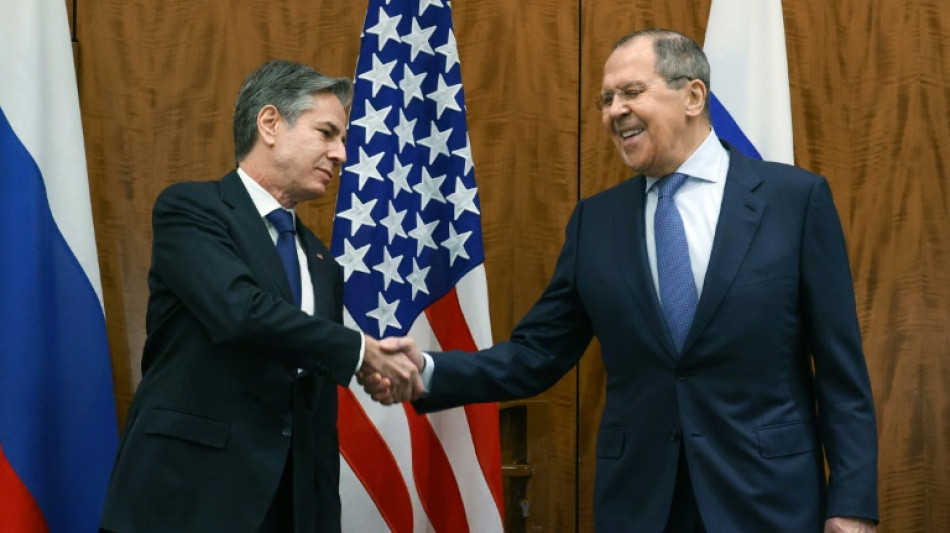
Geneva, the neutral turf that was once host to so much Cold War bargaining, is again welcoming Russian and US officials to discuss missiles, nuclear arms and spheres of influence on the eve of a possible conflagration.
There is a heavy whiff of the 20th-century East-West power struggles in the Swiss capital, a flashback to the tense period between World War II and the Soviet Union's collapse in 1991, when the fate of the world often appeared to hang in the balance.
The two rival camps are beginning to openly make the comparison themselves, even if observers note significant differences.
"What we're having now we have is kind of a remake of the Cold War, Cold War 2.0," Dmitri Polyansky, the Russian deputy ambassador to the United Nations, said last month, putting the blame on the United States.
In Berlin, the city once split by a wall that became the emblem of the Cold War, US Secretary of State Antony Blinken warned Thursday that any Russian invasion of Ukraine, which Westerners fear could happen at any moment, would bring the world back to a time "when this continent, and this city, were divided in two... with the threat of all-out war hanging over everyone's heads."
- 'Brinkmanship' -
The similarities are striking.
Firstly, the geographical split is identical, with Moscow facing down the West.
Military, too, there is once again the risk that a local conflict fought by proxy forces could degenerate into a much larger and more direct confrontation of great powers.
And as in the heyday of the Cold War, the two powers have rallied their allies and defended their spheres of influence in a classic display of realpolitik bloc logic.
While the Americans suspect the Russians of wanting to use Belarus as a rear base for a potential offensive in Ukraine, NATO, the transatlantic alliance that the United States recently tried to redirect towards China, has rediscovered its raison d'être from the time of its founding in 1949, namely to defend non-Soviet Europe from a possible attack by Moscow.
Russian President Vladimir Putin, a former KGB officer, is practicing "Cold War-style brinksmanship, threats and intimidation intended to burnish Putin's image as a strongman," Sarah Kreps, a professor at Cornell University, told AFP.
From the location of the talks to the vocabulary used and the issues on the table, it all has a vintage feel as the two sides haggle over the deployment of missiles and troops at the gates of the opposing bloc.
- Less ideology -
However, John Bolton, who served as national security advisor to former US president Donald Trump, noted that the current face-off lacks the ideological ingredient of Communism versus liberal democracy that "shaped the Cold War."
"What we're looking at now is much more a kind of typical nineteenth-century power-politics confrontation, and I don't think it's infused by ideology,” he said.
"The immediate issue that we face is not just Ukraine, but is Putin's effort to either reassert Russian control over the former Soviet Union or at a very, very, very bare minimum, establish Russian hegemony over it,” he said.
For Bolton, the current crisis is the culmination of a long drift borne of the blindness of Western leaders and thinkers who were lulled in the 1990s by the illusion of a world without major conflict and did not see that Moscow had never really accepted the dissolution of its empire. That was something Putin referred to in 2005 as the "greatest disaster" of the last century.
"Putin is both patient and agile," said Bolton, adding that the process has "not not been exactly fast, but it's been consistent," referring to the Russian military intervention in Georgia in 2008 then the annexation of Ukrainian Crimea in 2014.
If crisis erupts today, it is also because the US has partly withdrawn from the world stage -- President Joe Biden has made it clear that he has no intention of directly involving the United States in a new conflict.
"Clearly in Putin's mind, Russia is destined to be a great power” Bolton said, and the Russian leader likely resents that Beijing has replaced it in the role of Washington's number one rival.
Cold War or not, the strategic stakes have hardly changed. At the time, "there were nuclear weapons -- a lot of them -- but deterrence worked. Neither side was going to provoke a nuclear war because no one would win that war," said Kreps.
"Very little about that dynamic has changed other than the individuals involved, but the most important thing -- the strategic calculus -- remains the same.”
She warned that "we will see these types of crises come and go," but in the future, as in the Cold War of the past, "deterrence will keep a lid on major escalatory action.”
S.Fujimoto--JT