The Japan Times - Our galaxy's black hole not as sleepy as thought: astronomers

EUR -
AED 4.208399
AFN 73.327206
ALL 95.443491
AMD 432.388906
ANG 2.050961
AOA 1050.638449
ARS 1597.797451
AUD 1.630475
AWG 2.062323
AZN 1.948746
BAM 1.943569
BBD 2.310976
BDT 140.793986
BGN 1.958415
BHD 0.432562
BIF 3402.832693
BMD 1.145735
BND 1.465078
BOB 7.928827
BRL 6.043409
BSD 1.147439
BTN 106.407664
BWP 15.559995
BYN 3.497248
BYR 22456.404302
BZD 2.307687
CAD 1.573484
CDF 2600.81847
CHF 0.90886
CLF 0.026568
CLP 1049.068969
CNY 7.874693
CNH 7.906797
COP 4247.239324
CRC 535.908827
CUC 1.145735
CUP 30.361975
CVE 111.193704
CZK 24.498161
DJF 203.619906
DKK 7.474663
DOP 68.80171
DZD 151.997717
EGP 59.857436
ERN 17.186024
ETB 179.880066
FJD 2.546109
FKP 0.858669
GBP 0.864004
GEL 3.110683
GGP 0.858669
GHS 12.494286
GIP 0.858669
GMD 84.784244
GNF 10059.552798
GTQ 8.789572
GYD 240.054674
HKD 8.981015
HNL 30.441679
HRK 7.536413
HTG 150.373205
HUF 394.577381
IDR 19518.396264
ILS 3.551836
IMP 0.858669
INR 107.268515
IQD 1500.912737
IRR 1506641.41082
ISK 143.228118
JEP 0.858669
JMD 180.166218
JOD 0.812301
JPY 183.136532
KES 148.430115
KGS 100.194954
KHR 4594.397018
KMF 490.374163
KPW 1031.136674
KRW 1732.202746
KWD 0.351394
KYD 0.956116
KZT 553.517402
LAK 24576.014094
LBP 102585.696896
LKR 357.291571
LRD 210.070484
LSL 19.270906
LTL 3.383057
LVL 0.693044
LYD 7.309401
MAD 10.739833
MDL 20.004714
MGA 4777.714338
MKD 61.657059
MMK 2406.161833
MNT 4091.535941
MOP 9.26322
MRU 45.966756
MUR 53.288063
MVR 17.712808
MWK 1988.995904
MXN 20.460073
MYR 4.486128
MZN 73.211959
NAD 19.270894
NGN 1553.616757
NIO 42.071856
NOK 11.006685
NPR 170.246753
NZD 1.975556
OMR 0.44053
PAB 1.147434
PEN 3.927008
PGK 4.929811
PHP 68.826542
PKR 320.007136
PLN 4.279378
PYG 7415.814625
QAR 4.175008
RON 5.09348
RSD 117.464137
RUB 96.10281
RWF 1671.627239
SAR 4.301874
SBD 9.217712
SCR 16.540068
SDG 688.586873
SEK 10.788429
SGD 1.470552
SHP 0.859598
SLE 28.242067
SLL 24025.500669
SOS 654.828588
SRD 42.821822
STD 23714.399477
STN 24.633301
SVC 10.039689
SYP 126.701966
SZL 19.270862
THB 37.545767
TJS 10.97467
TMT 4.010072
TND 3.342678
TOP 2.758654
TRY 50.684222
TTD 7.777783
TWD 36.700981
TZS 2983.184004
UAH 50.461567
UGX 4316.759367
USD 1.145735
UYU 46.46758
UZS 13949.322477
VES 516.660955
VND 30144.285571
VUV 137.021717
WST 3.1321
XAF 651.809663
XAG 0.015196
XAU 0.000238
XCD 3.096406
XCG 2.067914
XDR 0.809897
XOF 649.058144
XPF 119.331742
YER 273.343656
ZAR 19.46103
ZMK 10312.985183
ZMW 22.437917
ZWL 368.926175
  • RBGPF

    0.1000

    82.5

    +0.12%

  • CMSC

    -0.1200

    22.83

    -0.53%

  • RIO

    -2.0800

    87.72

    -2.37%

  • BCE

    -0.2600

    25.75

    -1.01%

  • RYCEF

    -0.1800

    16.6

    -1.08%

  • BCC

    -1.0800

    71.84

    -1.5%

  • GSK

    -1.3500

    52.06

    -2.59%

  • JRI

    -0.1370

    12.323

    -1.11%

  • CMSD

    0.0100

    22.89

    +0.04%

  • NGG

    -3.0200

    87.4

    -3.46%

  • RELX

    -0.4300

    33.86

    -1.27%

  • VOD

    -0.3800

    14.37

    -2.64%

  • BTI

    -2.4600

    58.09

    -4.23%

  • BP

    0.7600

    44.61

    +1.7%

  • AZN

    -2.8700

    188.42

    -1.52%

Our galaxy's black hole not as sleepy as thought: astronomers
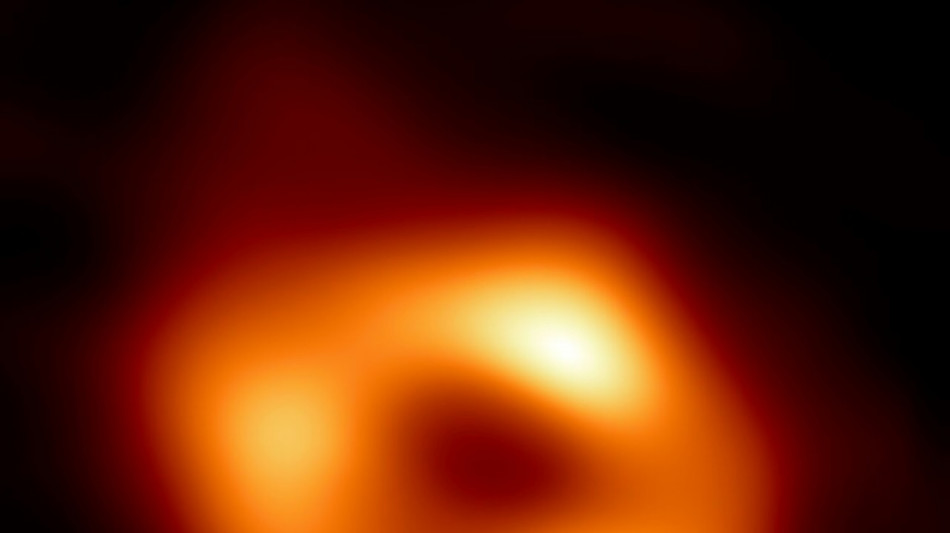
Our galaxy's black hole not as sleepy as thought: astronomers / Photo: Handout - European Southern Observatory/AFP/File

Our galaxy's black hole not as sleepy as thought: astronomers

The supermassive black hole lurking at the centre of our Milky Way galaxy is not as dormant as had been thought, a new study shows.

Text size:

The slumbering giant woke up around 200 years ago to gobble up some nearby cosmic objects before going back to sleep, according to the study published in the journal Nature on Wednesday.

NASA's IXPE space observatory spotted an x-ray echo of this powerful resurgence of activity, the researchers said.

The supermassive black hole Sagittarius A* -- abbreviated to Sgr A* -- is four million times more massive than the Sun. It sits 27,000 light years from Earth at the centre of the Milky Way's spiral.

Last year astronomers revealed the first-ever image of the black hole -- or rather, the glowing ring of gas that surrounds its blackness.

Sgr A* has "always been seen as a dormant black hole," said Frederic Marin, a researcher at France's Strasbourg Astronomical Observatory and the study's first author.

Most supermassive black holes squatting at the middle of their galaxies go dormant after swallowing up all the nearby matter.

"Imagine a bear going into hibernation after devouring everything around it," Marin told AFP.

But the international team of researchers discovered that at around the end of the 19th century, Sgr A* came out of its slumber and consumed any gas and dust unlucky enough to be within its reach.

The feeding frenzy lasted from several months to a year, before the beast went back into hibernation.

- Million times brighter -

When it was active, the black hole was "at least a million times brighter than it is today," Marin said.

Its awakening was noticable because nearby galactic molecular clouds started giving off vastly more x-ray light.

The surge in x-ray light was as "if a single glow-worm hidden in a forest suddenly became as bright as the Sun," French research agency CNRS said in a statement.

Astronomers using NASA's IXPE (Imaging X-ray Polarimetry Explorer) space observatory managed to track the x-ray light and found that it pointed straight back at Sgr A*.

The black hole "emitted an echo of its past activity, which we managed to observe for the first time," Marin said.

The pull of gravity from black holes is so intense that nothing can escape, including light.

But when matter is sucked beyond the black hole's final boundary, known as the event horizon, it emits a massive amount of heat and light before disappearing into the darkness.

Exactly what caused Sgr A* to briefly emerge from its dormant state remains unclear. Could a star or cloud of gas and dust have ventured too close?

The astronomers hope that further observations from the IXPE observatory will help them better understand what happened -- and perhaps reveal more about the origin of supermassive black holes, which remains shrouded in mystery.

K.Yamaguchi--JT