The Japan Times - Remains of new species of duck-billed dinosaur found in Chile

EUR -
AED 4.235825
AFN 75.545802
ALL 93.537535
AMD 423.305618
AOA 1058.811708
ARS 1726.050045
AUD 1.636636
AWG 2.076101
AZN 1.961033
BAM 1.95855
BBD 2.32222
BDT 142.730393
BHD 0.434886
BIF 3452.671024
BMD 1.153389
BND 1.479477
BOB 14.003296
BRL 5.934074
BSD 1.152999
BTN 110.036059
BWP 15.679013
BYN 3.398271
BYR 22606.431288
BZD 2.318956
CAD 1.622248
CDF 2606.660577
CHF 0.933046
CLF 0.026726
CLP 1055.304781
CNY 7.789473
CNH 7.782898
COP 3701.468641
CRC 522.824977
CUC 1.153389
CUP 30.564818
CVE 110.898381
CZK 24.174001
DJF 204.980328
DKK 7.474932
DOP 67.343891
DZD 153.308454
EGP 57.874195
ERN 17.30084
ETB 184.37006
FJD 2.552393
FKP 0.858551
GBP 0.857378
GEL 3.016125
GGP 0.858551
GHS 13.511962
GIP 0.858551
GMD 85.350816
GNF 10132.525167
GTQ 8.794347
GYD 241.385765
HKD 9.045745
HNL 30.980157
HRK 7.535899
HTG 150.750346
HUF 360.8921
IDR 20725.88762
ILS 3.473801
IMP 0.858551
INR 109.684501
IQD 1510.94005
IRR 1586054.532116
ISK 141.797162
JEP 0.858551
JMD 182.305956
JOD 0.817769
JPY 181.856081
KES 149.249433
KGS 100.863577
KHR 4671.226492
KMF 493.651222
KRW 1647.050939
KWD 0.356917
KYD 0.960828
KZT 543.160821
LAK 26066.599277
LBP 103286.016357
LKR 387.123519
LRD 209.080658
LSL 19.065344
LTL 3.405659
LVL 0.697674
LYD 7.341378
MAD 10.751869
MDL 20.182899
MGA 4953.807106
MKD 61.54284
MMK 2421.733025
MNT 4134.092669
MOP 9.314976
MRU 46.262325
MUR 53.621184
MVR 17.831455
MWK 2003.437477
MXN 19.901041
MYR 4.723245
MZN 73.697531
NAD 19.065769
NGN 1572.5428
NIO 42.429571
NOK 11.006044
NPR 176.060187
NZD 1.961494
OMR 0.443477
PAB 1.153019
PEN 3.915185
PGK 5.098267
PHP 70.350996
PKR 320.440363
PLN 4.295418
PYG 6874.681812
QAR 4.204969
RON 5.24954
RSD 117.355054
RUB 92.995645
RWF 1693.175568
SAR 4.318554
SBD 9.309186
SCR 15.476883
SDG 692.597559
SEK 10.979563
SGD 1.478288
SLE 28.200099
SOS 658.925127
SRD 43.703089
STD 23872.830891
STN 24.91321
SVC 10.089165
SZL 19.065835
THB 38.33829
TJS 10.642103
TMT 4.036863
TND 3.39216
TRY 54.866503
TTD 7.82799
TWD 37.381464
TZS 3062.246425
UAH 51.556685
UGX 4317.987553
USD 1.153389
UYU 46.455425
UZS 13856.819878
VES 849.069652
VND 30292.041232
VUV 137.419199
WST 3.151308
XAF 656.879254
XAG 0.019387
XAU 0.000283
XCD 3.117093
XCG 2.078018
XDR 0.817877
XOF 654.547231
XPF 119.331742
YER 274.974351
ZAR 18.891917
ZMK 10381.891222
ZMW 21.817226
ZWL 371.390901
  • CMSC

    0.0300

    21.79

    +0.14%

  • CMSD

    0.0000

    22.02

    0%

  • RBGPF

    3.9500

    69.95

    +5.65%

  • NGG

    0.5600

    80.42

    +0.7%

  • GSK

    0.0200

    51.53

    +0.04%

  • RIO

    3.1100

    99.01

    +3.14%

  • RYCEF

    0.1500

    20.35

    +0.74%

  • BCE

    0.2100

    22

    +0.95%

  • RELX

    0.6400

    36.8

    +1.74%

  • BTI

    -0.4400

    59.12

    -0.74%

  • AZN

    -2.3500

    155.62

    -1.51%

  • BCC

    3.4600

    86.49

    +4%

  • JRI

    -0.1000

    12.72

    -0.79%

  • VOD

    0.0800

    15.69

    +0.51%

  • BP

    -1.8200

    42.44

    -4.29%

Remains of new species of duck-billed dinosaur found in Chile
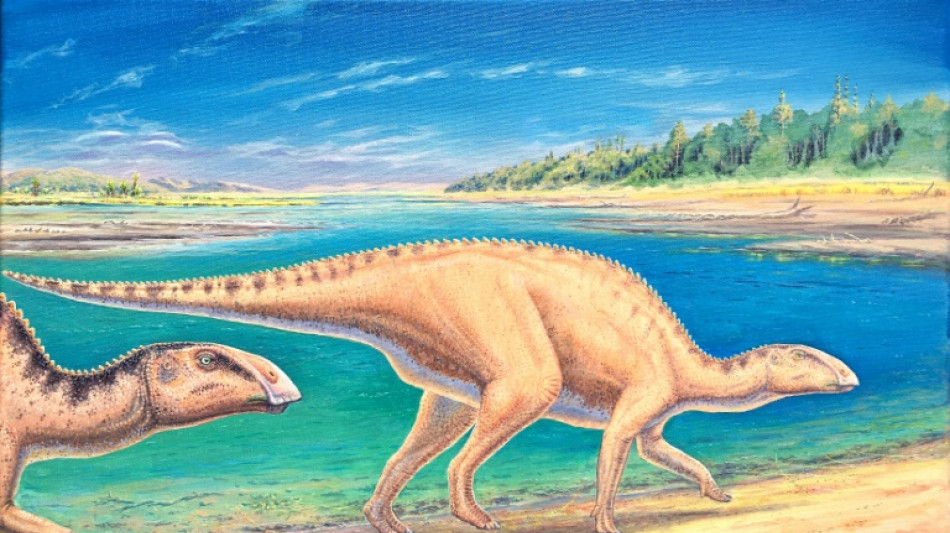
Remains of new species of duck-billed dinosaur found in Chile / Photo: Handout - Universidad de Chile/AFP

Remains of new species of duck-billed dinosaur found in Chile

Remains of a species of herbivorous dinosaur previously unknown in the southern hemisphere have been discovered in Chile, challenging long-held beliefs about the range of duck-billed dinosaurs, scientists said Friday.

Text size:

Measuring up to four meters (13 feet) in length and weighing a ton, Gonkoken nanoi lived 72 million years ago in the extreme south of what is now Chilean Patagonia.

"These were slender-looking dinosaurs, which could easily adopt a bipedal and quadrupedal posture to reach the vegetation at height and at ground level," said Alexander Vargas, director of the paleontological network of the University of Chile and one of the authors of the study published by the journal Science Advances and presented in Santiago.

The discovery demonstrated that Chilean Patagonia served as a refuge for very ancient species of hadrosaurs, a type of duck-billed dinosaur common in North America, Asia and Europe during the Cretaceous period, from 145 to 66 million years ago.

Their presence in the remote southern lands surprised scientists, who will have to "understand how their ancestors got there," Vargas said.

Gonkoken nanoi, the fifth species of dinosaur discovered in Chile, was actually found in 2013, kicking off a decade-long investigation.

The name Gonkoken comes from the Tehuelche language, the first inhabitants of the region, and means "similar to a wild duck or a swan."

H.Nakamura--JT