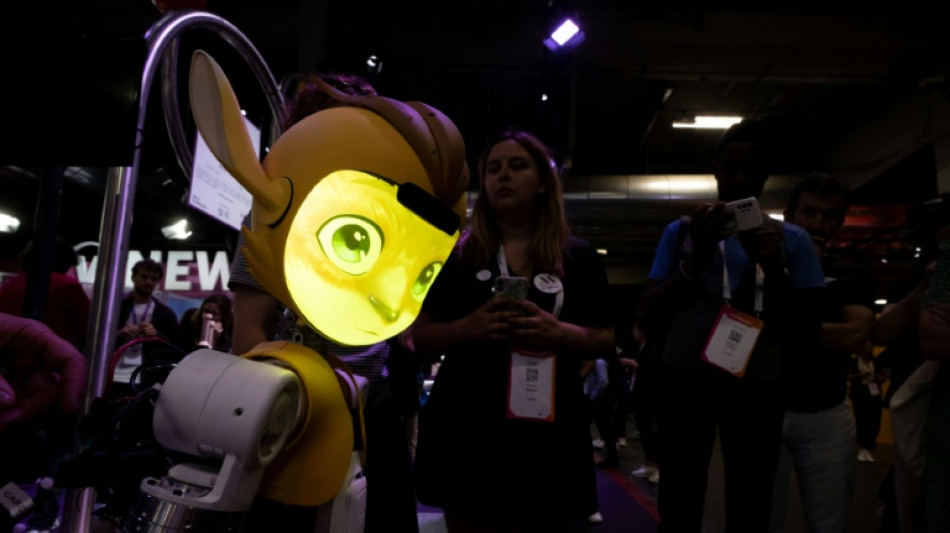
Rise of the cute robots / Photo: ALAIN JOCARD - AFP

The red eye that refuses to be extinguished, the metal body that cannot be crushed -- for many of us the word "robot" conjures one image: the Terminator.
But robots are now everywhere, serving as companions in care homes or vacuum cleaners in our homes, and manufacturers are keener than ever to design friendly machines.
"At first we noticed the kids could be a bit afraid," said Do Hwan Kim of his firm Neubility's tiny delivery robot.
To get around the problem, the firm added big doughy eyes that can indicate, making it look like the world's friendliest futuristic wheelie bin.
Dozens of the machines now trundle around campsites, university campuses and golf courses across South Korea.
"Campsites even use it on their posters," Kim told AFP at the VivaTech trade fair in Paris, underlining its transformation from potential threat to family friend.
And VivaTech played host to plenty of other robots designed with cuteness in mind -- ones with cartoon animal personas, others that looked like children's toys from the 1980s.
The aesthetic stands in stark contrast to the creepy dog-bots and anonymous drones that have become standard.
- 'Escaped' from cartoon -
As robots have become more common, a whole field of academia has grown up studying the interaction between machines and humans.
Kerstin Dautenhahn of Waterloo University in Canada, one of the most noted researchers in the area, said she had seen a huge shift in the way manufacturers looked at design: from an all-consuming concern with function to an acute awareness of appearance.
"What you find in many, many fields... is that people pay a lot of attention to how the robot moves, how it looks, how it can interact with them," she said.
This holds true for robots sharing production lines with human workers just as much as those designed to care for older and disabled people.
"Even with those robots where the main function for example is to transport objects from A to B, people still need to pay a lot of attention to how the robot moves, how it can express its intentions," she said.
A French firm called Enchanted Tools has fully committed to the friendly aesthetic.
Their robots have names, genders, cartoon-style personas and even a back story.
"These two characters have escaped from a cartoon to come into our everyday lives to help us manage our social spaces," said the firm's boss Jerome Monceaux.
He envisages the brightly coloured machines with cat-like features will help in hospitals, hotels, restaurants and anywhere with objects that need moving.
These cute robots take their design cues from a family of social companion robots, which are big business in Japan.
- Stairway hell -
Dautenhahn says there is plenty of evidence that people in Japan and South Korea hold more positive views about robots than people in the West.
"In Japan, if you say 'I want to build a robot that helps older people in a care home to be happier', they just think it's a great idea," she said.
In European countries, the initial response is often negative, fuelled by dystopian science fiction.
"We have to do a lot of convincing," she added.
Small pilot schemes in the United States have seen robots get bullied or even assaulted, though social-media videos have also shown people helping robots navigate pedestrian crossings.
Handling these cultural difficulties is a challenge, says Dautenhahn.
But there are plenty of other difficulties.
Robots are expensive to design and manufacture, and so they don't come cheap to buy.
Enchanted Tools reckons its robots will retail at 35,000 euros ($38,000) while Neubility said it aimed to manufacture its bot for $5,000.
Then there is the issue of finding a market.
Do Hwan Kim said Neubility was aiming to corner grocery deliveries and has a pilot scheme with the 7-Eleven chain in South Korea.
But its robot faces a common hurdle for machines: it cannot climb stairs.
Kim hopes market forces will give a helping hand.
"At the moment, the delivery cost is so much cheaper with the robot that people are happy to come down the stairs to get their groceries," he said.
K.Yamaguchi--JT