Meet the scientist (sort of) spending a year on Mars / Photo: Mark Felix - AFP/File

Living on Mars wasn't exactly a childhood dream for Canadian biologist Kelly Haston, though she'll soon spend a year preparing for just that.
"We are just going to pretend that we're there," the 52-year-old told AFP, summing up her participation in an exercise simulating a long stay on the Red Planet.
At the end of June, she will be one of the four volunteers stepping into a Martian habitat in Houston, Texas that will be their home for the next 12 months.
"It still sometimes seems a bit unreal to me," she laughs.
For NASA, which has carefully selected the participants, these long-term experiments make it possible to evaluate the behavior of a crew in an isolated and confined environment, ahead of a real mission in future.
Participants will face equipment failures and water limitations, the space agency has warned -- as well as some "surprises," according to Haston.
Their communications with the outside world will suffer from the delays that exist between Earth and Mars -- up to 20 minutes one-way, depending on the planets' positions -- and 40 minutes two ways.
"I'm very excited about this, but I'm also realistic for what the challenge is," says the research scientist, whose status as a permanent resident of the United States made her eligible for the program.
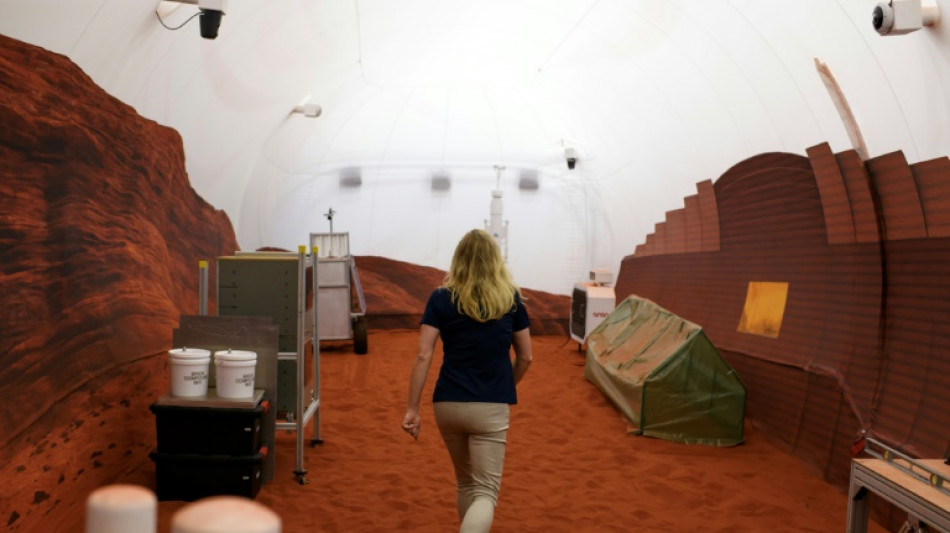
The habitat, dubbed Mars Dune Alpha, is a 3D printed 1,700 square-foot (160 square-meter) facility, complete with bedrooms, a gym, common areas, and a vertical farm to grow food.
"It's actually surprisingly spacious feeling when you go inside it," said Haston, who visited last year before her participation was confirmed.
"And we do have an outdoor area as well where we will mimic spacewalks or Mars walks."
This area, which is separated by an airlock, is filled with red sand, though it is still covered rather than being open air.
The crew will have to don their suits to do "spacewalks" -- "probably one of the things that I'm looking forward to the most," says Haston, a registered member of the Mohawk Nation.
- 'Close knit' -
Haston wasted no time in filling out her application when her partner told her about the opportunity.
"It's aligned with many of my goals in life to explore different avenues of research and science, and then also to be a test subject, and to give to a study that will hopefully further space exploration."
The four members of the mission -- herself, an engineer, an emergency doctor and a nurse -- did not know each other before the selection process, but have since met.
"We really are close-knit already," says Haston, who has been named commander of the group, adding she looks forward to seeing these relationships grow even stronger.
They might be simulating an important exploratory mission for humanity, but how the housemates get along as they share mundane chores including cleaning and meal preparation will be crucial.
A month of training is planned in Houston before entering the habitat.
A teammate could leave in case of injury or medical emergency.
But a whole series of procedures have been drawn up for situations that can be handled by the crew themselves -- including on how to tell them about a family problem that has arisen outside.
- Isolation -
What worries the Canadian most is how she will manage being away from family. She'll only be able to keep in regular touch through email, and only rarely via videos, but never live.
She'll miss being outside and getting to see mountains and the sea, she says.
To cope, she plans to draw on her past experiences, such as a research expedition in Africa where she studied the genetic characteristics of frogs around Lake Victoria.
She spent several months sleeping in cars and tents, with four people, without reliable cell phone coverage.
Feelings of isolation "are things that I think feel very familiar to me."
A specialist in the field of developing stem cell treatments for certain diseases, she has worked in recent years for start ups in California, where she also studied.
This mission is the first of a series of three planned by NASA, grouped under the title CHAPEA (Crew Health and Performance Exploration Analog).
A year-long mission simulating life on Mars took place in 2015-2016 in a habitat in Hawaii, but although NASA participated in it, it was not at the helm.
Under its Artemis program, America plans to send humans back to the Moon in order to learn how to live there long-term to help prepare a trip to Mars, sometime towards the end of the 2030s.
K.Inoue--JT