The Japan Times - 'Snowball Earth' might have been rather slushy: study

EUR -
AED 4.315389
AFN 75.20314
ALL 95.620417
AMD 434.770723
ANG 2.103214
AOA 1078.701182
ARS 1630.662976
AUD 1.621952
AWG 2.116569
AZN 1.980104
BAM 1.949993
BBD 2.374907
BDT 144.489124
BGN 1.960113
BHD 0.445595
BIF 3512.750059
BMD 1.175056
BND 1.492819
BOB 8.12178
BRL 5.786096
BSD 1.179152
BTN 111.210363
BWP 15.778369
BYN 3.319302
BYR 23031.095705
BZD 2.371506
CAD 1.60267
CDF 2721.429668
CHF 0.915304
CLF 0.026772
CLP 1053.66111
CNY 8.003599
CNH 7.996849
COP 4379.210091
CRC 538.014879
CUC 1.175056
CUP 31.138981
CVE 110.396794
CZK 24.325773
DJF 209.974835
DKK 7.472633
DOP 70.255001
DZD 155.328254
EGP 61.938769
ERN 17.625839
ETB 184.115797
FJD 2.566263
FKP 0.865572
GBP 0.864312
GEL 3.149673
GGP 0.865572
GHS 13.219015
GIP 0.865572
GMD 86.365776
GNF 10349.209811
GTQ 8.972244
GYD 245.866808
HKD 9.203767
HNL 31.347827
HRK 7.532929
HTG 154.322952
HUF 358.205803
IDR 20394.270258
ILS 3.418414
IMP 0.865572
INR 111.455108
IQD 1539.323233
IRR 1542848.400886
ISK 143.803446
JEP 0.865572
JMD 185.789671
JOD 0.83313
JPY 183.754035
KES 151.819926
KGS 102.723973
KHR 4726.009119
KMF 492.348489
KPW 1057.55442
KRW 1706.0761
KWD 0.361798
KYD 0.979479
KZT 544.286899
LAK 25815.978342
LBP 105200.39284
LKR 376.277914
LRD 215.710852
LSL 19.429521
LTL 3.469635
LVL 0.71078
LYD 7.463594
MAD 10.80875
MDL 20.204748
MGA 4913.049057
MKD 61.645047
MMK 2467.087736
MNT 4206.288306
MOP 9.486411
MRU 47.062049
MUR 54.898372
MVR 18.160455
MWK 2044.63658
MXN 20.268715
MYR 4.593301
MZN 75.097425
NAD 19.429617
NGN 1598.698819
NIO 43.389265
NOK 10.932185
NPR 178.505875
NZD 1.97232
OMR 0.45181
PAB 1.175395
PEN 4.068628
PGK 5.127117
PHP 71.18602
PKR 328.556533
PLN 4.23271
PYG 7216.540909
QAR 4.281931
RON 5.266244
RSD 117.379835
RUB 87.829436
RWF 1724.268174
SAR 4.416122
SBD 9.423281
SCR 16.81301
SDG 705.621732
SEK 10.858577
SGD 1.489677
SHP 0.877298
SLE 28.965269
SLL 24640.33026
SOS 673.843882
SRD 43.959988
STD 24321.284771
STN 24.505337
SVC 10.284331
SYP 130.670561
SZL 19.216003
THB 37.977673
TJS 10.984045
TMT 4.118571
TND 3.375344
TOP 2.829253
TRY 53.164129
TTD 7.965247
TWD 36.854802
TZS 3056.241658
UAH 51.698339
UGX 4419.819797
USD 1.175056
UYU 47.22936
UZS 14188.799821
VES 579.885899
VND 30918.070929
VUV 138.950861
WST 3.19919
XAF 656.097093
XAG 0.015053
XAU 0.00025
XCD 3.175648
XCG 2.118383
XDR 0.815974
XOF 656.097093
XPF 119.331742
YER 280.397755
ZAR 19.268038
ZMK 10576.910698
ZMW 22.315765
ZWL 378.367521
  • CMSC

    0.1300

    23.01

    +0.56%

  • NGG

    0.2100

    87.85

    +0.24%

  • GSK

    0.1500

    50.53

    +0.3%

  • BTI

    0.1600

    59.56

    +0.27%

  • AZN

    3.6800

    184.92

    +1.99%

  • CMSD

    0.1300

    23.42

    +0.56%

  • RIO

    5.0100

    105.51

    +4.75%

  • BCC

    2.1100

    74.24

    +2.84%

  • BP

    -1.8700

    44.63

    -4.19%

  • BCE

    0.1300

    24.23

    +0.54%

  • JRI

    0.1300

    13.17

    +0.99%

  • RYCEF

    0.8000

    17.3

    +4.62%

  • RBGPF

    0.0000

    63.18

    0%

  • VOD

    0.3900

    16.13

    +2.42%

  • RELX

    -0.4100

    35.75

    -1.15%

'Snowball Earth' might have been rather slushy: study
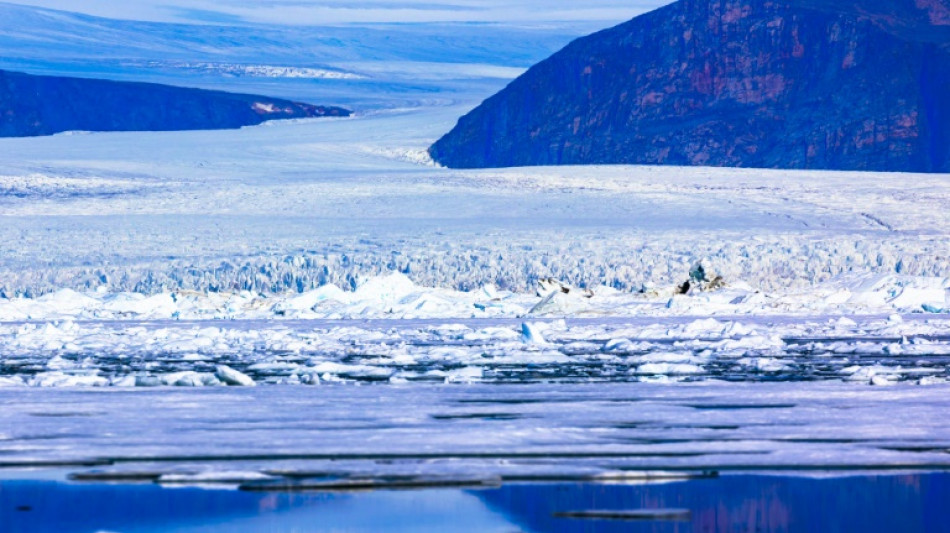
'Snowball Earth' might have been rather slushy: study / Photo: Kerem Yücel - AFP/File

'Snowball Earth' might have been rather slushy: study

Millions of years ago, the Earth was so cold that most of its surface was covered in ice. But that hard freeze might have been slushier than once thought.

Text size:

The longstanding "Snowball Earth" theory imagines our world as seen from space, a perfect sphere with ice covering land and sea alike.

It draws on clues including deposits made by glaciers near the Equator. For ice to have extended that far from the poles suggests much of our planet was once frozen.

But there has long been speculation about just how complete the cover was, with some convinced that areas of slush or open ocean remained, allowing oxygen to penetrate and creating incubators for life.

New research published Tuesday in the journal Nature Communications adds weight to that theory, and suggests these oases in the tundra might have existed much further north than previously suspected.

The evidence comes from a thin layer of black shale that would have been under the sea during the Marinoan ice age, which began around 650 million years ago.

The shale in the Nantuo Formation in southern China acts as a sort of archive for the conditions in oceans at the time.

By analysing levels of elements such as iron, and the presence of nitrogen, scientists can infer whether oxygen was penetrating the ocean and nitrogen was being produced by lifeforms.

"We found evidence of ice-free conditions at mid-northern paleolatitudes (locations before continental drift)," Huyue Song, who helped lead the research, told AFP.

"Until now, ice-free areas had been identified only in peri-equatorial regions."

Instead of a "narrow ice-free belt" across the middle of the Earth, "patchy ice-free areas may have existed much more widely," added Song, a professor at the China University of Geosciences, Wuhan.

The findings build on other research at sites ranging from Australia to Brazil that suggest life was able to cling on in pockets while most of Earth was in deep freeze.

These incubators may even have helped spur "a rapid rebound of the biosphere" at the end of the ice age, the research published Tuesday argues.

The work took four years in total, and involved collecting samples at a remote site in the Shennongjia region of Hubei province, some 500 kilometres from Song's base in Wuhan.

Song believes the findings will help scientists better understand both how our planet's climate works, and how life evolved and survived on Earth through the ages.

And while Earth's ice ages might seem like ancient history, Song argues they could have useful lessons for a planet now experiencing new severe climate change.

"It provides insight into how life survived extreme climate events -- a topic that will become of increasing relevance as modern climate change intensifies," he said.

K.Hashimoto--JT