The Japan Times - Dengue treatment advances in animal trials

EUR -
AED 4.322727
AFN 75.331116
ALL 95.78288
AMD 435.50965
ANG 2.106788
AOA 1080.533638
ARS 1633.433715
AUD 1.621742
AWG 2.120166
AZN 2.019903
BAM 1.953306
BBD 2.378942
BDT 144.734616
BGN 1.963443
BHD 0.446352
BIF 3518.71836
BMD 1.177052
BND 1.495355
BOB 8.13558
BRL 5.796518
BSD 1.181155
BTN 111.399314
BWP 15.805177
BYN 3.324941
BYR 23070.22645
BZD 2.375536
CAD 1.603763
CDF 2726.052992
CHF 0.915341
CLF 0.026817
CLP 1055.45124
CNY 8.017198
CNH 8.004886
COP 4386.650543
CRC 538.928988
CUC 1.177052
CUP 31.191888
CVE 110.584386
CZK 24.307485
DJF 210.33159
DKK 7.472823
DOP 70.374367
DZD 155.67707
EGP 62.057028
ERN 17.655786
ETB 184.428617
FJD 2.567271
FKP 0.865689
GBP 0.864151
GEL 3.154276
GGP 0.865689
GHS 13.242187
GIP 0.865689
GMD 86.515046
GNF 10366.793528
GTQ 8.987488
GYD 246.284546
HKD 9.219398
HNL 31.401088
HRK 7.534898
HTG 154.585153
HUF 356.531523
IDR 20387.370983
ILS 3.417569
IMP 0.865689
INR 110.777579
IQD 1541.938605
IRR 1545469.76174
ISK 143.800494
JEP 0.865689
JMD 186.105335
JOD 0.834493
JPY 184.049206
KES 152.016068
KGS 102.898504
KHR 4734.038796
KMF 493.184423
KPW 1059.359971
KRW 1708.444611
KWD 0.362215
KYD 0.981143
KZT 545.211664
LAK 25859.840498
LBP 105379.132476
LKR 376.917225
LRD 216.077381
LSL 19.462535
LTL 3.47553
LVL 0.711987
LYD 7.476275
MAD 10.827117
MDL 20.239077
MGA 4921.396522
MKD 61.684429
MMK 2471.623351
MNT 4214.371577
MOP 9.502529
MRU 47.142009
MUR 54.99241
MVR 18.191306
MWK 2048.110499
MXN 20.26012
MYR 4.601686
MZN 75.225274
NAD 19.462535
NGN 1602.380285
NIO 43.462985
NOK 10.86984
NPR 178.809164
NZD 1.970338
OMR 0.452583
PAB 1.177392
PEN 4.07554
PGK 5.135828
PHP 71.059853
PKR 329.114764
PLN 4.228472
PYG 7228.802098
QAR 4.289172
RON 5.266716
RSD 117.380426
RUB 87.982793
RWF 1727.197774
SAR 4.423625
SBD 9.439291
SCR 16.21817
SDG 706.820017
SEK 10.852129
SGD 1.490166
SHP 0.878788
SLE 29.014623
SLL 24682.195157
SOS 674.98877
SRD 44.03474
STD 24362.607597
STN 24.546972
SVC 10.301805
SYP 130.121144
SZL 19.248651
THB 37.837542
TJS 11.002707
TMT 4.125569
TND 3.381081
TOP 2.83406
TRY 53.257384
TTD 7.97878
TWD 36.950616
TZS 3055.549101
UAH 51.786176
UGX 4427.329246
USD 1.177052
UYU 47.309604
UZS 14212.90688
VES 580.871148
VND 30967.659325
VUV 139.00247
WST 3.191592
XAF 657.211828
XAG 0.01477
XAU 0.000249
XCD 3.181043
XCG 2.121982
XDR 0.817361
XOF 657.211828
XPF 119.331742
YER 280.874131
ZAR 19.179715
ZMK 10594.877244
ZMW 22.35368
ZWL 379.010383
  • RYCEF

    0.8000

    17.3

    +4.62%

  • RIO

    5.0100

    105.51

    +4.75%

  • CMSD

    0.1300

    23.42

    +0.56%

  • NGG

    0.2100

    87.85

    +0.24%

  • RBGPF

    0.0000

    63.18

    0%

  • BCE

    0.1300

    24.23

    +0.54%

  • CMSC

    0.1300

    23.01

    +0.56%

  • BCC

    2.1100

    74.24

    +2.84%

  • JRI

    0.1300

    13.17

    +0.99%

  • GSK

    0.1500

    50.53

    +0.3%

  • VOD

    0.3900

    16.13

    +2.42%

  • RELX

    -0.4100

    35.75

    -1.15%

  • BTI

    0.1600

    59.56

    +0.27%

  • AZN

    3.6800

    184.92

    +1.99%

  • BP

    -1.8700

    44.63

    -4.19%

Dengue treatment advances in animal trials
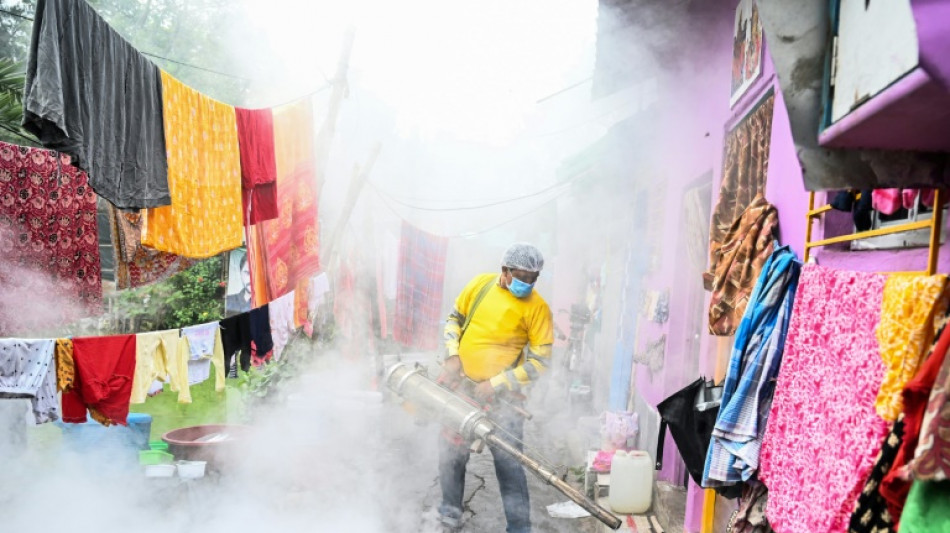
Dengue treatment advances in animal trials / Photo: DIBYANGSHU SARKAR - AFP

Dengue treatment advances in animal trials

A new dengue treatment that could become the first to prevent and treat the virus has proven effective in initial trials in monkeys, according to new research.

Text size:

Dengue is transmitted by mosquitoes and affects tens of millions each year, producing brutal symptoms that have earned it the moniker "breakbone fever".

It is endemic in dozens of countries, but no treatment exists, and two vaccines that have been developed are not yet universally approved.

Two years ago, researchers published work showing a compound could effectively prevent the virus from replicating in cell cultures and mice by preventing the interaction between two proteins.

Now the team has refined the compound and tested it in both mice and monkeys, with "very encouraging" results, said Marnix Van Loock, lead for emerging pathogens at the Janssen Companies of Johnson & Johnson, a drug company.

In rhesus macaques, a high dose of the compound known as JNJ-1802 "completely blocked viral replication", he told AFP, while in control animals viral RNA was detected between day three and seven after infection.

In monkeys, the compound was tested against the two most prevalent of the four strains of dengue, and only for its preventative properties, rather than for treatment.

But it was tested for both treatment and prevention in mice, against all four types of dengue, with successful outcomes, Van Loock said.

Dengue can cause intense flu-like symptoms, and sometimes develops into a severe form which can be fatal.

Because there are four different strains, getting infected by one does not protect against another, and catching dengue a second time is often more serious.

Researchers have warned that a warmer, wetter climate which is more hospitable to mosquitoes is likely to increase the prevalence of viruses passed on by the insect.

With no treatment available, efforts currently focus on reducing transmission -- including by infecting mosquitoes with a bacteria.

A vaccine called Dengvaxia is approved for use only in some countries and is effective against a single strain.

A second vaccine, Qdenga, was approved last December for use by the European Union, and it has also been greenlighted by Britain and Indonesia.

There are still questions to answer about the treatment however, including whether it could increase vulnerability to reinfection.

When people contract dengue, the presence of the virus in their blood generally stimulates a potent immune response that protects them from future infection.

But in some people, the immune response is weaker and that leaves them vulnerable to reinfection, which can produce more serious symptoms.

It is not yet clear whether preventing or reducing viral replication could produce that same vulnerability to reinfection.

The researchers will need to submit safety data from their current phase of testing before moving ahead with further trials involving humans, including field studies in areas affected by dengue.

Van Loock was reluctant to speculate on when a treatment might realistically be deployable.

"We are guided by the science and the data that we generate to really answer that question," he said.

Y.Hara--JT