The Japan Times - Costa Rica's 'urban mine' for planet-friendlier lithium

EUR -
AED 4.32464
AFN 77.740992
ALL 96.464556
AMD 447.574742
ANG 2.108331
AOA 1079.834899
ARS 1709.556878
AUD 1.766179
AWG 2.122576
AZN 2.000414
BAM 1.95569
BBD 2.363067
BDT 143.371909
BGN 1.955626
BHD 0.443886
BIF 3466.298337
BMD 1.177574
BND 1.513825
BOB 8.124542
BRL 6.586144
BSD 1.173234
BTN 105.188064
BWP 15.475127
BYN 3.412507
BYR 23080.441516
BZD 2.359667
CAD 1.617774
CDF 2661.316446
CHF 0.930101
CLF 0.027311
CLP 1071.414928
CNY 8.291237
CNH 8.268456
COP 4466.57179
CRC 584.866995
CUC 1.177574
CUP 31.205699
CVE 110.258778
CZK 24.322134
DJF 208.92821
DKK 7.470279
DOP 73.425856
DZD 152.639428
EGP 55.923086
ERN 17.663603
ETB 181.842238
FJD 2.681865
FKP 0.883315
GBP 0.872994
GEL 3.161821
GGP 0.883315
GHS 13.405244
GIP 0.883315
GMD 86.550939
GNF 10255.811591
GTQ 8.990493
GYD 245.466148
HKD 9.158172
HNL 30.926255
HRK 7.534589
HTG 153.6122
HUF 388.554479
IDR 19765.571982
ILS 3.771279
IMP 0.883315
INR 105.69535
IQD 1537.013263
IRR 49575.846669
ISK 147.997138
JEP 0.883315
JMD 187.269432
JOD 0.834941
JPY 183.770931
KES 151.235955
KGS 102.979128
KHR 4706.454632
KMF 493.403332
KPW 1059.816155
KRW 1747.389558
KWD 0.361786
KYD 0.977745
KZT 605.005858
LAK 25413.565852
LBP 105067.570788
LKR 363.249501
LRD 207.668281
LSL 19.597194
LTL 3.477069
LVL 0.712302
LYD 6.366641
MAD 10.740594
MDL 19.863879
MGA 5285.701715
MKD 61.551527
MMK 2473.272155
MNT 4181.82663
MOP 9.402069
MRU 46.766361
MUR 54.144854
MVR 18.205057
MWK 2034.485189
MXN 21.160461
MYR 4.789188
MZN 75.236061
NAD 19.597194
NGN 1714.487931
NIO 43.175364
NOK 11.89002
NPR 168.300502
NZD 2.025781
OMR 0.452776
PAB 1.173334
PEN 3.951077
PGK 4.991422
PHP 69.206505
PKR 328.666153
PLN 4.216243
PYG 7927.552629
QAR 4.288558
RON 5.087349
RSD 117.400563
RUB 92.793938
RWF 1708.903563
SAR 4.416419
SBD 9.593396
SCR 16.653484
SDG 708.31001
SEK 10.856127
SGD 1.515785
SHP 0.883485
SLE 28.320651
SLL 24693.132803
SOS 669.362226
SRD 45.22648
STD 24373.394906
STN 24.497057
SVC 10.266421
SYP 13022.057466
SZL 19.591894
THB 36.728798
TJS 10.794191
TMT 4.121507
TND 3.431906
TOP 2.835315
TRY 50.432508
TTD 7.97655
TWD 37.104937
TZS 2909.164856
UAH 49.385213
UGX 4227.761417
USD 1.177574
UYU 45.987405
UZS 14075.205703
VES 332.26374
VND 31004.922699
VUV 142.019348
WST 3.282858
XAF 655.919985
XAG 0.016984
XAU 0.000263
XCD 3.182451
XCG 2.114581
XDR 0.815754
XOF 655.919985
XPF 119.331742
YER 280.817031
ZAR 19.676523
ZMK 10599.577001
ZMW 26.516504
ZWL 379.178202
  • RYCEF

    -0.3200

    15.36

    -2.08%

  • RBGPF

    0.0000

    80.22

    0%

  • SCS

    0.0200

    16.14

    +0.12%

  • BP

    0.2000

    34.14

    +0.59%

  • VOD

    0.0400

    12.88

    +0.31%

  • BTI

    0.3200

    56.77

    +0.56%

  • RELX

    0.2500

    40.98

    +0.61%

  • CMSC

    -0.0500

    23.12

    -0.22%

  • GSK

    -0.0200

    48.59

    -0.04%

  • RIO

    1.7800

    80.1

    +2.22%

  • NGG

    0.3000

    76.41

    +0.39%

  • JRI

    -0.0100

    13.37

    -0.07%

  • BCC

    -0.5400

    74.23

    -0.73%

  • CMSD

    -0.0500

    23.2

    -0.22%

  • BCE

    -0.1100

    22.73

    -0.48%

  • AZN

    0.1900

    91.55

    +0.21%

Costa Rica's 'urban mine' for planet-friendlier lithium
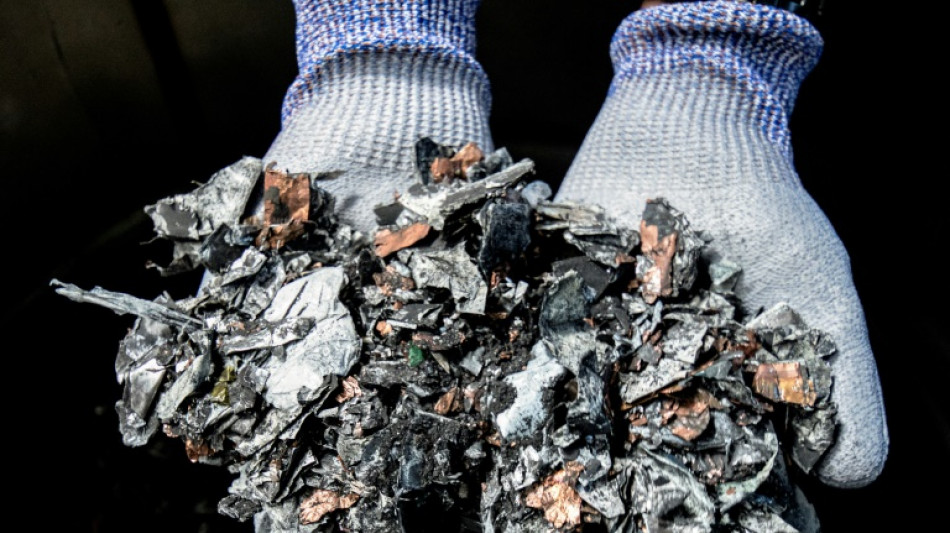
Costa Rica's 'urban mine' for planet-friendlier lithium / Photo: Ezequiel BECERRA - AFP

Costa Rica's 'urban mine' for planet-friendlier lithium

Costa Rica, a country where open pit mining is banned, has become a leader in the extraction of heavy metals such as lithium -- not from the Earth, but old batteries.

Text size:

The Fortech recycling factory which opened nearly three decades ago in Cartago about 27 kilometers (17 miles) from the capital San Jose, is referred to by its staff as an "urban mine."

For the last six years, it has focused on extracting lithium contained in rechargeable batteries used in everything from mobile phones and laptops to electric cars and solar panels.

Millions of batteries are discarded every year.

While the battery casings take about 100 years to decompose, the often toxic heavy metals inside never do.

For Fortech, this presents a proverbial gold mine, and for our planet, perhaps a lifeboat.

"We now know that waste does not exist. We know it is a resource that can be used again," Fortech managing director Guillermo Pereira told AFP.

"It’s important to break paradigms," added the 54-year-old, who with his son Francisco, 25, created a new method for extracting metals from used batteries.

"The world needs a circular economy" that recycles precious primary materials rather than sourcing new ones, said Pereira.

- 'White gold' -

Unlike lithium mined elsewhere in conditions often harmful to the environment, workers and local populations, Fortech's metals are taken from 1,500 tons of used batteries discarded every year in Costa Rica alone, according to his son, the company's project manager.

They are collected in malls, electronics stores or electric vehicle sales points.

Lithium, dubbed "white gold" or the "oil of the 21st century," has seen its price explode on the global market from $5,700 per ton in November 2020 to 60,500 dollars in September 2022 due to electric cars replacing their polluting, gas-guzzling forerunners.

But lithium production plants consume millions of liters of water and can be harmful to the environment.

Obtaining lithium from recycling batteries expels only a quarter of the planet-warming CO2 that comes with mining it, according to Fortech chemist Henry Prado.

Recycling also saves the planet of the environment pollution caused by the "usual disposal method" of lithium batteries, which is often simply to dump them, he added.

According to the American Chemical Society, as little as five percent of the world’s lithium-ion batteries are thought to be recycled.

- 'Pioneer' -

At Fortech, collected spent batteries are placed on a conveyor belt that feeds them into a crusher.

The waste extracted in this way is then transformed into a mix of cobalt, nickel, manganese and lithium known as "black mass."

These metals comprise about 57 percent of each battery -- the rest is copper, aluminum, plastic and iron, all of which can also be recycled.

Fortech does not have the technology to further separate the individual metals in the "black mass," which it sells instead to factories in Europe to complete the process and manufacture new batteries.

According to the German development agency GIZ, Fortech has turned Costa Rica into "a pioneer in Latin America in the valorization of used lithium batteries."

Y.Watanabe--JT