The Japan Times - SpaceX Dragon crew blasts off for International Space Station

EUR -
AED 4.240175
AFN 72.738255
ALL 96.17702
AMD 434.215423
ANG 2.066785
AOA 1058.745466
ARS 1612.053897
AUD 1.622129
AWG 2.078234
AZN 1.976838
BAM 1.957673
BBD 2.319658
BDT 141.335218
BGN 1.973525
BHD 0.436011
BIF 3420.057227
BMD 1.154575
BND 1.471902
BOB 7.959615
BRL 5.997436
BSD 1.151722
BTN 106.372769
BWP 15.651534
BYN 3.45502
BYR 22629.662253
BZD 2.316646
CAD 1.581865
CDF 2615.111973
CHF 0.906515
CLF 0.026533
CLP 1047.672158
CNY 7.951382
CNH 7.939542
COP 4272.630328
CRC 539.92123
CUC 1.154575
CUP 30.596227
CVE 110.370594
CZK 24.433126
DJF 205.084235
DKK 7.47264
DOP 70.307874
DZD 152.49491
EGP 60.475578
ERN 17.318619
ETB 179.826801
FJD 2.547684
FKP 0.865294
GBP 0.863541
GEL 3.129059
GGP 0.865294
GHS 12.550007
GIP 0.865294
GMD 84.860843
GNF 10094.614005
GTQ 8.823442
GYD 240.990561
HKD 9.049538
HNL 30.487432
HRK 7.536374
HTG 151.0939
HUF 388.231453
IDR 19540.020611
ILS 3.569195
IMP 0.865294
INR 106.739556
IQD 1508.937096
IRR 1517111.030971
ISK 143.606336
JEP 0.865294
JMD 181.204932
JOD 0.818573
JPY 183.209056
KES 149.344238
KGS 100.96799
KHR 4622.402328
KMF 493.002867
KPW 1039.092206
KRW 1715.258568
KWD 0.353889
KYD 0.959914
KZT 555.018594
LAK 24718.54168
LBP 103149.932317
LKR 358.701624
LRD 210.791669
LSL 19.269953
LTL 3.409158
LVL 0.698391
LYD 7.372904
MAD 10.801534
MDL 20.094137
MGA 4794.839797
MKD 61.646581
MMK 2424.726099
MNT 4123.103378
MOP 9.297555
MRU 45.821235
MUR 53.699572
MVR 17.837555
MWK 1997.328183
MXN 20.355422
MYR 4.512649
MZN 73.789014
NAD 19.269953
NGN 1567.02341
NIO 42.390372
NOK 11.054203
NPR 170.198306
NZD 1.967424
OMR 0.443931
PAB 1.151902
PEN 3.937067
PGK 4.969755
PHP 68.712779
PKR 321.550404
PLN 4.258822
PYG 7465.978894
QAR 4.199718
RON 5.093402
RSD 117.432957
RUB 95.105991
RWF 1684.626307
SAR 4.334863
SBD 9.288763
SCR 16.489423
SDG 693.899631
SEK 10.700517
SGD 1.473168
SHP 0.86623
SLE 28.400322
SLL 24210.864673
SOS 657.134385
SRD 43.440844
STD 23897.363242
STN 24.523462
SVC 10.078599
SYP 127.67951
SZL 19.270432
THB 37.282949
TJS 11.040663
TMT 4.052557
TND 3.395549
TOP 2.779938
TRY 51.051155
TTD 7.815443
TWD 36.74895
TZS 3006.200215
UAH 50.602123
UGX 4348.159972
USD 1.154575
UYU 46.824798
UZS 13978.312799
VES 517.02793
VND 30365.312105
VUV 138.078881
WST 3.156265
XAF 656.590861
XAG 0.014531
XAU 0.000231
XCD 3.120296
XCG 2.075977
XDR 0.816454
XOF 656.482724
XPF 119.331742
YER 275.423263
ZAR 19.209368
ZMK 10392.557279
ZMW 22.467787
ZWL 371.772552
  • RBGPF

    0.1000

    82.5

    +0.12%

  • CMSC

    -0.0400

    22.95

    -0.17%

  • BCE

    0.1100

    26.01

    +0.42%

  • RELX

    -0.1800

    34.29

    -0.52%

  • CMSD

    -0.0700

    22.88

    -0.31%

  • NGG

    -0.4700

    90.42

    -0.52%

  • RYCEF

    0.6900

    16.81

    +4.1%

  • VOD

    0.1500

    14.75

    +1.02%

  • GSK

    -0.3600

    53.41

    -0.67%

  • RIO

    -0.0600

    89.8

    -0.07%

  • BTI

    -0.3900

    60.55

    -0.64%

  • AZN

    -0.7200

    191.29

    -0.38%

  • JRI

    -0.0800

    12.46

    -0.64%

  • BP

    0.9500

    43.85

    +2.17%

  • BCC

    1.2000

    72.92

    +1.65%

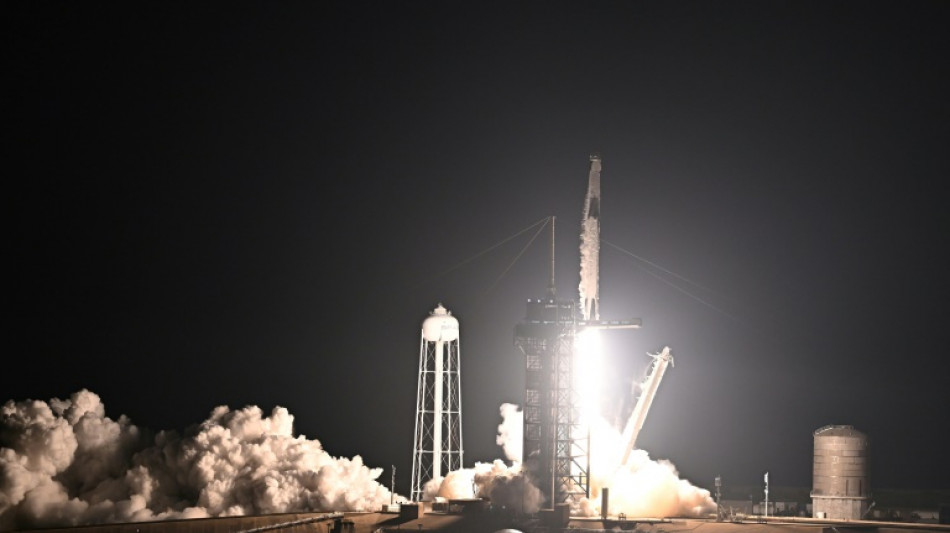
SpaceX Dragon crew blasts off for International Space Station
SpaceX Dragon crew blasts off for International Space Station / Photo: CHANDAN KHANNA - AFP

SpaceX Dragon crew blasts off for International Space Station

A SpaceX Falcon 9 rocket blasted off on Thursday to the International Space Station carrying two NASA astronauts, a Russian cosmonaut and the second Emirati to voyage to space.

Text size:

The SpaceX Dragon Crew-6 mission launched at 12:34 am (0534 GMT) Thursday from Launch Complex 39A at NASA's Kennedy Space Center in Florida, a livestream of the launch showed.

The launch had been scrubbed on Monday just minutes before liftoff because of a clog in a filter that supplies ignition fluid to start the rocket engines.

The US space agency tweeted that the SpaceX Dragon Endeavour departed on Thursday "lighting up the skies as the crew heads to orbit."

The Dragon crew capsule, dubbed Endeavour, is scheduled to dock with the ISS at 1:17 am (0617 GMT) on Friday after a 24-hour voyage.

NASA's Stephen Bowen and Warren Hoburg, Russia's Andrey Fedyaev and Sultan al-Neyadi of the United Arab Emirates are to spend six months on the orbiting station.

Neyadi, 41, will be the fourth astronaut from an Arab country and the second from the oil-rich UAE to journey to space; his compatriot Hazzaa al-Mansoori flew an eight-day mission in 2019.

Neyadi, Hoburg, the Endeavour pilot, and Fedyaev, the Russian mission specialist, will all be making their first space flights.

Fedyaev is the second Russian cosmonaut to fly to the ISS aboard a SpaceX rocket. NASA astronauts fly regularly to the station on Russian Soyuz craft.

Space has remained a rare venue of cooperation between Moscow and Washington since the Russian offensive in Ukraine placed them in sharp opposition.

Bowen, a veteran of three space shuttle missions, said politics rarely come up while in space.

"We're all professionals. We keep focused on the mission itself," he said. "It's always been a great relationship we've had with cosmonauts once we get to space."

- Rescue capsule -

While aboard the ISS, the Crew-6 members will conduct dozens of experiments including studying how materials burn in microgravity and researching heart, brain and cartilage functions.

The current crew is the sixth to be transported by a SpaceX rocket to the ISS. The Endeavour capsule has flown into space three times previously.

NASA pays SpaceX to ferry astronauts to the ISS roughly every six months.

The agency expects Crew-6 to have a handover of several days with the four members of Crew-5 who have been on the ISS since October. Crew-5 will then return to Earth.

Also aboard the ISS are cosmonauts Dmitry Petelin and Sergei Prokopyev and NASA astronaut Frank Rubio.

They had been scheduled to return to Earth on March 28 but the cooling system of their Soyuz MS-22 capsule was damaged by a tiny meteoroid in December while docked with the ISS.

An uncrewed Russian Soyuz capsule, MS-23, was launched from Kazakhstan last month to bring them home. They are now scheduled to return in September.

Construction of the ISS began in 1998 at a time of increased US-Russia cooperation following the Cold War space race.

Russia has been using the aging but reliable Soyuz capsules to ferry astronauts into space since the 1960s.

But in recent years, Russia's space program has been beset by a litany of problems that have led to the loss of satellites and vehicles.

T.Sasaki--JT