The Japan Times - Narwhals' climate-vulnerable winter feeding crucial for survival: study

EUR -
AED 4.32464
AFN 77.740992
ALL 96.464556
AMD 447.574742
ANG 2.108331
AOA 1079.834899
ARS 1709.556878
AUD 1.766179
AWG 2.122576
AZN 2.000414
BAM 1.95569
BBD 2.363067
BDT 143.371909
BGN 1.955626
BHD 0.443886
BIF 3466.298337
BMD 1.177574
BND 1.513825
BOB 8.124542
BRL 6.586144
BSD 1.173234
BTN 105.188064
BWP 15.475127
BYN 3.412507
BYR 23080.441516
BZD 2.359667
CAD 1.617774
CDF 2661.316446
CHF 0.930101
CLF 0.027311
CLP 1071.414928
CNY 8.291237
CNH 8.268456
COP 4466.57179
CRC 584.866995
CUC 1.177574
CUP 31.205699
CVE 110.258778
CZK 24.322134
DJF 208.92821
DKK 7.470279
DOP 73.425856
DZD 152.639428
EGP 55.923086
ERN 17.663603
ETB 181.842238
FJD 2.681865
FKP 0.883315
GBP 0.872994
GEL 3.161821
GGP 0.883315
GHS 13.405244
GIP 0.883315
GMD 86.550939
GNF 10255.811591
GTQ 8.990493
GYD 245.466148
HKD 9.158172
HNL 30.926255
HRK 7.534589
HTG 153.6122
HUF 388.554479
IDR 19765.571982
ILS 3.771279
IMP 0.883315
INR 105.69535
IQD 1537.013263
IRR 49575.846669
ISK 147.997138
JEP 0.883315
JMD 187.269432
JOD 0.834941
JPY 183.770931
KES 151.235955
KGS 102.979128
KHR 4706.454632
KMF 493.403332
KPW 1059.816155
KRW 1747.389558
KWD 0.361786
KYD 0.977745
KZT 605.005858
LAK 25413.565852
LBP 105067.570788
LKR 363.249501
LRD 207.668281
LSL 19.597194
LTL 3.477069
LVL 0.712302
LYD 6.366641
MAD 10.740594
MDL 19.863879
MGA 5285.701715
MKD 61.551527
MMK 2473.272155
MNT 4181.82663
MOP 9.402069
MRU 46.766361
MUR 54.144854
MVR 18.205057
MWK 2034.485189
MXN 21.160461
MYR 4.789188
MZN 75.236061
NAD 19.597194
NGN 1714.487931
NIO 43.175364
NOK 11.89002
NPR 168.300502
NZD 2.025781
OMR 0.452776
PAB 1.173334
PEN 3.951077
PGK 4.991422
PHP 69.206505
PKR 328.666153
PLN 4.216243
PYG 7927.552629
QAR 4.288558
RON 5.087349
RSD 117.400563
RUB 92.793938
RWF 1708.903563
SAR 4.416419
SBD 9.593396
SCR 16.653484
SDG 708.31001
SEK 10.856127
SGD 1.515785
SHP 0.883485
SLE 28.320651
SLL 24693.132803
SOS 669.362226
SRD 45.22648
STD 24373.394906
STN 24.497057
SVC 10.266421
SYP 13022.057466
SZL 19.591894
THB 36.728798
TJS 10.794191
TMT 4.121507
TND 3.431906
TOP 2.835315
TRY 50.432508
TTD 7.97655
TWD 37.104937
TZS 2909.164856
UAH 49.385213
UGX 4227.761417
USD 1.177574
UYU 45.987405
UZS 14075.205703
VES 332.26374
VND 31004.922699
VUV 142.019348
WST 3.282858
XAF 655.919985
XAG 0.016984
XAU 0.000263
XCD 3.182451
XCG 2.114581
XDR 0.815754
XOF 655.919985
XPF 119.331742
YER 280.817031
ZAR 19.676523
ZMK 10599.577001
ZMW 26.516504
ZWL 379.178202
  • SCS

    0.0200

    16.14

    +0.12%

  • CMSD

    -0.0500

    23.2

    -0.22%

  • BCC

    -0.5400

    74.23

    -0.73%

  • CMSC

    -0.0500

    23.12

    -0.22%

  • NGG

    0.3000

    76.41

    +0.39%

  • JRI

    -0.0100

    13.37

    -0.07%

  • GSK

    -0.0200

    48.59

    -0.04%

  • BTI

    0.3200

    56.77

    +0.56%

  • AZN

    0.1900

    91.55

    +0.21%

  • BCE

    -0.1100

    22.73

    -0.48%

  • RIO

    1.7800

    80.1

    +2.22%

  • RBGPF

    0.0000

    80.22

    0%

  • RELX

    0.2500

    40.98

    +0.61%

  • VOD

    0.0400

    12.88

    +0.31%

  • BP

    0.2000

    34.14

    +0.59%

  • RYCEF

    -0.3200

    15.36

    -2.08%

Narwhals' climate-vulnerable winter feeding crucial for survival: study
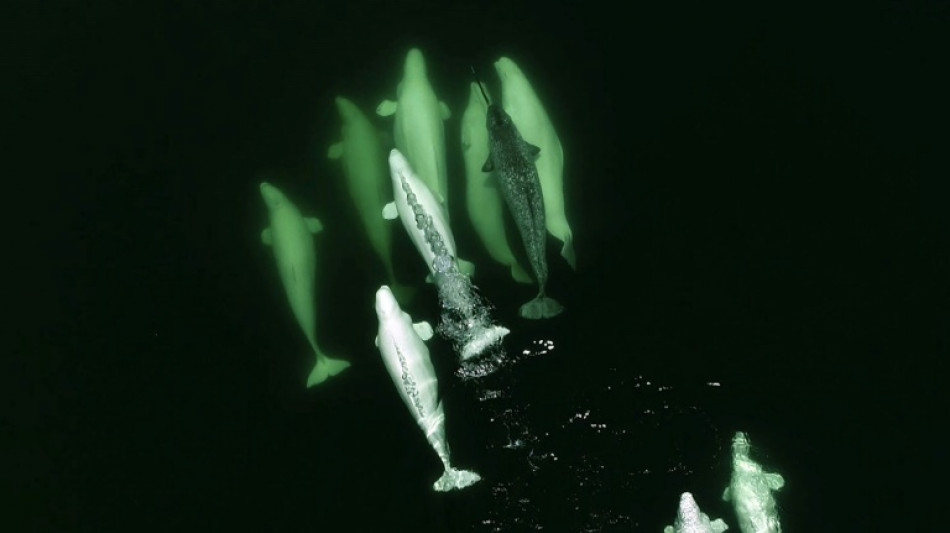
Narwhals' climate-vulnerable winter feeding crucial for survival: study / Photo: HO - GREMM/AFP

Narwhals' climate-vulnerable winter feeding crucial for survival: study

Narwhals are likely more dependent on fat reserves and abundant prey in climate-threatened winter habitats than previously thought, researchers said Wednesday, warning of severe risks posed by global warming.

Text size:

Scientists studying the long-horned marine mammals in the fjords off the eastern coast of Greenland during the summer found narwhals were largely unsuccessful in capturing prey.

"(This) suggests that they could actually rely on the wintering grounds to build up sufficient body reserves and energy stores to sustain year-round activities," said Philippine Chambault of the University of California Santa Cruz, co-author of the study published in the journal Biology Letters.

Researchers believe most narwhals spend their winters feasting off fish and squid under sea ice off the coast of Greenland, but Chambault said this cold-water habitat may essentially "disappear" because of climate change, with expected increases in ocean temperatures driving ice melt and potentially causing prey to relocate.

While the exact causes of the low summer feeding rate are not yet clear, researchers said it could be due to a decline or relocation of squid and cod, lower energy needs, or even because they are picky eaters.

Normally narwhal eating habits are hard to track because they dive deep, up to one kilometre (3,000 feet) and stay in the open water.

The researchers were able to study the foraging behaviours of 14 narwhals using so-called stomach temperature pills that could detect when the whales swallowed cold prey and icy water.

They also used acoustic tags tuned to the sound waves or "buzzes" emitted when narwhals narrow-in on their prey.

- 'Little flexibility' -

More than two-thirds of the hunting dives recorded over roughly 1,000 hours were deemed unsuccessful due to the presence of buzzes without an accompanying stomach temperature drop, said the study.

The researchers said the small sample size and limits to the detection capabilities of the equipment meant the feeding rates could be underestimated.

But they also worked with local indigenous Inuit communities to test their findings.

Inuit hunters examined the stomach contents of the narwhals caught during summer hunting season, confirming that the whales' stomachs were in fact "pretty empty", Chambault told AFP.

Diet limitation is just one factor complicating the species' survival.

Their preference for cold water and a strong tendency to remain within or near where they were born mean they are particularly sensitive to climate change.

This means they might "show very little flexibility to changing habitats," Chambault said.

K.Inoue--JT