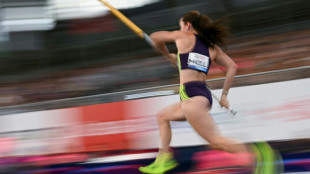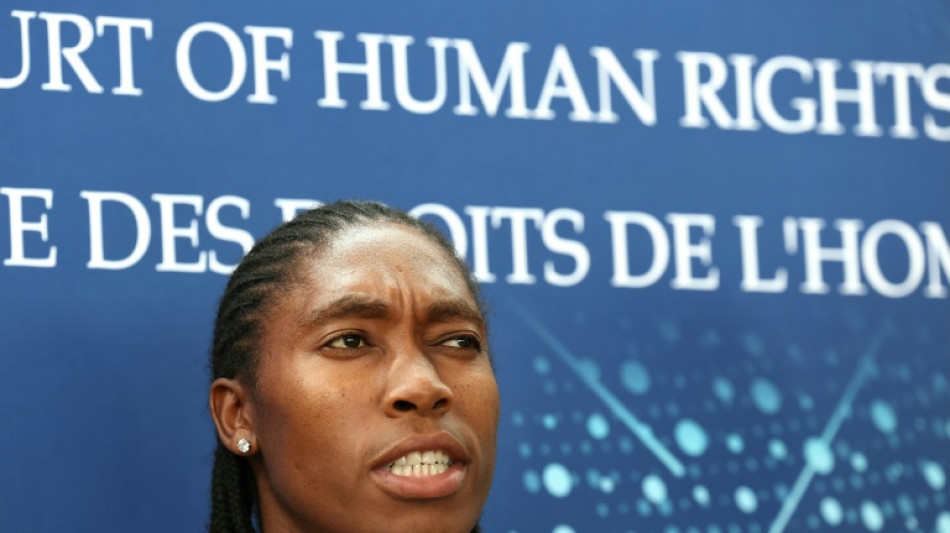
IOC's gender test directive throws up multiple questions / Photo: Frederick FLORIN - AFP

The International Olympic Committee's announcement on Thursday that it is reintroducing gender testing to protect the female category, after last being used at the 1996 Atlanta Olympics, raises practical, legal, ethical and scientific questions.
AFP Sport endeavours to answer some of them:
Question: What do the tests consist of?
The screening of the SRY gene the IOC says is the "least intrusive and most precise method" and can be carried out by a swab of the interior of a cheek.
This test has been used since last year by athletics, boxing and skiing.
The test for the SRY gene is "almost always on the male Y chromosome" and "is used as a highly accurate proxy for biological sex" according to World Athletics.
Madeleine Pape, a sports sociologist at Lausanne University, told AFP "these tests are dependent on the (legal) context of each country".
An example arose at the World Boxing Championships in Liverpool last year.
French law forbids testing without medical justification and so as a result its women's team was barred from competing: they were tested on arrival in England but missed the deadline for submitting the results.
"The solution we have found, is that we benefit from all the occasions when athletes are outside France in order to do what is required," French athletics federation president Jean Gracia told AFP.
Question: What are the consequences for the athletes?
Those who have two X chromosomes can compete, and will not have to undergo a new test. But for those who test positive in the SRY test, there are two possible solutions.
Either they produce other factors in their defence, for example proof that their body does not know how to use the testosterone, or they show evidence of possessing feminine genitalia.
This is what happened in the eight "SRY" cases detected at the 1996 Atlanta Olympics, who were cleared as eligible to compete, and Taiwan's 2024 Olympic boxing champion Lin Yu-ting, who was recently cleared to compete in the female category in World Boxing events, after the latter's medical experts ruled she was female.
However, committing oneself to this battle compels the athlete to undergo costly and complex investigations, either genetic sequencing, or an intrusive gynaecological examination.
For others the impact goes way beyond being disqualified, as the athletes suffer loss of income and social shame.
"Our dreams were broken and our lives turned upside down," nine athletes who have differences in sexual development (DSD), including South Africa's two-time Olympic women's 800m champion Caster Semenya, said in a letter to IOC president Kirsty Coventry on Wednesday.
"Some among us were disowned by members of their family, missed out on the possibility of receving an education and were forced to leave their country", others also had to undergo "harmful and pointless medical interventions", they said.
Question: Are the tests relevant to sport?
The IOC's previous policy -- under Coventry's predecessor Thomas Bach -- dating back to 2021 left it up to each international federation to set its own rules.
Nevertheless it did offer guidance to rely on data, without "presuming" that those with differences in sexual development or transgender automatically enjoy "a disproportionate competitive advantage".
Supporting this premise is that no scientific consensus has been reached in the intervening years to link sporting performance with possessing the SRY gene, taking into consideration a broad range of events such as sprinting, gymnastics, judo or shooting.
"The interest of these tests for sporting bodies is to 'target' both transgender and those with differences in sexual development", putting an end to distinct regulations, said Pape.
"However, while there is some data on trans athletes, there is no independent study on the performances of those with differences in sexual development."
The most damning response to the reintroduction of the testing for the SRY gene comes from the scientist who discovered it, Andrew Sinclair.
The idea that the biological sex be entirely defined by chromosomes is "overly simplistic" given the role played by the "hormones, genital organs and secondary sexual characteristics", he said last year.
"Along with numerous other experts, I convinced the IOC to abandon the use of the SRY test before the 2000 Olympics in Sydney," he said.
"It is therefore extremely surprising years later there is an ill-advised move to reintroduce it," he added.
H.Takahashi--JT