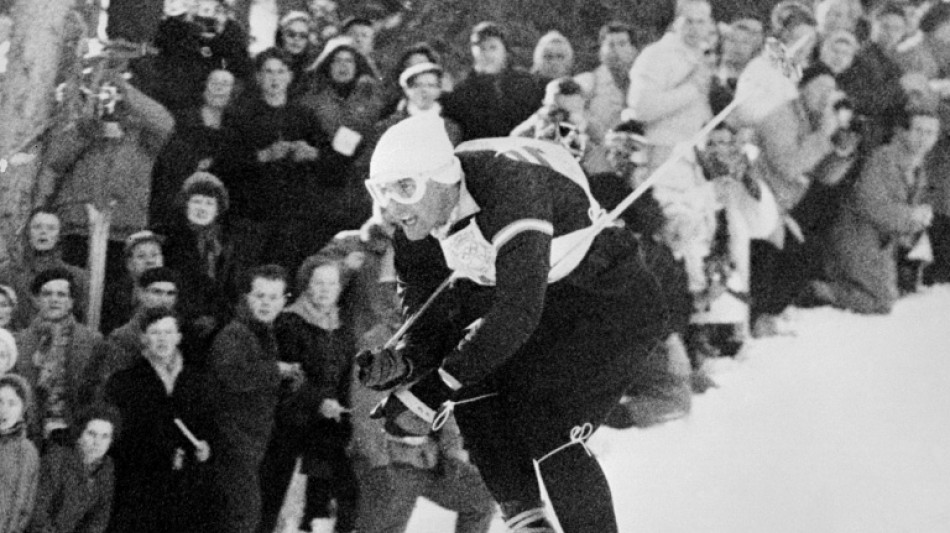
Legends of Winter Olympics: heroes of the slopes / Photo: STAFF - AFP

With the Milan-Cortina Winter Olympics opening on February 6, AFP looks back at some of the golden stars of the ski slopes.
Toni Sailer, the 'blitz from Kitz'
The Austrian great from Kitzbuhel swept all before him during a brief career.
In the first Winter Games broadcast on television, Sailer, then aged 20, won all three men's events: the slalom, the giant slalom and the downhill.
The competition doubled up as the world championships, with a bonus gold medal for the combined champion.
Sailer came close to repeating his sweep at the 1958 worlds in his native Austria, but was edged into second place in the slalom by compatriot Josl Rieder. He then retired.
He appeared in movies, including as stunt double for George Lazenby's James Bond in 'On Her Majesty's Secret Service', recorded 18 albums as a singer, launched a ski gear company and served as a skiing administrator.
He was named Austrian 'Sportsman of the Century' in 1999.
Jean-Claude Killy, the king of France
The second skier to sweep all three Alpine gold medals also did so in his home country and then, after his controversial victory in his final event, had to be airlifted out to escape his fans.
Early in his career, Jean-Claude Killy was fast but wild. He struggled at the 1964 Games, slowed down by dysentery and hepatitis that he caught on military service in Algeria.
In 1966, he won two world championship golds and dominated the World Cup for the next two seasons.
In Grenoble in 1968, he swept to Olympic victory in a windy downhill and then in the giant slalom.
In the slalom, his second run was shrouded by fog and controversy.
Norwegian Hakon Mjoen and Austrian Karl Schranz, who were granted a second chance because an official had strayed onto the course, both outpaced Killy.
Officials pored over TV replays and subsequently ruled that, in the fog, Schranz had missed one gate and Mjoen two.
Killy had his hat-trick to match Sailer -- only Janica Kostelic, in 2002, has since won three skiing golds at the same Games -- and the crowd went wild.
"At the end of the Games, the police helicopter had to rescue me from the crowd and take me 200 kilometres away!" Killy said.
Aged 24, Killy retired. He tried motor racing, briefly returned to skiing, co-chaired the 1992 Albertville Olympics and became a member of the International Olympic Committee.
His friendship with Vladimir Putin drew criticism after the invasion of Ukraine.
Hermann Maier, legend of the fall
Rejected as a junior skier because he was so small, Maier worked as a bricklayer while racking up wins in regional competitions and developing into a muscular skier of reckless bravery.
He opened his first Olympics in Nagano in 1998 with a bang: somersaulting out of the downhill, landing on his head, smashing through two fences, and plunging down a slope.
Three days later, Maier won the super-G and three days after that he took the giant slalom. He then became known as the 'Hermanator'.
In 2000-01, he equalled Killy's record of 13 World Cup victories in a season but the following summer crashed his motorbike, damaging his right leg so badly that doctors considered amputation.
He missed the 2002 Salt Lake City Games but returned in 2003. In 2006, at the age of 34, in the Turin Olympics he added silver in super-G and bronze in the giant slalom.
Ingemar Stenmark, the silent Swede
Stenmark dominated skiing's technical events for almost a decade, winning a record 86 World Cup races between 1974 and 1989, but a timing error and amateurism rules cost him and meant that he was only at his best for one Olympics.
He made the most of his golden moment, though.
In 1976 in Innsbruck, aged 20, he stumbled out of the gates collecting just a giant slalom bronze.
By Lake Placid in 1980, he was utterly dominant.
In the giant slalom he was third after the first run but was three-quarters-of-a-second faster than his nearest rival in the second run the next day to take gold.
In the slalom, he was fourth after the first run but obliterated the field by a second the next day and took gold.
"For me to win in Lake Placid was most of all a relief. I had won so many races in the World Cup, I felt under enormous pressure to do well," he told the IOC in 1980.
It turned out to be his last chance.
He was barred from the Sarajevo Games in 1984 for taking money directly from sponsors and, in decline, could only collect a fifth place in Calgary in 1988, by which time Alberto Tomba ruled the slaloms.
Stenmark collected one last World Cup victory in 1989 to set a record that stood until Mikaela Shiffrin broke it in 2023.
T.Ueda--JT