From hair weaves to dagger-toting refs: five sumo facts / Photo: STR - JIJI Press/AFP

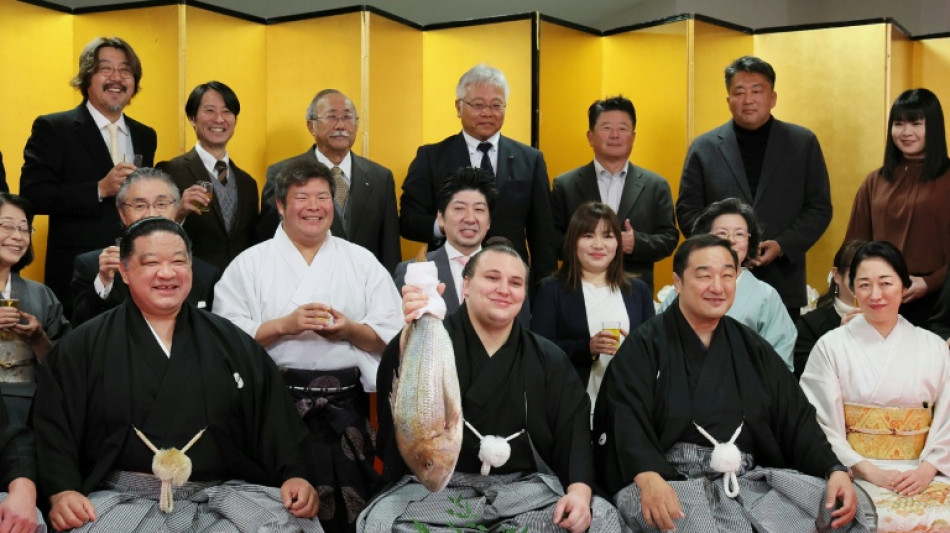
Ukrainian sumo wrestler Danylo Yavhusishyn celebrated his promotion to the ancient Japanese sport's second-highest rank on Wednesday by holding aloft a large sea bream.
From hair weaves to dagger-toting referees, AFP looks at five sumo facts:
- Hair today, gone tomorrow -
Sumo wrestlers wear their hair in a topknot known as a "mage", reminiscent of the samurai style of old Japan.
The hair is teased and held in place with a sweet-smelling wax and tended to daily by specialist sumo hairdressers called "tokoyama".
The styling of the topknot during competitions depends on the wrestler's rank, and the top competitors wear theirs in a fanned-out "oicho" style, so called for its resemblance to a gingko leaf.
The topknot has proved problematic for some wrestlers -- the Estonian Kaido Hoovelson, known as Baruto, had hair so fine that he reportedly once borrowed strands from a stablemate and weaved them into his own.
When a sumo retires, a ceremony is held where peers, family, sponsors and others queue up to cut strands of the wrestler's hair one by one before the stablemaster chops the topknot off completely.
- Best of the best -
The highest rank a sumo wrestler can attain is that of yokozuna, and to date only 75 have reached the exalted level in the centuries-old history of the sport.
Unlike other ranks in sumo, a yokozuna can never be demoted and they are expected to retire if they can no longer perform at the highest level.
The word yokozuna means "horizontal rope" and comes from the heavy braid they wear round their waists as they enter the ring, similar to those used to mark sacred areas in the Shinto religion.
Yokozuna perform ring-entering ceremonies every day of a tournament, flanked by two attendants known as the "dew-sweeper" and "sword-bearer".
There are currently only two active yokozuna, both of whom reached the rank this year.
- Man in the middle -
Sumo rankings do not only apply to wrestlers, but also to referees.
The lowest-ranked officials take to the ring barefoot and wearing simple cotton outfits, while the highest are decked out in brightly coloured silk kimonos with traditional split-toed socks.
The two highest-ranked referees carry daggers in their belts to represent their symbolic willingness to commit ritual suicide should they make a wrong decision in the ring.
Like wrestlers, referees adopt a ring name, taking either the surname Kimura or Shikimori.
Referees also have duties other than officiating matches, including performing religious rituals and writing the banzuke, the ranking sheet published before each tournament.
- Food, glorious food -
Sumo wrestlers fuel their exertions with chanko nabe, a filling hotpot dish packed with meat, fish and vegetables.
Meals are prepared while the higher-ranked wrestlers take part in training, with the lower-ranked fighters chopping the ingredients to put into the giant pot.
Some superstitious wrestlers prefer to eat chicken in their chanko nabe during tournaments instead of pork or beef.
This is because a chicken walks on two legs like a victorious sumo wrestler, while pigs and cows resemble a beaten fighter on all fours.
Fish also play a part in sumo celebrations, with wrestlers holding up sea bream to signify good fortune.
- League of nations -
Yavhusishyn is by no means the first foreign-born wrestler to make his mark in sumo.
He follows wrestlers from Estonia, Bulgaria and Georgia as the fourth ozeki -- the second-highest ranking -- born in Europe.
And more than 30 countries have been represented in the sport's top division.
Hawaiian-born Chad Rowan, also known as Akebono, became the first foreign-born yokozuna in 1993, and he was subsequently joined at the top rank by one American and six Mongolians.
Egypt's Abdelrahman Shalan became the first African-born sumo wrestler when he made his debut in 2012.
Known as Osunaarashi -- literally "Great Sandstorm" in Japanese -- Shalan reached the fourth-highest rank of maegashira before being forced to retire six years later after being caught driving without a license.
K.Yoshida--JT