Essequibo - the Guyanese region claimed by Venezuela / Photo: Patrick FORT - AFP

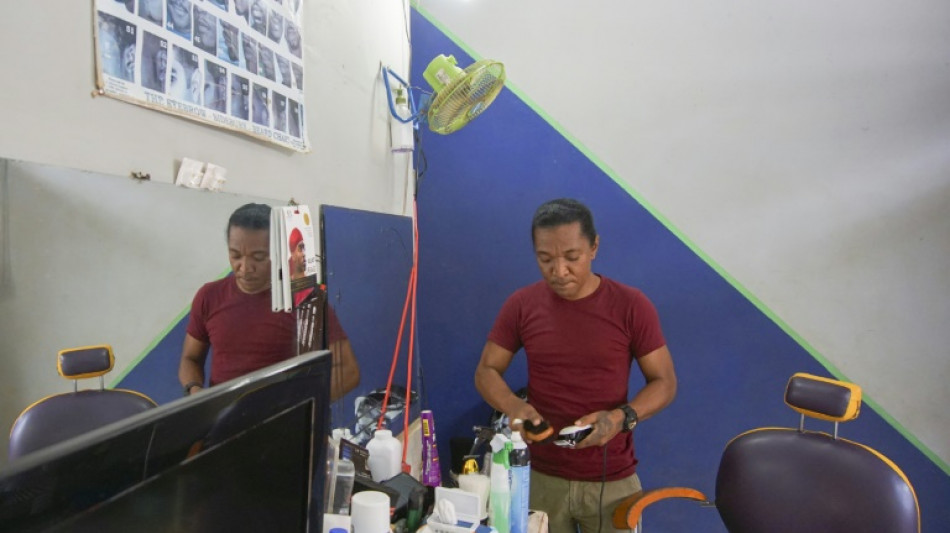
Hairdresser Kimtse Kimo Castello is adamant that the small town where he lives, near a tropical forest, lies in Guyana and not Venezuela, which claims it.
"It's not about giving it back. I doubt they (Venezuela) ever owned it, so there's no question about giving it back, it's ours!"
Castello is talking about Essequibo, a disputed area of 160,000 square kilometers that is administered by Guyana but which Venezuala has long argued is its territory.
The region is home to 125,000 of Guyana's 800,000 residents. Like the rest of Guyana, they speak English.
The former British colony sees its current borders, established by a court of arbitration in Paris in 1899, as accurate.
But Venezuela insists that the Essequibo river to the east of the region is the more natural border between the two countries, as was the case in 1777.
In 2018, Guyana asked the International Court of Justice in The Hague to resolve the dispute and ratify the current borders.
- 'Kind, welcoming people' -
"Essequibo is 100 percent Guyanese. We are very clear about where our borders are," Guyana President Irfaan Ali told AFP.
However, Venezuela President Nicolas Maduro often punctuates speeches with the claim that "the Venezuelan sun rises over Essequibo."
Although not quite at the level of Argentina's obsession with the Falkland Islands, the Venezuelan claim to Essequibo is regularly repeated in schools and barracks.
In September, Maduro published a photo of the Kaieteur Falls, the world's largest single-drop waterfall and Guyana's main tourist attraction, on social media with a map including Essequibo in Venezuela.
Many Guyanese demanded that Facebook and Twitter remove the "illegal and offensive publications."
"It's over, it's Guyanese. We've been speaking English ever since," said mechanic Andrew Bailey, 33.
"I actually (only) learned Venezuela was claiming it when I finished school," he added, pointing to the region's oil reserves as Venezuela's motivation.
"They will always claim it," said the hairdresser Castello as he cleaned his electric shavers in his small shop in Port Kaituma.
"I always felt Guyanese, and we are kind people, people that welcome anybody into the area," he said, adding that explained the large numbers of Venezuelans in the area.
Around 25,000 Venezuelans who fled their country's economic collapse live in Guyana, according to local authorities. Several thousand of them live in Essequibo.
- 'Life better than in Venezuela' -
Ironically, in the past, it was Guyanese, fleeing one of the poorest countries on the planet, who migrated to Venezuela where Caracas automatically bestowed citizenship on those born in Essequibo.
In Port Kaituma, dozens of Venezuelan migrants squat in a three-story building abandoned by a Chinese company.
Anneris Valenzuela, 23, and her husband Tucupita, came from the Amacuro Delta, one of Venezuela's poorest regions.
"We had nothing. We had nothing to feed our children," she said.
Tucupita works as a day laborer.
"Life is better than in Venezuela, although it's pretty tough. There's no electricity, we use lanterns."
Running water is intermittent, and when it rains, the building's inhabitants bring out buckets, saucepans, and other receptacles to collect water.
"It's a tough situation," added Alexis Zapata, 47, who lives with seven family members in two rooms in the building, sleeping in hammocks attached to the walls.
"Here, at least we can find something to eat," adds Zapata, who also left the Amacuro Delta, in August 2021.
He chose Guyana because of ease of access: there were no people smugglers to pay or police to avoid, and he could come on foot.
Zapata unloads boats that arrive at Port Kaituma and insists he is paid "less than the Guyanese" whom he says take advantage of the migrants' precarious situation.
He insists Essequibo is Venezuelan.
"That's what I learned and what's written in the (Venezuelan) books."
However, the children of most of the Venezuelans living in Essequibo learn the opposite in Guyana schools.
Paul Small, 52, has dual Guyanese-Venezuelan nationality and went to school in both countries.
Born in Guyana, he moved to Venezuela at the age of around six or seven.
He spent most of his life there before returning to Guyana with his wife and children.
An odd-job man, he lives better than most migrants in a small house close to the center of Port Kaituma.
"Life is better here. There is freedom, work, healthcare in hospital, security," he said.
And for him, "Essequibo belongs to Guyana because it's been that way since I was born."
S.Suzuki--JT