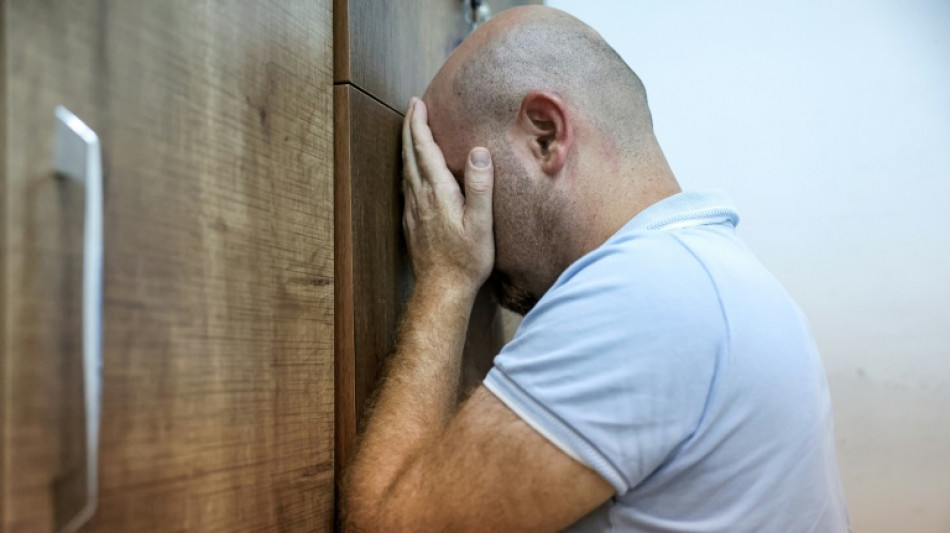
Syrian ex-prisoners haunted by horrors of 'salt rooms' / Photo: OMAR HAJ KADOUR - AFP

When a Syrian prison guard tossed him into a dimly-lit room, the inmate Abdo was surprised to find himself standing ankle-deep in what appeared to be salt.
On that day in the winter of 2017, the terrified young man had already been locked up for two years in war-torn Syria's largest and most notorious prison, Sednaya.
Having been largely deprived of salt all that time in his meagre prison rations, he brought a handful of the coarse white crystals to his mouth with relish.
Moments later came the second, grisly, surprise: as a barefoot Abdo was treading gingerly across the room, he stumbled on a corpse, emaciated and half-buried in the salt.
Abdo soon found another two bodies, partially dehydrated by the mineral.
He had been thrown into what Syrian inmates call "salt rooms" -- primitive mortuaries designed to preserve bodies in the absence of refrigerated morgues.
The corpses were being treated in a way already known to the embalmers of ancient Egypt, to keep up with the industrial-scale prison killings under President Bashar al-Assad's regime.
The salt rooms are described in detail for the first time in an upcoming report by the Association of Detainees and the Missing in Sednaya Prison, or ADMSP.
In additional research and interviews with former inmates, AFP found that at least two such salt rooms were created inside Sednaya.
Abdo, a man from Homs now aged 30 and living in eastern Lebanon, asked that his real name not be published for fear of reprisals against him and his family.
Speaking in his small rental flat in an unfinished building, he recounted the day he was thrown into the salt room, which served as his holding cell ahead of a military court hearing.
"My first thought was: may God have no mercy on them!" he said. "They have all this salt but don't put any in our food!
"Then I stepped on something cold. It was someone's leg."
- 'My heart died' -
Up to 100,000 people have died in Syrian regime prisons since 2011, a fifth of the war's entire death toll, according to Britain-based monitoring group the Syrian Observatory for Human Rights.
Abdo, fortunate to have survived, described the salt room on the first floor of the red building as a rectangle of roughly six by eight metres (20 by 26 feet), with a rudimentary toilet in a corner.
"I thought this would be my fate: I would be executed and killed," he said, recalling how he curled up in a corner, crying and reciting verses from the Koran.
The guard eventually returned to escort him to the court, and Abdo lived to tell the tale.
On his way out of the room, he had noticed a pile of body bags near the door.
Like tens of thousands of others, he had been jailed on blanket terrorism charges. He was released in 2020 but says the experience scarred him for life.
"This was the hardest thing I ever experienced," he said. "My heart died in Sednaya. If someone announced the death of my brother right now, I wouldn't feel anything."
Around 30,000 people are thought to have been held at Sednaya alone since the start of the conflict. Only 6,000 were released.
Most of the others are officially considered missing because death certificates rarely reach the families unless relatives pay an exorbitant bribe, in what has become a major racket.
AFP interviewed another former inmate, Moatassem Abdel Sater, who recounted a similar experience in 2014, in a different first-floor cell of around four by five metres, with no toilet.
Speaking at his new home in the Turkish town of Reyhanli, the 42-year-old recounted finding himself standing on thick layer of the kind of salt used to de-ice roads in winter.
"I looked to my right and there were four or five bodies," he said.
"They looked a bit like me," Moatassem said, describing how their skeletal limbs and scabies-covered skin matched his own emaciated body. "They looked like they had been mummified."
He said he still wonders why he was taken to the makeshift mortuary, on the day of his release, May 27, 2014, but guessed that "it might have been just to scare us".
- Black hole -
The ADMSP, after extensive research on the infamous prison, dates the opening of the first salt room to 2013, one of the deadliest years in the conflict.
"We found that there were at least two salt rooms used for the bodies of those who died under torture, from sickness or hunger," the group's co-founder Diab Serriya said during an interview in the Turkish city of Gaziantep.
It was not clear whether both rooms existed at the same time, nor whether they are still being used today.
Serriya explained that when a detainee died, his body would typically be left inside the cell with the inmates for two to five days before being taken to a salt room.
The corpses remained there until there were enough of them for a truckload.
The next stop was a military hospital where death certificates -- often declaring a "heart attack" as the cause of death -- were issued, before mass burials.
The salt rooms were meant to "preserve the bodies, contain the stench... and protect the guards and prison staff from bacteria and infections," Serriya explained.
US-based professor of anatomy Joy Balta, who has published extensively on human body preservation techniques, explained how salt could be used as a simple and cheap alternative to cold rooms.
"Salt has the ability to dehydrate any living tissue ... and can therefore be used to significantly slow down the decomposition process," he told AFP.
A body can remain in salt without decomposing longer than in a purpose-built refrigerated chamber, "although it will alter the surface anatomy", said Balta, who founded the Anatomy Learning Institute at Point Loma Nazarene University in San Diego.
The ancient Egyptians are known to have used the mummification process, which includes the immersion of the body in a salt solution called natron.
The tonnes of rock salt used in Sednaya are thought to have come from Sabkhat al-Jabul, Syria's largest salt flats, in Aleppo province.
The report by ADMSP is the most thorough study yet of the structure of Sednaya, which has manufactured death on a terrifying scale for years.
It provides detailed schematics of the facility and of how duties were split between various army units and wardens.
"The regime wants Sednaya to be a black hole, no-one is allowed to know anything about it," Serriya said. "Our report denies them that."
- 'Salt was a treasure' -
The fighting in Syria's brutal war has ebbed over the past three years, but Assad and the prison that has become a monument to his bloody rule are still there.
New layers to the horror of the war are still being uncovered as survivors abroad share their stories, and investigations into regime crimes by foreign courts fuel a drive for accountability.
"If a political transition ever occurs in Syria," said Serriya, "we want Sednaya to be turned into a museum, like Auschwitz."
Prisoners recall that, aside from torture and disease, their biggest torment was hunger.
Moatassem said his weight more than halved, from 98 kilograms when he was jailed in 2011 to 42 kilograms when he got out.
The ex-inmates also see as a sickening irony the fact that the salt they craved so badly formed an integral part of the horrific death machine that was decimating them.
The wheat, rice and potatoes they were sometimes fed were always cooked without salt, or sodium chloride, a lack of which can have serious health impacts on the human body.
Low sodium levels in the blood can cause nausea, dizziness and muscle cramps and, if sustained, coma and death.
Detainees used to soak olive pits in their water to salt it, and would even spend hours sifting through laundry detergent to pick out tiny crystals which they treated like a delicacy.
Former inmate Qais Murad recounted how, on a summer day in 2013, he was called out of his cell to see his parents, but on his way to the visitation area was shoved into a room.
Inside, he stepped on something like grit on the floor. Kneeling with his bowed head against the wall, he caught a glimpse of guards dumping around 10 bodies behind him.
When a cellmate returned from a visit later that day, his socks and pockets stuffed with salt, Murad understood what the substance was.
"From that day onwards, we always made sure to wear socks, and trousers with pockets, for visits in case we found salt," Murad told AFP, also in Gaziantep.
He remembered how the excited cellmates ate boiled potatoes with their first pinch of salt in years that day, oblivious to its provenance.
"All we cared about was the salt," Murad said. "Salt was a treasure."
M.Sugiyama--JT