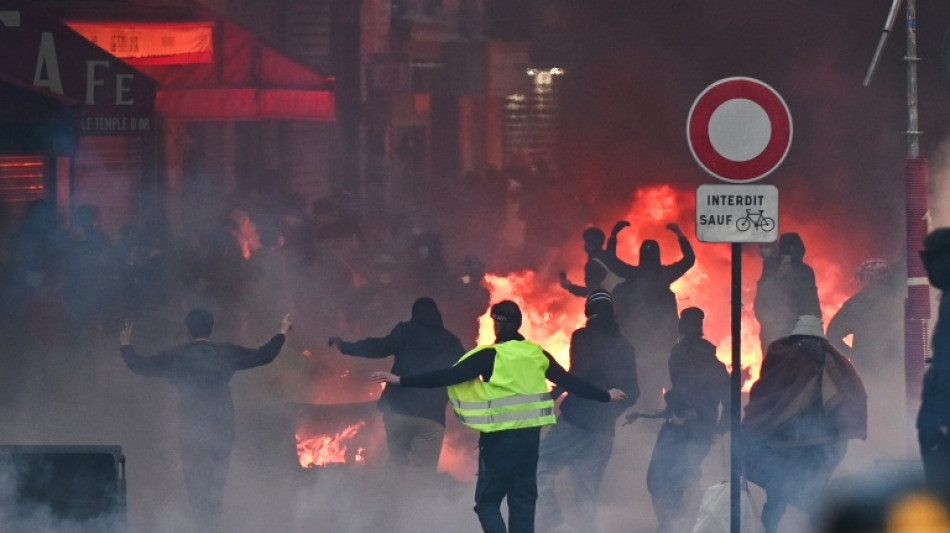
An unhappy republic: France's troubles extend beyond the street / Photo: Matthieu RONDEL - AFP/File

"Revolution!" some shouted during France's protests. Others demanded better classroom conditions. Many simply wanted their household budgets to stop shrinking as fuel and food prices spike.
Some, meanwhile, relished confrontation. Masked youths battled police and seized a lawless opportunity to loot city stores of expensive sneakers and TVs.
France's unrest is exposing deep political and economic fault lines ahead of next year's presidential election, analysts say, strengthening anti-establishment forces while leaving the cash-strapped government with little room to respond.
It adds up to a grievous problem for President Emmanuel Macron, whose rise was partly made possible by the collapse of France's traditional party system and whose presidency has coincided with further political fragmentation.
Analysts say the gap between what France's citizens expect of the state and what the state can afford to deliver may become one of the defining issues of the post-Macron era.
Previous governments might have tried to buy social peace. This one has far less room to do so.
"It's difficult for the government to respond to the legitimate demands of students and others because it has no money," analyst Mujtaba Rahman, head of the Eurasia Group, said on X.
"And (it's) impossible to respond to demands of the violent minority because they have none except 'screw the system'," he said.
- Who are the protesters? -
The profiles of those in, and on the margins of, the protests are as varied as their demands.
One placard summed up the mood: "Everything's fine, except everything."
An unemployed former hotel employee who gave her first name as Oumy said as she marched on the weekend that she no longer believed in the government's promises.
"Everything is tough. We have dramatically tightened our belts," she said.
Those frustrations reflected a feeling by many voters that they were unheard by traditional parties, while students and young workers expressed anxiety about future prospects.
Yellow Vest demonstrators demanding action on inflation marched alongside students who had been blocking schools since late September.
Hovering behind the economic grievances were familiar French arguments over immigration, policing, secularism and national identity.
But it was the actions of hundreds of masked youths on the margins of the demonstration that quickly dominated.
They fought police, vandalised public buildings, torched cars and bicycles, and looted shops in a frenzy that is shaping the political and security response.
"There are two types of rioters: virtually professional ones, ultra-left militants often coming from the Black Bloc movement; and 'casseurs' (hooligans or violent vandals), much more numerous, who are there by opportunity," Jerome Fourquet, a French political scientist, told Le Parisien daily.
They were there for the "adrenaline" and because they see "minimal risk" of punishment if caught, he said.
"The looters who exploited the chaos were very young kids from the poor suburbs, brown and black in many cases but almost certainly French," Eurasia Group's Rahman said.
He dismissed as "nonsense" claims by US President Donald Trump that the violence stemmed from immigration.
The focus on the "casseurs" has eclipsed concerns voiced by many protesters, particularly younger people facing expensive housing, uncertain employment prospects and diminishing expectations of matching their parents' living standards.
- Anti-establishment forces -
The unrest is widely being interpreted through the lens of the presidential race.
Some observers believe the unrest could help far-right leader Marine Le Pen by reinforcing concerns about law and order. Others argue it may strengthen support for the radical left among younger urban voters frustrated by economic conditions.
Surveys place Le Pen as the frontrunner ahead of the April-May election -- if she can overcome a graft conviction -- while far-left candidate Jean-Luc Melenchon also enjoys significant support.
The government has accused "ultra-left groups" of fomenting and carrying out the unrest.
Macron came to power in 2017 promising to modernise the economy and transcend France's traditional political divide.
Supporters point to investment and lower unemployment since then, while critics say many voters feel excluded from decision-making and unconvinced the gains have improved daily life.
As Macron nears the end of his maximum two consecutive terms, his approval ratings are low, with an Ifop survey carried out before the street violence showing just 17 percent support the president and 56 percent are unhappy with his governance.
France today faces weak growth, rising inflation, and mounting debt and deficits that are forcing the government to pursue spending cuts that would tighten conditions for many households, while at the same time protesters are demanding greater investment in schools, public services and purchasing power.
- Warning for Europe? -
Sebastien Maillard, an analyst at Chatham House and the Jacques Delors Institute, told AFP that "what is new in the phenomenon of such upheaval is that it is taking place just ahead of the country's major election".
He said that "the protests risk replacing an organised debate among candidates, as a democratic presidential race would require".
What's happening in France may point to pressures emerging elsewhere in Europe. Protests have also taken place in Brussels, Milan and Lisbon, albeit on a smaller scale.
"France serves as a protest model for other movements witnessed in northern Italy, Brussels and Portugal," Maillard said.
He added that the issues fuelling public anger in France were felt elsewhere, and the sort of disruption France was seeing could "spread elsewhere on the continent".
Those concerns include living costs, housing affordability, sluggish growth and declining trust in public institutions.
Together, the unrest, economic anxiety and growing support for political outsiders point to an uncertain future for France.
H.Hayashi--JT