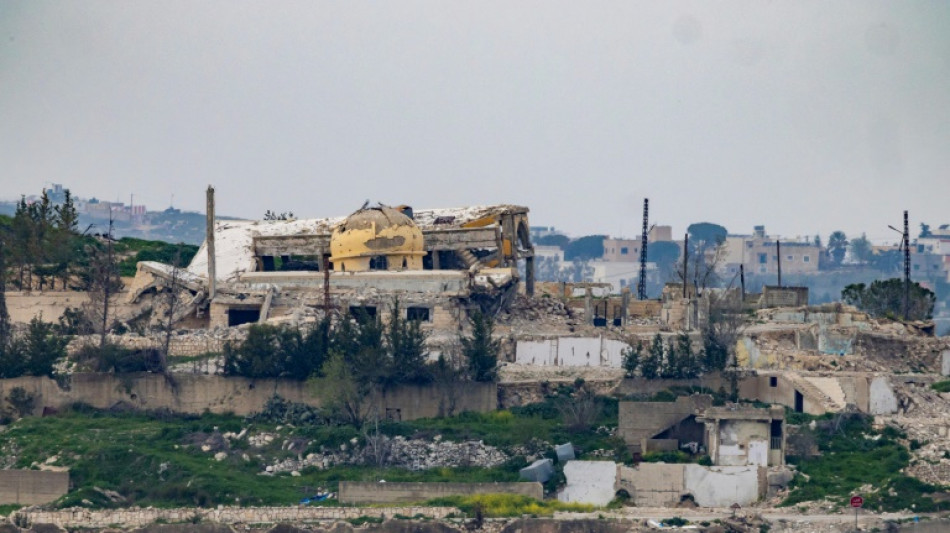
Lebanese accuse Israel of wiping their towns off the map / Photo: Odd ANDERSEN - AFP

Lebanese mother-of-two Hala Farah is collecting photos and videos to preserve the memory of her hometown which, like many others along the southern border, has been completely destroyed by Israeli forces.
Testimony from residents and officials, as well as satellite images and photographs taken by AFP journalists on both sides of the border, show widespread destruction in dozens of Lebanese towns and villages since the start of the Israel-Hezbollah war on March 2.
Responding to Hezbollah's attacks, Israel carried out massive airstrikes and launched a ground invasion in the south, which borders Israel and where the Iran-backed movement holds sway.
While a ceasefire began on April 17, the destruction, demolitions and bulldozing in southern areas have only intensified, affecting homes, infrastructure, schools, places of worship and farmland.
Israel's army, which sometimes issued evacuation warnings ahead of strikes, has repeatedly said its attacks target Hezbollah sites and operatives -- not civilians.
But Farah, 33, said everything in her hometown Yarun, less than a kilometre (mile) from Israel, has been destroyed.
"All that's left are memories and some pictures that we and the neighbours are trying to collect... so that we can tell our children what Yarun was like," she told AFP.
"I had hoped my daughters would grow up in the family home," she said, wearing a pin showing her village.
Yarun has found itself on the front line before: satellite images seen by AFP show it had been mostly destroyed by early 2025 following the previous Israel-Hezbollah war, with its Saint George church left with only three walls standing.
Other medium-resolution images, taken earlier this month and reviewed by AFP, show that what had previously been spared is now gone.
- Reduced to rubble -
Unable to return to the south, some displaced families are sharing the cost of purchasing satellite images -- at $140 -- to catch a glimpse of their hometowns.
Some post images of their homes on social media, taken before and after their destruction.
Among them is an anti-Hezbollah activist whose grandfather's three-storey home in the city of Nabatieh was wrecked in an Israeli strike.
A veteran writer meanwhile mourned his book collection in the border town of Bint Jbeil.
"Israel is trying to remove all the essential elements of life necessary for return," said Farah, who learned through satellite imagery that her house in Yarun, a town where both Christians and Muslims lived, was now rubble.
Her voice broke as she scrolled through dozens of photos and videos on her phone.
"What happened during the truce confirms that Israel's goal is the urbicide of the south, including Yarun," she said.
Environment Minister Tamara Zein last month also accused Israel of committing an "urbicide" in the area, using a term which means the deliberate destruction of urban areas.
Israel occupied south Lebanon until the year 2000, and Hezbollah has insisted it must retain its arsenal, despite a Lebanese government push to reclaim the monopoly of force.
While the majority of the south is Shia, Farah said Israel's demolitions in Yarun have included "the church hall, a convent and the Saint George school".
Around six kilometres (four miles) north of Yarun, satellite images from early April showed no sign of major damage in Bint Jbeil, an ancient hilltop town that had become a Hezbollah bastion.
A month later, the town appeared to have been razed almost entirely, including the stadium where slain Hezbollah chief Hassan Nasrallah delivered his "liberation" speech in 2000 to mark the withdrawal of Israeli forces.
- 'Destroy the land' -
At Lebanon's government-linked National Council for Scientific Research (CNRS) in Beirut, research director Chadi Abdallah showed AFP journalists before and after images of Bint Jbeil.
"Most buildings in Bint Jbeil are destroyed," he said, with most demolitions and detonations occurring since the truce.
"The Israelis are not conducting military or clearing operations; they are entering to destroy the land, the people, and the infrastructure," he said.
The agriculture ministry estimated this month that Israeli attacks have damaged more than 560 square kilometres of farmland.
"They are trying to erase the memory of the people in this region and to erase its history," said Abdallah.
According to the CNRS, Israeli attacks since 2023 have destroyed more than 290,000 housing units, 61,000 of them since the start of the latest war.
Among them, some 12,000 units were completely or partially destroyed since the truce began.
Lebanese officials say Israeli attacks have killed more than 3,000 people since Hezbollah drew Lebanon into the Middle East war in support of Iran after Israeli strikes killed the Islamic republic's supreme leader.
"Lebanon is witnessing such destruction for the first time in its history," said researcher Hanaa Jaber, who has roots in Bint Jbeil.
More than a million people displaced from the south face an "uprooting... with terrible repercussions," she said.
- 'Life support' -
Others, like Imad Bazzi from Bint Jbeil, spoke to AFP about the loss of their life's work.
"There is a total annihilation of... Bint Jbeil, from residential buildings and water and electricity institutions to the hospital, and even schools and gas stations," said Bazzi, 60, a municipal councillor and owner of an engineering firm that was destroyed.
"What is happening today is a blatant change of geography. It is systematic destruction."
Israel, whose soldiers are operating inside a self-declared "yellow line" that runs around 10 kilometres north of the border, says it is protecting its communities from Hezbollah attacks.
Lebanon and Israel began their first direct talks in decades last month in Washington, and Farah, the woman from Yarun, hopes for a positive outcome.
"We hope this will be the last war, because our villages in the south... are currently on life support," she said.
"We hope the Israelis will withdraw from every inch of our land and let us... create new memories for our children, erasing the echoes of the strikes that still ring in their ears."
burs-lar/nad-lg/ser
Y.Kimura--JT