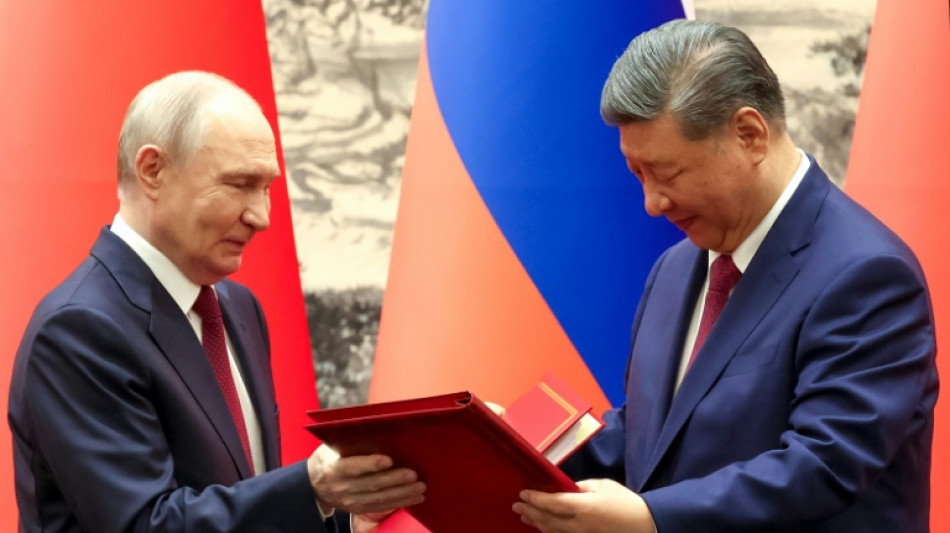
Key takeaways from Putin-Xi meeting / Photo: Alexander KAZAKOV - POOL/AFP

China's President Xi Jinping and Russia's Vladimir Putin met in Beijing on Wednesday, just days after Donald Trump left the Chinese capital, seeking to underscore their close ties.
Here are the key takeaways from the talks between the two leaders:
- Outdoing Trump -
Xi and Putin -- who have met dozens of times over the past decade -- were keen to showcase their unshakeable relations in the aftermath of Trump's visit to Beijing.
Neither leader referred to the United States directly on Wednesday, but Putin said ties were at an "unprecedentedly high level", while Xi described relations as "unyielding".
The Chinese leader also made an apparent swipe at the United States when he warned of "unilateral and hegemonic countercurrents running rampant" in the international system.
And while Trump left Beijing with few concrete announcements, Xi and Putin signed a slew of agreements on trade, media, and energy.
They also extended their treaty of "friendly cooperation" as both leaders lauded their countries' special ties.
Putin also invited Xi to visit Russia next year, and said he intended to be at November's APEC summit in Shenzhen -- which Trump has also said he will try to attend.
- Iran -
Xi told Putin that the Middle East was at a "critical juncture" and called for an "early end to the conflict", in particular to secure energy supplies.
"A comprehensive ceasefire is of utmost urgency, resuming hostilities is even more inadvisable and maintaining negotiations is particularly important," he said.
The two sides stressed the need for dialogue and negotiations, according to a joint statement released by the Kremlin.
Xi's priorities may differ from the Russian president's, however, as the pinch on crude and gas flows from the Middle East gives an opportunity to Putin to offer Russian energy sources as an alternative.
The Russian leader described the energy sector as "the locomotive of economic cooperation", adding that Russia would remain a "reliable supplier" of resources to China against the backdrop of the war.
- No pipeline breakthrough -
China is the world's top buyer of Russian fossil fuels, making it a key economic partner of Moscow, which is facing Western sanctions on oil and gas over the Ukraine war.
But the Kremlin said Wednesday that there had been no breakthrough on the proposed "Power of Siberia 2" natural gas pipeline, pushed for years by Moscow.
It would carry 50 billion cubic metres of gas a year, and help make up for the exports Russia used to send to Europe before it launched its invasion of Ukraine in 2022.
Kremlin spokesman Dmitry Peskov told Russian media on Wednesday that while the two sides had reached a "basic understanding" -- including on the route and how it will be built -- there was no "clear timeline", and "there are still some details to be worked out".
Beijing is wary of becoming over-reliant on any one country for energy and, as Russia's main economic backer, it remains in a strong position to negotiate on price.
- Ukraine -
The two sides agreed that there needed to be a solution to the "root causes" of the Ukraine conflict, while supporting "the search for a solution through dialogue and negotiations".
Beijing has regularly called for talks to end the war in Ukraine, but has never condemned Russia for sending in troops and continues to prop up Russia's economy with vital revenue and dual-use equipment.
Xi has stuck to this stance during talks with Trump, and now with Putin.
"The Russian side positively assesses the objective and unbiased position of the Chinese side regarding the situation in Ukraine and welcomes China's aspiration to play a constructive role in resolving the Ukrainian crisis by political and diplomatic means," the joint statement said.
K.Yamaguchi--JT