The Japan Times - Hormuz tanker traffic edges higher after wartime low

EUR -
AED 4.274174
AFN 72.728636
ALL 95.493789
AMD 428.267562
ANG 2.083455
AOA 1068.223828
ARS 1622.679427
AUD 1.627085
AWG 2.096011
AZN 1.984175
BAM 1.957099
BBD 2.343335
BDT 142.993675
BGN 1.943189
BHD 0.438793
BIF 3466.615661
BMD 1.163642
BND 1.489595
BOB 8.068355
BRL 5.850097
BSD 1.163462
BTN 112.039841
BWP 15.821569
BYN 3.209544
BYR 22807.389083
BZD 2.339963
CAD 1.599967
CDF 2615.285125
CHF 0.914891
CLF 0.026726
CLP 1051.735067
CNY 7.924285
CNH 7.9168
COP 4422.550562
CRC 526.351597
CUC 1.163642
CUP 30.836521
CVE 110.338231
CZK 24.316691
DJF 207.186618
DKK 7.473365
DOP 69.406363
DZD 154.599203
EGP 62.045062
ERN 17.454635
ETB 181.666771
FJD 2.562568
FKP 0.873216
GBP 0.869247
GEL 3.112751
GGP 0.873216
GHS 13.312287
GIP 0.873216
GMD 84.360918
GNF 10200.68245
GTQ 8.875929
GYD 243.370477
HKD 9.112657
HNL 30.949674
HRK 7.529463
HTG 152.301736
HUF 361.340038
IDR 20576.686793
ILS 3.379159
IMP 0.873216
INR 112.045779
IQD 1524.118094
IRR 1534844.193826
ISK 143.407135
JEP 0.873216
JMD 184.012127
JOD 0.825001
JPY 184.918469
KES 150.86647
KGS 101.760856
KHR 4680.086026
KMF 493.384339
KPW 1047.278056
KRW 1743.188489
KWD 0.358577
KYD 0.969548
KZT 544.093448
LAK 25491.027724
LBP 104188.949377
LKR 387.578898
LRD 212.912223
LSL 19.424675
LTL 3.435934
LVL 0.703876
LYD 7.401913
MAD 10.714811
MDL 20.139453
MGA 4878.258623
MKD 61.609648
MMK 2443.087741
MNT 4163.550684
MOP 9.384769
MRU 46.43682
MUR 55.044042
MVR 17.931517
MWK 2017.438958
MXN 20.153412
MYR 4.627834
MZN 74.35394
NAD 19.424675
NGN 1596.913176
NIO 42.818602
NOK 10.791188
NPR 179.263746
NZD 1.985895
OMR 0.447424
PAB 1.163472
PEN 3.995569
PGK 5.069364
PHP 71.695485
PKR 324.057467
PLN 4.245607
PYG 7085.641792
QAR 4.252886
RON 5.209047
RSD 117.432482
RUB 84.229162
RWF 1703.938212
SAR 4.366517
SBD 9.328131
SCR 16.351091
SDG 698.765594
SEK 10.950078
SGD 1.488762
SHP 0.868777
SLE 28.621577
SLL 24400.999662
SOS 664.938457
SRD 43.319497
STD 24085.046228
STN 24.51606
SVC 10.180757
SYP 128.611546
SZL 19.419972
THB 37.903325
TJS 10.855158
TMT 4.084384
TND 3.40486
TOP 2.801771
TRY 53.039311
TTD 7.899277
TWD 36.750733
TZS 3022.56437
UAH 51.390608
UGX 4385.873178
USD 1.163642
UYU 46.640955
UZS 13985.28192
VES 593.630741
VND 30670.120105
VUV 137.695893
WST 3.149258
XAF 656.38982
XAG 0.01523
XAU 0.000256
XCD 3.144801
XCG 2.096901
XDR 0.817055
XOF 656.392643
XPF 119.331742
YER 277.647907
ZAR 19.37319
ZMK 10474.181796
ZMW 21.902537
ZWL 374.692346
  • RBGPF

    2.3900

    63.18

    +3.78%

  • CMSC

    0.0100

    22.99

    +0.04%

  • BTI

    1.1450

    66.235

    +1.73%

  • RELX

    1.2010

    33.601

    +3.57%

  • VOD

    0.3200

    15

    +2.13%

  • RIO

    -0.1800

    103.51

    -0.17%

  • RYCEF

    -0.8300

    15.1

    -5.5%

  • GSK

    0.6800

    50.35

    +1.35%

  • BCE

    0.0800

    23.87

    +0.34%

  • NGG

    2.9400

    83.58

    +3.52%

  • BCC

    1.8600

    67.85

    +2.74%

  • CMSD

    0.0010

    23.051

    0%

  • BP

    1.4800

    45.83

    +3.23%

  • JRI

    0.1600

    12.61

    +1.27%

  • AZN

    2.5900

    184.17

    +1.41%

Hormuz tanker traffic edges higher after wartime low
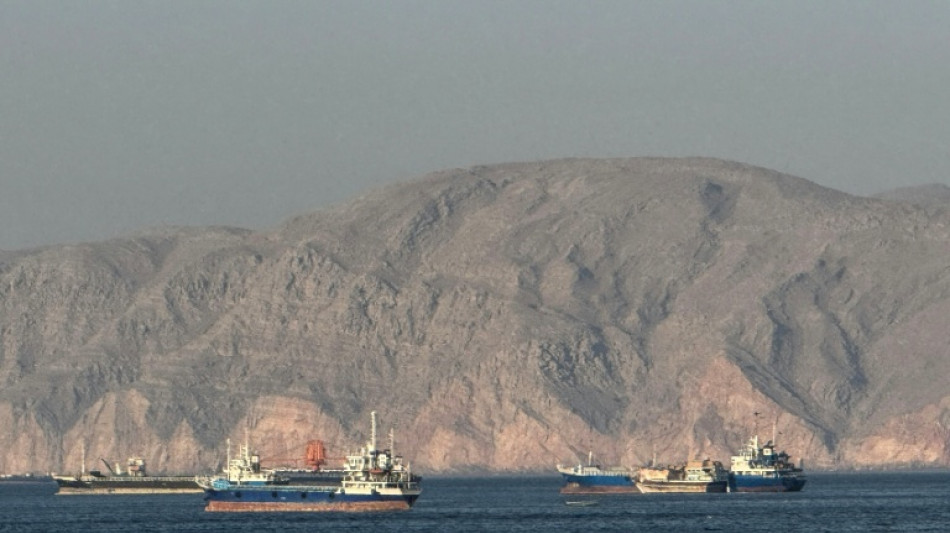
Hormuz tanker traffic edges higher after wartime low / Photo: - - AFP

Hormuz tanker traffic edges higher after wartime low

Traffic through the Strait of Hormuz was slightly higher last week, returning to levels in line with the average recorded since the start of the Middle East conflict after hitting a wartime low.

Text size:

A total of 55 commodities vessels crossed the strategic waterway between May 11 and 17, according to data from maritime tracking firm Kpler as of Monday morning.

That marked a sharp increase from the previous week, when just 19 vessels crossed -- the lowest weekly figure since the first US-Israeli strikes on Iran on February 28, which led to widespread disruption of traffic through the strait.

Iranian state television said Friday the Revolutionary Guards were allowing more ships to transit the strait, after reporting a day earlier that "more than 30 ships" had been permitted to pass.

Despite the increase, last week's crossings remain broadly in line with wartime averages.

Since March 1, Kpler has recorded 663 commodity vessels transiting the strait, 55 per week on average.

Around half the tankers crossing last week carried liquids.

These included three very large crude carriers, reportedly bound for China, Oman and Japan.

Kpler data also showed 15 dry bulk commodity vessels and 16 liquefied petroleum gas (LPG) tankers crossed the strait last week.

Only one liquefied natural gas tanker carrying Qatari gas to Pakistan crossed, on May 12.

That brought the total number of LNG tanker crossings since the start of the war to eight.

In peacetime, the Strait of Hormuz handles roughly a fifth of global oil and LNG shipments, as well as other major commodities, including fertiliser.

Iran has repeatedly warned that maritime traffic through the shipping lane would "not return to its pre-war status".

On Monday, Tehran announced the creation of a new body to oversee the strait and charge vessels for transiting the waterway, which Iran has reportedly been doing since early on in the war.

- Chinese vessels crossing -

Iranian officials said on Thursday that Chinese vessels had been allowed to transit, after a slowdown the previous week.

According to Kpler, only three commodities vessels linked to China through their flag, ownership or cargo crossed the strait last week.

Two additional Hong Kong-flagged vessels also transited and were heading to Oman and the United Arab Emirates.

The data may not provide a complete picture, however, as vessels do not always disclose final destinations while crossing.

Traffic through the strait since the start of the war has depended on nationality, with Iran saying on Monday that countries complying with US sanctions against the Islamic republic would face difficulties crossing.

Since the start of the conflict, China and India have been among the most frequently reported non-Gulf destinations or departure points for commodity carriers transiting the strait.

Other non-Gulf destinations listed in Kpler's shipping data include Brazil, Pakistan, Thailand and Malaysia, while relatively few vessels reported Western countries as destinations.

Iran's control of the Strait of Hormuz remains one of the central issues in stalled negotiations with the United States, which have yet to produce a breakthrough.

S.Yamada--JT