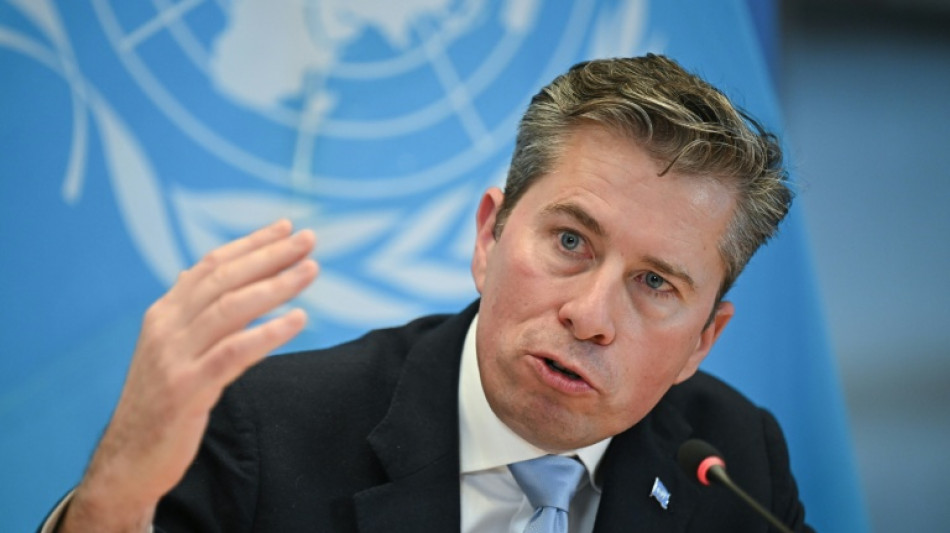
UN urges 'exemptions' to get aid through Strait of Hormuz / Photo: Fabrice COFFRINI - AFP

The United Nations aid chief warned Wednesday that the Middle East war was impacting aid routes and called for "exemptions" so humanitarian supplies could get through.
The war in the Middle East has effectively closed the Strait of Hormuz, while fuel supply disruptions are sending freight rates soaring.
UN aid chief Tom Fletcher warned that the escalating war and its impact on the strait was having "a direct impact on our humanitarian supplies, including going to areas of key need in sub-Saharan Africa".
"I'm worried that further escalation will damage other supply routes," he told reporters in Geneva, warning that the war was pushing up prices and driving "more people into greater need".
"We're appealing to all the parties to try and secure those routes, including the Strait of Hormuz, for our humanitarian traffic... so we can reach anyone, anywhere, on the basis of greatest need."
"We're living through a moment right now of grave peril," Fletcher said.
"We're seeing these crises escalate rapidly and increasingly collide in dangerous ways," he said, calling for "calmer heads to prevail".
The last two weeks of fighting are further confirmation that "we're living in a time of brutality, impunity and indifference", he said, cautioning that "the rules-based scaffolding meant to restrain the worst excesses of war is cracking".
"Human ingenuity is being applied to find ever more sinister ways to kill at scale, while civilians are subjected to ever more abject violence."
- 'Massive gap' -
The UN aid chief warned that such violence was taking a heavy toll at a time when humanitarians were already on their knees.
"We're seeing violence reverberate across borders, displacement, economic shocks, soaring humanitarian needs -- and we're seeing the consequences spread faster than we can respond," he said.
"Humanitarian action (is) overstretched, under sustained attack and under-resourced."
When Fletcher launched the UN's annual Global Humanitarian Appeal for 2026 last December, he requested $23 billion to help 87 million of the world's most vulnerable people, with a heavy focus on dire conflict situations like those in Gaza, Ukraine, Sudan, Haiti and Myanmar.
The amount and scope were dramatically reduced compared to recent years, as the UN strives to adapt to a new reality since US President Donald Trump returned to the White House in January 2025, slashing foreign aid.
The UN has stressed that its smaller appeal did not mean humanitarian needs have shrunk.
Fletcher voiced optimism Wednesday that the 2026 target could be reached, while acknowledging that "the needs are far greater" than the people the UN can reach.
The UN has already received $5 billion towards the 2026 plan, including $2 billion from the US, with additional pledges bringing the total to $8.7 billion, he said.
"So that's over a third of what we're looking to get this year for this plan, delivered in the first quarter," he said.
But, he warned, "we still face a massive gap".
"Without additional support, millions of people will die."
The towering humanitarian needs were all the more distressing when around $1 billion is being spent every day on the Middle East war, he said.
Just a day's worth of war funding "would allow us to save millions of lives", Fletcher insisted.
T.Sasaki--JT