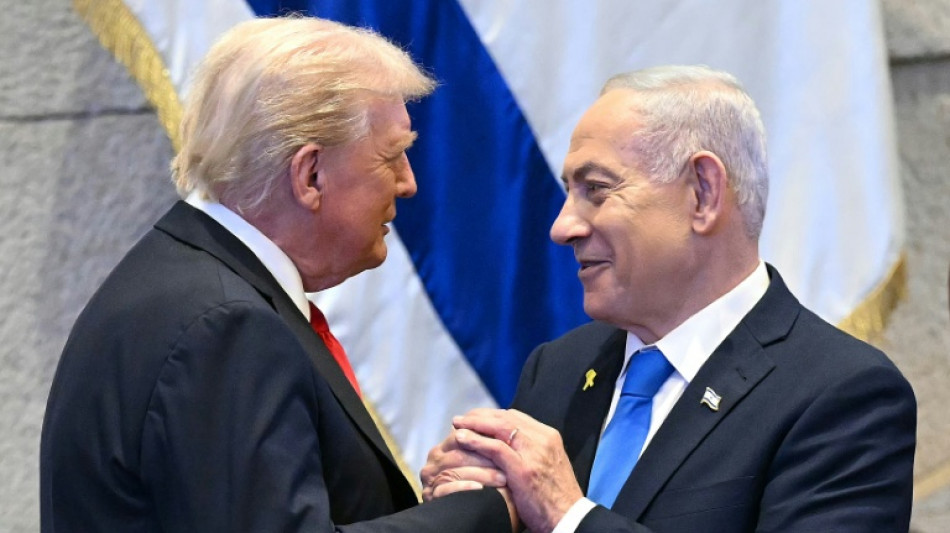
Netanyahu to meet Trump in US on Monday / Photo: SAUL LOEB - POOL/AFP

Israeli Prime Minister Benjamin Netanyahu is due to meet US President Donald Trump in Florida on Monday, an Israeli official told AFP, in what is seen as a crucial visit for the next steps of the fragile Gaza truce plan.
It will be Netanyahu's fifth visit to see key ally Trump in the United States this year.
His trip comes as the Trump administration and regional mediators push to proceed to the second stage of the ceasefire between Israel and Hamas in the Gaza Strip.
An Israeli official on Saturday said Netanyahu would leave for the US on December 28 and meet with Trump a day later in Florida, without providing a specific location.
Trump told reporters in mid-December that Netanyahu would probably visit him in Florida during the Christmas holidays.
"He would like to see me. We haven't set it up formally, but he'd like to see me," Trump said before leaving for his Mar-a-Lago resort.
Israel's Yedioth Ahronoth newspaper reported on Wednesday that a wide range of regional issues was expected to be discussed, including Iran, talks on an Israel-Syria security agreement, the ceasefire with Hezbollah in Lebanon and the next stages of the Gaza deal.
- 'Going nowhere' -
Concerning Gaza, the timing of the meeting is "very significant", said Gershon Baskin, the co-head of peacebuilding commission the Alliance for Two States, who has taken part in back-channel negotiations with Hamas.
"Phase one is basically over, there's one remaining Israeli deceased hostage which they (Hamas) are having difficulty finding," he told AFP.
"Phase two has to begin, it's even late and I think the Americans realise that it's late because Hamas has had too much time to re-establish its presence and this is certainly not a situation that the Americans want to leave in place," he added.
Progress in moving to the second phase of October's Gaza ceasefire agreement, which was brokered by Washington and its regional allies, has so far been slow.
Both sides allege frequent ceasefire violations and mediators fear that Israel and Hamas alike are stalling.
Under the next stages, Israel is supposed to withdraw from its positions in Gaza, an interim authority is to govern the Palestinian territory instead of Hamas, and an international stabilisation force (ISF) is to be deployed.
It also includes a provision for Palestinian Islamist movement Hamas to lay down its weapons -- a major sticking point.
On Friday, US news outlet Axios reported that the meeting between Trump and Netanyahu was key to advancing to the next steps of the deal.
Citing White House officials, Axios said that the Trump administration wanted to announce the Palestinian technocratic government for Gaza and the ISF as soon as possible.
It reported that senior Trump officials were growing exasperated "as Netanyahu has taken steps to undermine the fragile ceasefire and stall the peace process".
"There are more and more signs that the American administration is getting frustrated with Netanyahu," said Yossi Mekelberg, a Middle East expert at London-based think-tank Chatham House.
"The question is what it's going to do about it," he added, "because phase two is right now going nowhere."
- Iran tops agenda -
While the Trump administration is keen for progress on Gaza, analysts said the prospect of Iran rebuilding its nuclear programme and ballistic missile capabilities was likely to top the agenda for Netanyahu.
"All the news that we've heard in the Israeli media over the last two weeks about Iran building up its missiles and being a threat to Israel is all part of a planned strategy of deflecting attention from Gaza to the issue that Netanyahu loves to talk about which is Iran," said Baskin.
In June, Israel launched strikes on Iranian military and nuclear sites as well as residential areas.
Iran responded with drone and missile strikes on Israel, and later on in the 12-day war, the United States joined Israel in targeting Iranian nuclear facilities.
Mekelberg shared the view that Netanyahu could be attempting to shift attention from Gaza onto Iran.
With Israel entering an election year, Mekelberg said with regards to the Trump meeting, Netanyahu would be "taking a defensive approach, to minimise what can be difficult for him coming back home".
"Everything is connected to staying in power," he said of the long-time Israeli premier.
K.Okada--JT