The Japan Times - Slovenia holds crunch vote on contested assisted dying law

EUR -
AED 4.237091
AFN 72.685001
ALL 95.954988
AMD 434.520707
ANG 2.065282
AOA 1057.974892
ARS 1578.268494
AUD 1.674968
AWG 2.079607
AZN 1.961076
BAM 1.955893
BBD 2.321221
BDT 141.406739
BGN 1.97209
BHD 0.434945
BIF 3423.363136
BMD 1.153735
BND 1.481071
BOB 7.98138
BRL 6.041996
BSD 1.15246
BTN 108.601646
BWP 15.844824
BYN 3.46098
BYR 22613.205604
BZD 2.317921
CAD 1.598326
CDF 2636.861817
CHF 0.916875
CLF 0.027131
CLP 1071.288545
CNY 7.973981
CNH 7.982415
COP 4256.232177
CRC 534.325463
CUC 1.153735
CUP 30.573977
CVE 110.270255
CZK 24.510982
DJF 205.230669
DKK 7.473549
DOP 69.483311
DZD 153.46996
EGP 60.805986
ERN 17.306025
ETB 178.11666
FJD 2.604445
FKP 0.862804
GBP 0.865071
GEL 3.109331
GGP 0.862804
GHS 12.5996
GIP 0.862804
GMD 84.806546
GNF 10103.481469
GTQ 8.81642
GYD 241.11149
HKD 9.029246
HNL 30.602591
HRK 7.535854
HTG 150.927192
HUF 387.816349
IDR 19534.982991
ILS 3.604379
IMP 0.862804
INR 108.656856
IQD 1509.77849
IRR 1515200.148882
ISK 143.420403
JEP 0.862804
JMD 181.129416
JOD 0.818
JPY 184.183982
KES 149.651251
KGS 100.893962
KHR 4615.219932
KMF 492.645362
KPW 1038.428166
KRW 1741.043798
KWD 0.354439
KYD 0.96045
KZT 555.218864
LAK 24893.29414
LBP 103205.065372
LKR 362.458843
LRD 211.480994
LSL 19.716525
LTL 3.406679
LVL 0.697883
LYD 7.359383
MAD 10.760113
MDL 20.243052
MGA 4803.249709
MKD 61.64141
MMK 2422.824743
MNT 4134.787378
MOP 9.286983
MRU 45.972191
MUR 53.798539
MVR 17.836537
MWK 1998.403892
MXN 20.670085
MYR 4.609743
MZN 73.734887
NAD 19.716525
NGN 1597.645586
NIO 42.412021
NOK 11.188379
NPR 173.763034
NZD 2.002301
OMR 0.443616
PAB 1.152455
PEN 3.98849
PGK 4.980237
PHP 69.473364
PKR 321.687324
PLN 4.276492
PYG 7544.392214
QAR 4.2022
RON 5.096397
RSD 117.469833
RUB 93.889678
RWF 1682.987494
SAR 4.328787
SBD 9.278308
SCR 15.858649
SDG 693.394519
SEK 10.87701
SGD 1.483547
SHP 0.8656
SLE 28.32444
SLL 24193.258148
SOS 658.634241
SRD 43.33659
STD 23879.9847
STN 24.501168
SVC 10.084524
SYP 128.575537
SZL 19.711025
THB 38.038772
TJS 11.029273
TMT 4.04961
TND 3.391062
TOP 2.777916
TRY 51.293934
TTD 7.822407
TWD 36.856028
TZS 2967.654281
UAH 50.571029
UGX 4287.204301
USD 1.153735
UYU 46.722226
UZS 14037.668947
VES 537.661435
VND 30402.070452
VUV 137.321383
WST 3.172229
XAF 655.991103
XAG 0.016798
XAU 0.000262
XCD 3.118027
XCG 2.077108
XDR 0.815842
XOF 655.991103
XPF 119.331742
YER 275.338743
ZAR 19.72108
ZMK 10385.000211
ZMW 21.638125
ZWL 371.502193
  • RBGPF

    -13.5000

    69

    -19.57%

  • CMSD

    0.0700

    22.75

    +0.31%

  • RYCEF

    -0.6000

    15.3

    -3.92%

  • CMSC

    -0.0900

    22.82

    -0.39%

  • BCE

    -0.0200

    25.47

    -0.08%

  • RIO

    -1.7500

    85.79

    -2.04%

  • GSK

    -0.7600

    53.94

    -1.41%

  • BCC

    -0.3600

    74.29

    -0.48%

  • NGG

    -1.8900

    82.4

    -2.29%

  • BTI

    -0.1900

    58.26

    -0.33%

  • VOD

    -0.0900

    14.63

    -0.62%

  • JRI

    -0.0300

    12.07

    -0.25%

  • RELX

    -0.4000

    32.07

    -1.25%

  • AZN

    -3.7400

    183.4

    -2.04%

  • BP

    0.7600

    46.17

    +1.65%

Slovenia holds crunch vote on contested assisted dying law
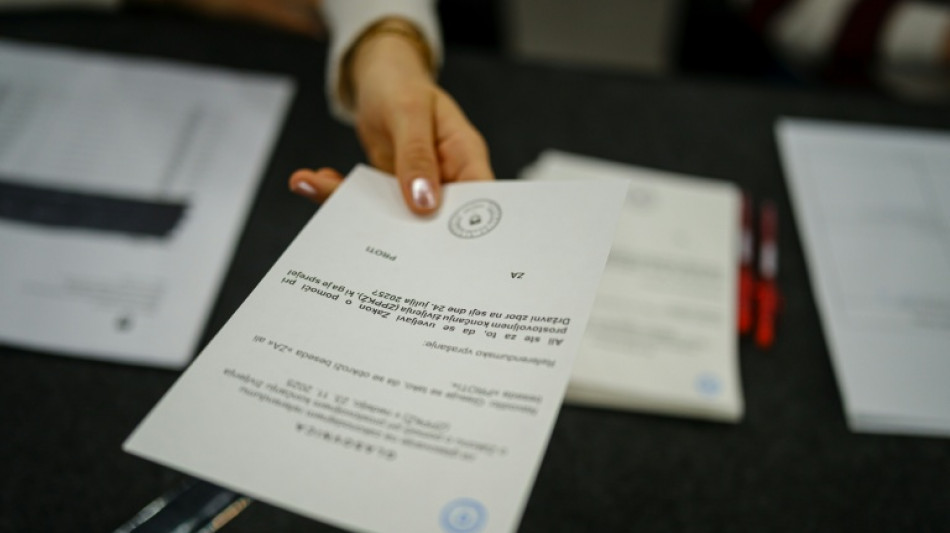
Slovenia holds crunch vote on contested assisted dying law / Photo: Jure Makovec - AFP

Slovenia holds crunch vote on contested assisted dying law

Slovenians began voting Sunday in a new referendum that will determine if a law legalising assisted dying will be enforced or suspended, after critics mounted a campaign against the legislation.

Text size:

Several European countries, including Austria, Belgium, the Netherlands and Switzerland allow terminally ill people to receive medical help to end their lives.

Slovenia's parliament approved a law in July allowing assisted dying after a 2024 referendum supported it.

But a new vote was called after a civil group, backed by the Catholic Church and the conservative parliamentary opposition, gathered 46,000 signatures in favour of a repeat, exceeding the 40,000 required.

The law will come into force unless a majority of participants, representing at least 20 percent of the 1.7 million eligible voters, rejects it.

Polls opened at 7:00 am (0600 GMT) and will close 12 hours later, with first partial results expected late Sunday.

- 'Culture of death' -

At the Stozice sports hall, the largest polling station in Ljubljana, 63-year-old pensioner Romana Hocevar said she would vote in favour of assisted dying.

"I'm a stage four cancer patient, I would not like to suffer. Had my father die of cancer and mother suffering dementia and I know what it looks like."

Vid Ursic, a 24-year-old student, said it was "good that we get to vote on relevant issues" and added that he supported "the right for people to decide on their own lives".

But Marija Unuk, in her late fifties, said she had voted against the law "because I support the culture of life, not the culture of death".

Under the disputed law, which was to take effect this year, lucid, terminally ill patients would have the right to aid in dying if their suffering is unbearable and all treatment options have been exhausted.

It also allows for assisted dying if treatment offers no reasonable prospect of recovery or improvement in the patient's condition, but not to end unbearable suffering from mental illness.

Prime Minister Robert Golob, who voted in advance, has urged citizens to back the law "so that each of us can decide for ourselves how and with what dignity we will end our lives".

The group opposing the law, called Voice for the Children and the Family, has accused the government of using the law to "poison" ill and elderly people.

- 'Human dignity' -

The Catholic Church has said allowing assisted dying "contradicts the foundations of the Gospel, natural law and human dignity".

Some 54 percent of citizens back the legalisation of assisted dying, almost 31 percent oppose it and 15 percent are undecided, according to a poll published this week by the Dnevnik daily, based on 700 responses.

In June 2024, 55 percent backed the law.

If a majority of voters oppose the new law on Sunday, parliament cannot vote again on a bill that deals with the same issue over the next 12 months.

While several European countries already allow terminally ill people to receive medical help to end their lives, in others it remains a crime, even in cases of severe suffering.

In May, France's lower house of parliament approved a right-to-die bill in a first reading. The British parliament is debating similar legislation.

K.Abe--JT