US soybean farmers battered by trade row with China / Photo: ROBERTO SCHMIDT - AFP

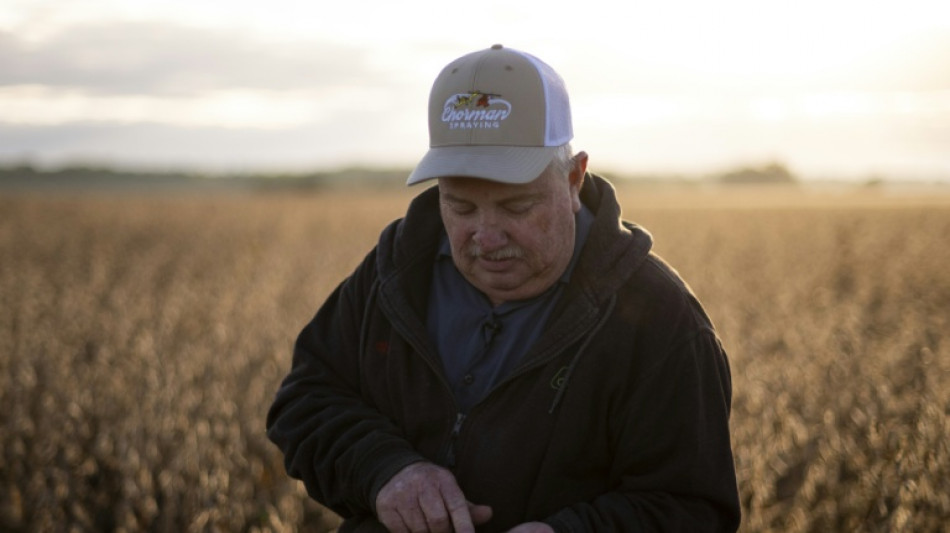
The US soybean harvest is underway and in rural Maryland, farmer Travis Hutchison cracks open a pod to show how a field is nearly dry enough for reaping.
But a decent yield is not enough to secure his income this year -- with China, once the biggest buyer of US soybean exports, halting orders in a trade row triggered by President Donald Trump's aggressive tariffs.
Soybean prices "are really depressed because of the trade war," Hutchison told AFP. His family tills 3,400 acres of soybeans, corn and other crops.
"I wasn't against the president trying it, because I think we needed better trade deals," added the 54-year-old of Trump's policies.
But he expressed disappointment at how things played out: "I was hoping it would get resolved sooner."
Hutchison is among American farmers -- a key support base for Trump -- reeling from the trade impasse.
The world's second biggest economy in 2024 bought more than half the $24.5 billion in US soybean exports.
But exports to China have fallen by over 50 percent in value this year, and Chinese buyers have held off on new soybean orders from the US autumn harvest.
With lower demand, soybean prices are down about 40 percent from three years ago.
This comes as American soybeans have become pricier for Chinese buyers.
As Trump slapped tariffs on Chinese products in his second presidency, Beijing's counter-duties on US soybeans rose to 20 percent.
This makes them "prohibitively more expensive" than exports from South America, where US farmers face growing competition, said the American Soybean Association (ASA).
Last month, Argentina suspended its export tax on key crops like soybeans, making them more attractive to Chinese buyers too.
Trump vowed to tap tariff revenues to help US farmers but has not provided details, while prospects of a longer-term deal appear more distant than ever.
On Friday, Trump promised additional 100-percent tariffs targeting China and threatened to scrap talks with Chinese leader Xi Jinping over Beijing's rare earth industry export curbs.
ASA president Caleb Ragland said the group had hoped top-level talks would restore soybean exports to China.
"These latest developments are deeply disappointing at a moment when soybean farmers are facing an ever-growing financial crisis," he said.
- 'Band-aid' -
Hutchison, whose family has been farming in Cordova for generations, acknowledges that farmers are easy targets in trade spats.
But a government bailout is a "band-aid" rather than a long-term solution, he said.
"I'm glad that he's thinking of us," Hutchison added, referring to Trump.
But securing a reliable trading partner is more important: "We're in the farming game for the long term."
Time is limited, as China's soybean purchasing window from the United States usually runs from October through January, said farmer David Burrier, based in Union Bridge, Maryland.
"This year's going to be a very, very tough year," he told AFP. "40 percent of our acres are probably going to be breakeven or under breakeven."
Burrier said it would be a "four-alarm fire" if China stopped soybean purchases for good.
ASA chief economist Scott Gerlt warned the situation is especially harsh in Midwestern states like North and South Dakota.
There, the soybean industry is built up around exporting to the Pacific Northwest and subsequently to China.
They are hard-hit if they run out of storage and cannot ship their harvests out.
- Worse than 2018 -
Gerlt said farmers have it harder than in 2018, when they were also caught in Washington and Beijing's tariffs war.
From 2018 to 2019, retaliatory tariffs caused over $27 billion in US agriculture export losses. The government provided $23 billion to help farmers hit by trade disputes.
But they enter this trade war under greater financial stress, Gerlt said.
Crop revenues are lower, yet costs for everything from fertilizers to equipment have ballooned as Trump's new tariffs bite.
"Getting parts to fix your combines and your planters and everything is costing more because of the tariffs," Hutchison said. "It's going to affect our bottom line."
US farm bankruptcies this year have surged about 50 percent from 2024, said professor Chad Hart of Iowa State University.
Asked if economic conditions have changed his feelings about supporting Trump, Hutchison paused: "It makes me think a little bit more."
M.Fujitav--JT