Private military contractors bolster Russian influence in Africa

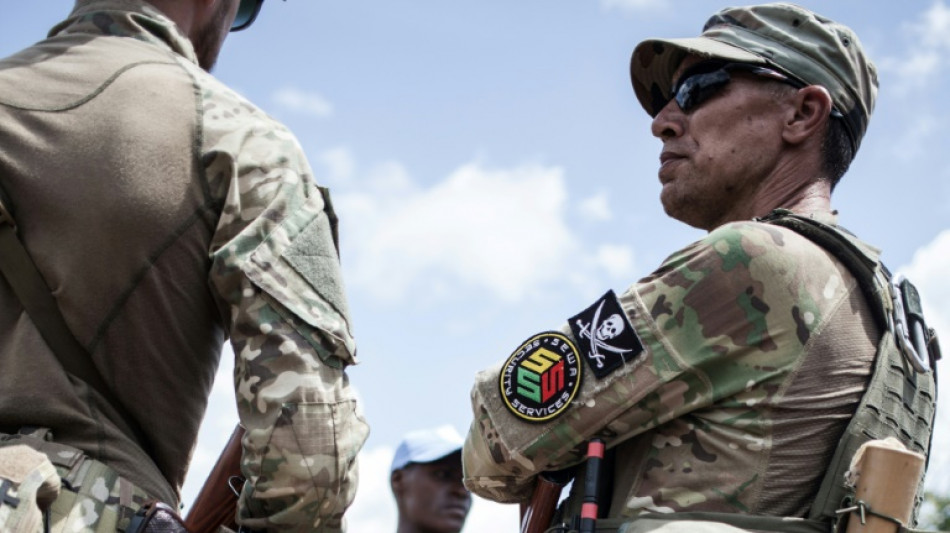
Russia's geopolitical ambitions in Africa have in recent years been backed by private military contractors, often described as belonging to the "Wagner group" -- an entity with no known legal status.
Most recently, Western nations have condemned the alleged arrival of Russian mercenaries in Mali's capital Bamako, a claim denied by the junta that seized power in 2020.
As relations with France worsen, the military rulers may be looking for ways to make up for shrinking numbers of European troops fighting Mali's years-old jihadist insurgency.
"Mercs (mercenaries) working in Africa is an established norm" thanks in part to decades of operations by contractors from South Africa, said Jason Blazakis of the New York-based Soufan Group think-tank.
"The Wagner folks are walking through a door that has long been open to their ilk," he added.
No information is publicly available about the group's size or finances.
But around Africa, the Center for Strategic and International Studies (CSIS) in Washington has found evidence since 2016 of Russian soldiers of fortune in Sudan, South Sudan, Libya, the Central African Republic (CAR), Madagascar and Mozambique.
Botswana, Burundi, Chad, the Comoros, the Democratic Republic of Congo, Congo-Brazzaville, Guinea, Guinea-Bissau, Nigeria and Zimbabwe are also on the CSIS's list.
In Africa "there is a convergence of many states' interests, including China's," Alexey Mukhin of the Moscow-based Centre for Political Information told AFP.
"Every state has the right to defend its business assets," he added.
- 'Hysteria' -
Wagner does not officially exist, with no company registration, tax returns or organisational chart to be found.
When the EU wanted to sanction the group in 2020, it targeted Russian oligarch Yevgeny Prigozhin, an ally of President Vladimir Putin who is suspected of running Wagner.
It imposed further sanctions in December last year when mercenaries' arrival in Mali appeared certain -- drawing accusations of "hysteria" from Moscow.
Western experts say military contractors are embedded in Russia's official forces like intelligence agencies and the army, providing plausible deniability for Moscow.
Their deployment to African countries aims to "enable Russia to... regain this sphere of influence" that fell away with the collapse of the Soviet Union, said CSIS researcher Catrina Doxsee.
The mercenaries' presence has been growing even faster since a 2019 Russia-Africa summit.
Moscow has been active "especially in what has traditionally been France's zone of influence" in former colonies like CAR and Mali, said Djallil Lounnas, a researcher at Morocco's Al Akhawayn university.
While military contractors sometimes shepherd Russian arms sales, the revenue "really pales compared with the profit they are able to generate from mining concessions and access to natural resources", Doxsee said.
That makes unstable countries with mineral or hydrocarbon wealth prime customers -- such as in Syria where the mercenaries first became known to the wider public.
- No questions asked -
Lounnas said that another advantage for clients is a lack of friction over human rights and democracy that might come with Western partners.
"Russia has its interests. It doesn't ask questions," he added.
Reports of violence and abuse on the ground suggest that same latitude may extend to the mercenaries themselves.
In the CAR, the United Nations is probing an alleged massacre during a joint operation by government forces and Wagner fighters.
One military source told AFP that more than 50 people died, some in "summary executions".
On Thursday, the European Union said it would not resume military training in the CAR -- suspended since mid-December -- unless the country's soldiers stop working for Wagner.
Meanwhile the mercenaries' results do not always measure up to the hopes of the governments that hire them.
In Libya, Russian mercenaries suffered heavy losses in Marshal Khalifa Haftar's year-long attempt to conquer the capital Tripoli, which was ultimately unsuccessful.
And in Mozambique, the Russians retreated in the face of Islamic State group jihadists, ultimately losing out to South African competitors.
Although lacking language skills and experience with the terrain, Wagner "were picked because they were the cheapest", Doxsee said.
"They didn't have what it took to succeed," she added, noting that "they've had a fair few failures" across Africa.
Succeeding completely might actually harm the mercenaries' business model, which thrives on unrest, conflict and crisis.
"If a country such as the CAR hires them to train forces, to help them in their military efforts, it’s in their interest to accomplish that just well enough to continue to be employed," Doxsee said.
"If they actually were to do it well enough to resolve the conflict, they would no longer be needed".
M.Ito--JT