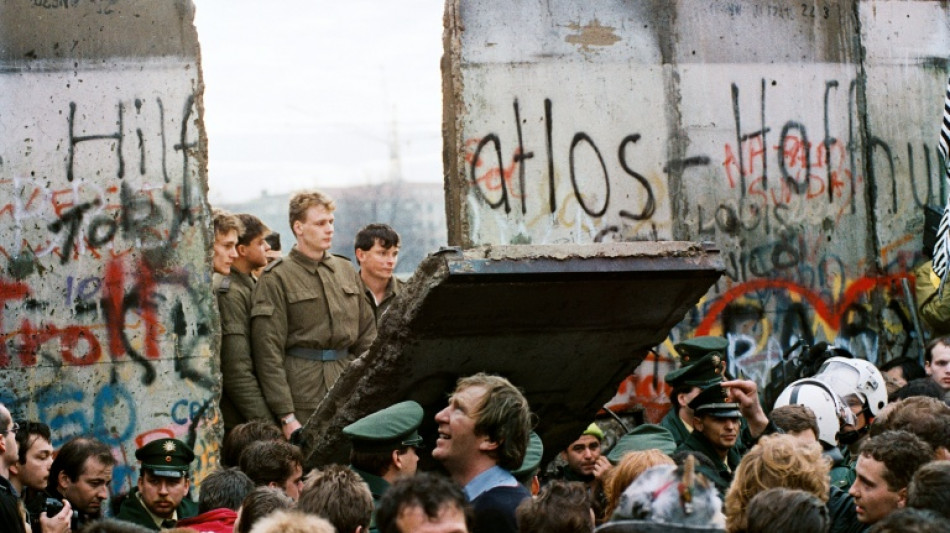
East Germany's empty towns try to lure people with 'trial living' / Photo: GERARD MALIE - AFP/File

Depopulated towns in Germany's ex-communist east have come up with a novel scheme to bring back life: offering people several weeks of super-cheap housing to give would-be residents a taste of the place.
The "trial-living" scheme aims to revitalise half-deserted communities as Germany nears the 35th anniversary of its reunification on October 3.
One of those giving it a shot is Weslawa Goeller, 50, a kindergarten educator with a two-year-old daughter who is getting to know the small town of Guben on the Polish border.
Hailing from the much bigger western German city of Mainz, she said she found the quiet streets unsettling at first: "Since I arrived, I feel like I never see anyone."
"But it's green and quiet," she added, warming to the town's tranquil charms, as well as the free childcare for her toddler.
"I could easily work here as an educator," she told AFP, sitting at a terrace cafe.
Goeller was among 16 people who came over the summer to discover the town and its services under a scheme run by local authorities, a tourism agency and real estate companies.
They paid just 100 euros ($118) in weekly rent for a maximum of four weeks, with a view to settling there.
While finding a reasonably priced flat in Berlin has become a real struggle, many properties in Guben can be rented for just five to seven euros per square metre.
"Old trees like me are hard to uproot," said Goeller. "But I might decide to move here."
- 'Bomb for economy' -
Like many places in the east, Guben hit hard times in the years after the Berlin Wall fell in 1989.
As the Soviet-backed regime collapsed and outdated businesses closed across the east, waves of unemployment sparked population flight and a sense of social dislocation.
Scars from that turbulent era and an enduring east-west wealth gap are often cited as contributing to the surging popularity of the far-right Alternative for Germany (AfD) party in the east.
While large cities like Dresden and Leipzig are growing, smaller eastern towns continue to see young people and women leaving, said Tim Leibert, a researcher at the Leibniz Institute of Geography.
The trend threatens to become "a bomb for the German economy", he said.
Eastern Germany could lose between eight and 16 percent of its population over the next 20 years, according to the statistics institute Destatis.
Guben also saw its population plummet from around 31,000 in 1990 to just 16,000 today.
Its slogan, "A town where people stay", contrasts sharply with the empty streets and blank advertising spaces.
- Overcoming prejudice -
Some of the newcomers like it that way -- among them former social worker Anika Franze, 38, who gave up the "Berlin party scene" to move here last year.
She now works for the trial-living initiative, persuading others to move to her adopted town.
For her, it was essential to test life in Guben for several weeks before making the move.
"Not having to decide immediately whether to move is a very modern concept, a bit like a 30-day right of return," she said.
Kerstin Geilich, 61, the head of the Guben repopulation project, said she remembers the trauma of the 1990s when the east German economy collapsed.
The situation in the region has improved since then, she said, with factories reopening and jobs available in other sectors such as healthcare.
But prejudices remain difficult to overcome, according to Geilich. "It's hard to make (people) understand that you can find a good job here today."
- 'Tragedy of the 1990s' -
Thirty kilometres (48 miles) north of Guben, the town of Eisenhuettenstadt launched a similar programme this year, to help overcome what Mayor Frank Balzer calls "the tragedy of the 1990s".
The town was built from scratch in 1950 as a hub for communist East Germany's steel industry and was originally known as Stalinstadt.
It has lost half its population since reunification, and its historic blast furnaces, taken over by Arcelor Mittal, now operate with one quarter of the former workforce.
One person considering a move to Eisenhuettenstadt is IT consultant Melanie Henninger, who hails from the east but now lives in the west German city of Bremen.
"I would like to contribute to society here, for example by training older people in digital technology," she told AFP during a recent visit.
Henninger said she "tries not to have any preconceptions" over the strength of the far right in the region and that instead "I have to give this place a chance".
K.Inoue--JT