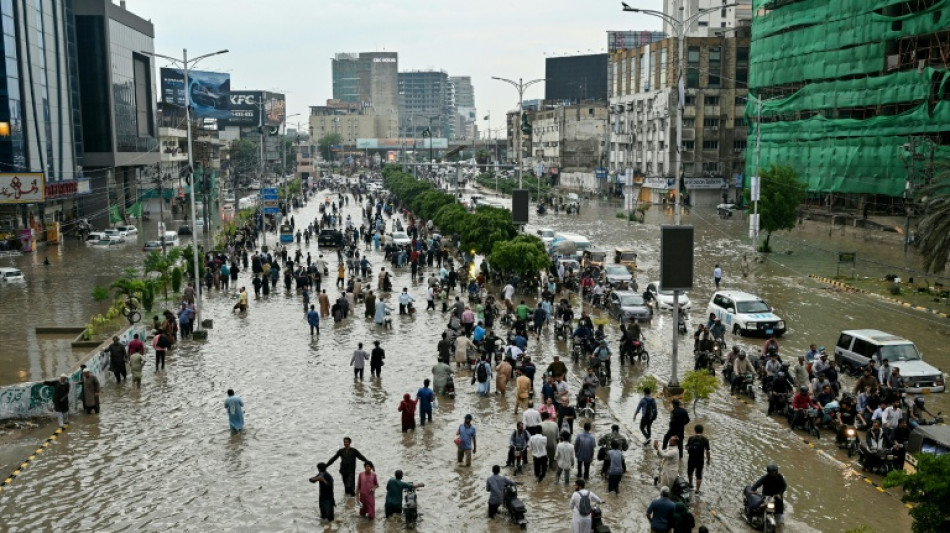
Pakistan's monsoon misery: nature's fury, man's mistake / Photo: Asif HASSAN - AFP

Floodwaters gushing through mountain villages, cities rendered swamps, mourners gathered at fresh graves -- as Pakistan's monsoon season once again delivers scenes of calamity, it also lays bare woeful preparedness.
Without better regulation of construction and sewer maintenance, the annual downpours that have left hundreds dead in recent months will continue to kill, experts say.
Even Prime Minister Shehbaz Sharif appeared to agree as he toured flood-stricken northwestern Khyber Pakhtunkhwa province last week, where landslides killed more than 450 people.
"Natural disasters are acts of God, but we cannot ignore the human blunders," he said.
"If we keep letting influence-peddlingand corruption control building permits, neither the people nor the governments will be forgiven."
Pakistan is among the countries most vulnerable to climate change, with limited resources for adaptation.
In the devastated mountain villages the prime minister visited, and beyond, residential areas are erected near riverbeds, blocking "natural storm drains," former climate change minister Sherry Rehman told AFP.
Entrepreneur Fazal Khan now recognises the "mistake" of building too close to the river.
His home in the Swat Valley was destroyed first by 2010 floods and then again in the 2022 inundation that affected nearly four million Pakistanis.
"On August 15, once again, the floodwater surged through the channel and entered our home," the 43-year-old father said.
– Man-made mistakes –
Since it began in June, this year's monsoon has killed around 800 people and damaged more than 7,000 homes, with further downpours expected through September.
While South Asia's seasonal monsoon brings rainfall that farmers depend on, climate change is making the phenomenon more erratic, unpredictable and deadly across the region.
By the middle of this month, Pakistan had already received 50 percent more rainfall than this time last year, according to disaster authorities, while in neighbouring India, flash floods and sudden storms have killed hundreds.
Extractive practices have also compounded the climate-related disasters, with cash-strapped but mineral-rich Pakistan eager to meet growing American and Chinese demand.
Rehman, the former minister, said mining and logging have altered the natural watershed.
"When a flood comes down, especially in mountainous terrain, a dense forest is very often able to check the speed, scale and ferocity of the water, but Pakistan now only has five percent forest coverage, the lowest in South Asia," she said.
Urban infrastructure, too, has faltered.
Days after villages were swept away in the north, a spell of rain in the south brought Pakistan's financial capital, Karachi, to a standstill.
The coastal megacity -- home to more than 20 million people -- recorded 10 deaths last week, with victims electrocuted or crushed by collapsing roofs.
A Human Rights Commission of Pakistan (HRCP) report said brown water inundating streets is not only the result of rain but "clogged drains, inadequate solid waste disposal, poor infrastructure, encroachments, elitist housing societies... and so on."
Published in the wake of 2020's deadly floods, the report still rings true today.
- 'Negligence' -
According to the commission, the problems are "inherently political" as various parties use building permits to fuel their patronage networks -- often disregarding the risks of constructing on top of drainage canals.
In some areas, "the drain has become so narrow that when high tide occurs and it rains simultaneously, instead of the water flowing into the sea, it flows back into the river," urban planning expert Arif Hasan said in an interview after the 2022 floods.
In the sprawling, rapidly swelling city, the various authorities, both civil and military, have failed to coordinate urban planning, according to the rights commission.
As a result, what infrastructure does get built can solve one problem while creating others.
"Karachi isn't being destroyed by rain, but by years of negligence," said Taha Ahmed Khan, an opposition lawmaker in the Sindh provincial assembly.
"Illegal construction and encroachments on stormwater drains, along with substandard roads... have only worsened the crisis," he added.
Karachi Mayor Murtaza Wahab says he has been asking Islamabad every year for help financing the revamping of drainage canals, to no avail.
"It's easy to suggest that drainage capacity should be enhanced, but the cost is so high that it might require spending almost the entire national budget," he told AFP.
Yet during June's budget vote, the opposition accused the city of having spent only 10 percent of funds earmarked for a massive development project.
The five-year plan, designed with international donors, was supposed to end the city's monsoon suffering by the end of 2024.
But nearly a year later, there is no respite.
K.Abe--JT