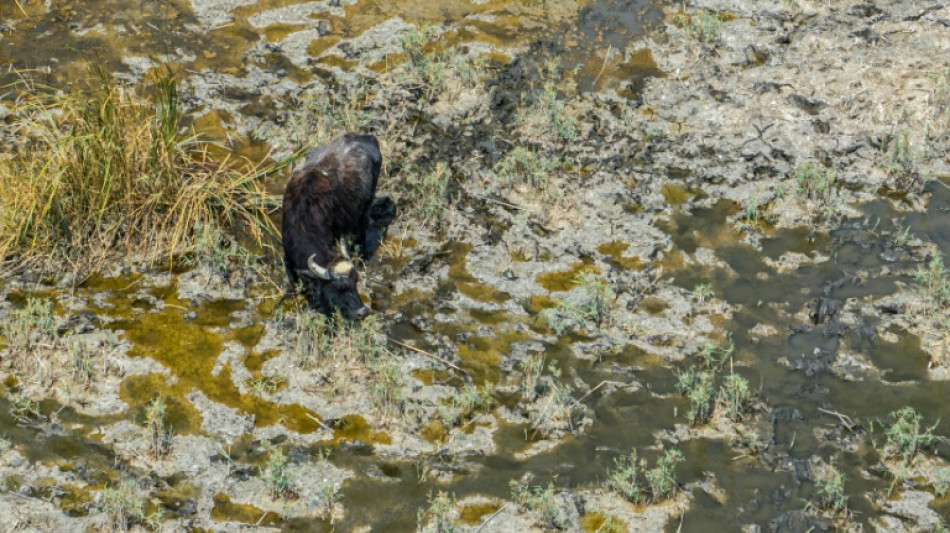
'The marshes are dead': Iraqi buffalo herders wander in search of water / Photo: Asaad NIAZI - AFP

Like his father, Iraqi buffalo herder Watheq Abbas grazes his animals in Iraq's southern wetlands, but with persistent drought shrinking marshland where they feed and decimating the herd, his millennia-old way of life is threatened.
"There's no more water, the marshes are dead," said 27-year-old Abbas, who has led his buffaloes to pasture in the marshland for the past 15 years.
"In the past, the drought would last one or two years, the water would return and the marshes would come back to life. Now we've gone without water for five years," the buffalo herder told AFP.
This year has been one of the driest since 1933, authorities have said, with summer temperatures topping 50C across Iraq, which is particularly vulnerable to the effects of climate change.
The UNESCO-listed swamplands in the country's south -- where tradition has it that the biblical Garden of Eden was located -- have sustained civilisations dating back to ancient Mesopotamia.
But the unrelenting dry spell has reduced the mythical waterways to a barren land of cracked earth, stripped of the slender reeds that once dominated the landscape.
Abbas and tens of thousands of Iraqis like him who rely on the marshes -- livestock herders, hunters and fishermen -- have watched helplessly as their source of livelihood evaporated.
At the Chibayish marshes, scarce water still fills some channels, which authorities have deepened so that animals like Abbas's 25 buffaloes could cool off.
For years, he and his herd have been on the move, heading wherever there was still water, in Chibayish or in the neighbouring province of Missan.
- 'Battle for water' -
But it has become an increasingly challenging feat. Last year, seven of his animals died.
Just recently Abbas lost another of his buffaloes which drank stagnant, brackish water that he said had "poisoned it".
The drought has been brought about by declining rainfall and soaring temperatures that increase evaporation.
But upstream dams built in Turkey and in Iran have dramatically reduced the flow of the Tigris and Euphrates rivers in Iraq and exacerbated the effects of climate change.
With the Iraqi government forced to ration water supply to ensure the country's 46 million people have enough to drink and to meet agricultural needs, the marshes appear to be at the bottom of their priorities.
"There's a battle for water" in Iraq, said environmental activist Jassim al-Assadi, from the Nature Iraq NGO.
He was among a group of activists and engineers who two decades ago sought to re-flood 5,600 square kilometres (about 2,160 square miles) of marshland.
They were part of the areas that Saddam Hussein's government had drained in the 1990s to chase out Shiite Muslim militants sheltering there.
Today, only 800 square kilometres of the marshes are submerged, Assadi said, with many residents leaving the dried-up region.
The ecosystem of the marshes is also suffering irreversible damage, with turtles, otters and migratory birds among the victims.
"We used to have 48 species of fish but now only four remain, and from 140 species of wild birds we are now down to 22," said veterinarian Wissam al-Assadi.
- 'We have nothing else' -
In collaboration with a French agriculture and veterinarian NGO, he helps treat the buffaloes, which in summer typically need be in the water for 14 hours a day and drink dozens of litres to avoid heat exhaustion.
But the reduced water flow means "the water does not renew, and salinity and pollution levels increase," the veterinarian explained.
"Animals that used to weigh 600 kilos (1,300 pounds) are now 400 or 300 kilos, their immune systems weaken and diseases multiply," he added.
The Mesopotamian water buffaloes now produce one-third of their usual output of milk, which is used to make cheese and geymar, a thick clotted cream that is a popular breakfast food in Iraq.
A UN report issued in July warned that "without urgent conservation measures", the buffalo population was "at risk of extinction".
Citing water scarcity as the cause, it said their numbers in the marshes have gone from 309,000 in 1974 to just 40,000 in 2000.
Towayeh Faraj, 50, who has lived in the hamlet of Hassja in Chibayish for the past two years, said he has been wandering the marshes for three decades to find water for his buffaloes.
"If the livestock is alive, so are we," he said.
"We have nothing else: no salary, no jobs, no state support."
He has 30 animals -- down from the 120 he began his career with, selling many off one-by-one to buy fodder for the remaining herd.
Faraj inherited the profession from his father, but the family tradition might end with him. His eldest of 16 children works for a Chinese oil company, and another is a minibus driver.
M.Fujitav--JT