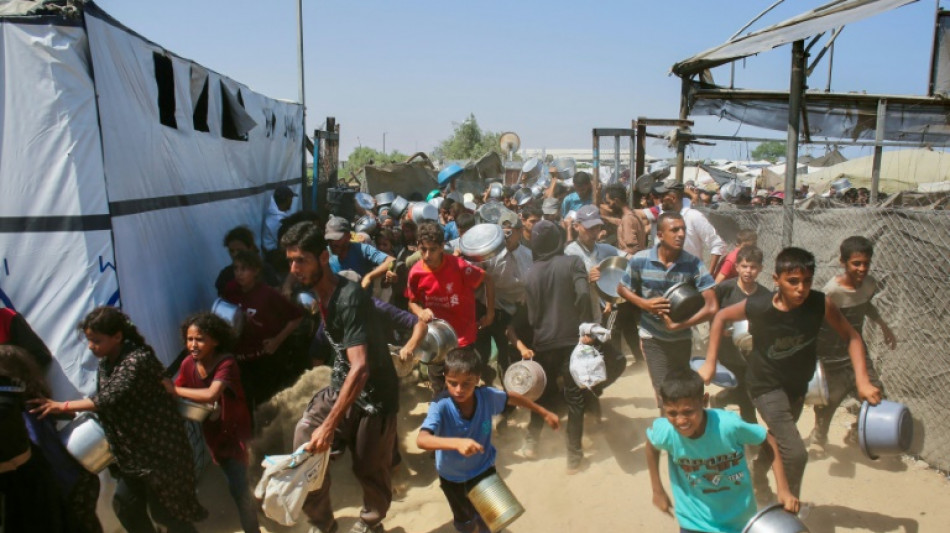
Hungry and exhausted, AFP journalists document Gaza war / Photo: - - AFP

AFP journalists in the Gaza Strip said Tuesday that chronic food shortages are affecting their ability to cover Israel's conflict with Hamas militants.
Palestinian text, photo and video journalists working for the international news agency said desperate hunger and lack of clean water is making them ill and exhausted.
Some have even had to cut back on their coverage of the war, now in its 22nd month, with one journalist saying "we have no energy left due to hunger".
The United Nations in June condemned what it claimed was Israel's "weaponisation of food" in Gaza and called it a war crime, as aid agencies urge action and warnings about malnutrition multiply.
Israel says humanitarian aid is being allowed into Gaza and accuses Hamas of exploiting civilian suffering, including by stealing food handouts to sell at inflated prices or shooting at those awaiting aid.
Witnesses and Gaza's civil defence agency, however, have repeatedly accused Israeli forces of firing on aid seekers, with the UN saying the military had killed more than 1,000 Palestinians trying to get food since late May.
- 'We have no energy' -
Bashar Taleb, 35, is one of four AFP photographers in Gaza who were shortlisted for the prestigious Pulitzer Prize earlier this year. He lives in the bombed-out ruins of his home in Jabalia al-Nazla, in northern Gaza.
"I've had to stop working multiple times just to search for food for my family and loved ones," he said. "I feel for the first time utterly defeated emotionally.
"I've tried so much, knocked on many doors to save my family from starvation, constant displacement and persistent fear but so far to no avail."
Another Pulitzer nominee, Omar al-Qattaa, 35, is staying in the remains of his wife's family's home after his own apartment was destroyed.
"I'm exhausted from carrying heavy cameras on my shoulders and walking long distances," he said. "We can't even reach coverage sites because we have no energy left due to hunger and lack of food."
Qattaa relies on painkillers for a back complaint, but said basic medicines were not available in pharmacies, and the lack of vitamins and nutritious food have added to his difficulties.
The constant headaches and dizziness he has suffered due to lack of food and water have also afflicted AFP contributor Khadr Al-Zanoun, 45, in Gaza City, who said he has even collapsed because of it.
"Since the war began, I've lost about 30 kilos (66 pounds) and become skeletal compared to how I looked before the war," he said.
"I used to finish news reports and stories quickly. Now I barely manage to complete one report per day due to extreme physical and mental fatigue and near-delirium."
Worse, though, was the effect on his family, he said.
"They're barely hanging on," he added.
- 'Hunger has shaken my resolve' -
Eyad Baba, another photojournalist, was displaced from his home in Rafah, in the south, to a tent in Deir el-Balah, in central Gaza, where the Israeli military this week began ground operations for the first time.
But he could not bear life in the sprawling camp, so he instead rented an apartment at an inflated price to try to at least provide his family some comfort.
Baba, 47, has worked non-stop for 14 months, away from his family and friends, documenting the bloody aftermath of bullets and bombs, and the grief that comes with it.
Hardest to deal with, though, is the lack of food, he said.
"I can no longer bear the hunger. Hunger has reached my children and has shaken my resolve," he added.
"We've psychologically endured every kind of death during our press coverage. Fear and the sense of looming death accompany us wherever we work or live."
Working as a journalist in Gaza is to work "under the barrel of a gun", he explained, but added: "The pain of hunger is sharper than the fear of bombing.
"Hunger robs you of focus, of the ability to think amid the horrors of war."
- 'Living the catastrophe' -
The director of Al-Shifa hospital in Gaza, Mohammed Abu Salmiya, warned on Tuesday that Gaza was heading towards "alarming numbers of deaths" due to lack of food, revealing that 21 children had died from malnutrition and starvation in the last three days.
AFP text journalist Ahlam Afana, 30, said an exhausting "cash crisis" -- from exorbitant bank charges and sky-high prices for what food is available -- was adding to the issue.
Cash withdrawals carry fees of up to 45 percent, said Zanoun, with high prices for fuel -- where it is available -- making getting around by car impossible, even if the streets were not blocked by rubble.
"Prices are outrageous," said Afana. "A kilo of flour sells for 100–150 shekels ($30-45), beyond our ability to buy even one kilo a day.
"Rice is 100 shekels, sugar is over 300 shekels, pasta is 80 shekels, a litre of oil is 85–100 shekels, tomatoes 70–100 shekels. Even seasonal fruits now -- grapes, figs -- cost 100 shekels per kilo.
"We can't afford them. I don't even remember how they taste."
Afana said she keeps working from a worn-out tent in intense heat that can reach more than 30C, but going days without food and only some water makes it a struggle.
"I move slowly, unlike before," she said. "The danger isn't just the bombing. Hunger is slowly killing our bodies and threatening our ability to carry on.
"Now, I'm not just reporting the news. I'm living the catastrophe and documenting it at the same time."
- 'I prefer death over this life' -
Media watchdog Reporters Without Borders (RSF) said on July 8 that more than 200 journalists had been killed in Gaza since Hamas's attack on Israel on October 7, 2023, which sparked the war.
Video journalist Youssef Hassouna, 48, said the loss of colleagues, friends and family had tested him as a human being "in every possible way".
But despite "a heavy emptiness", he said he carries on. "Every frame I capture might be the last trace of a life buried beneath the earth," he added.
"In this war, life as we know it has become impossible."
Zuheir Abu Atileh, 60, worked at AFP's Gaza office, and shared the experience of his journalist colleagues, calling the situation "catastrophic".
"I prefer death over this life," he said. "We have no strength left; we're exhausted and collapsing. Enough is enough."
bur-strs-az-phz/acc/smw
T.Sato--JT