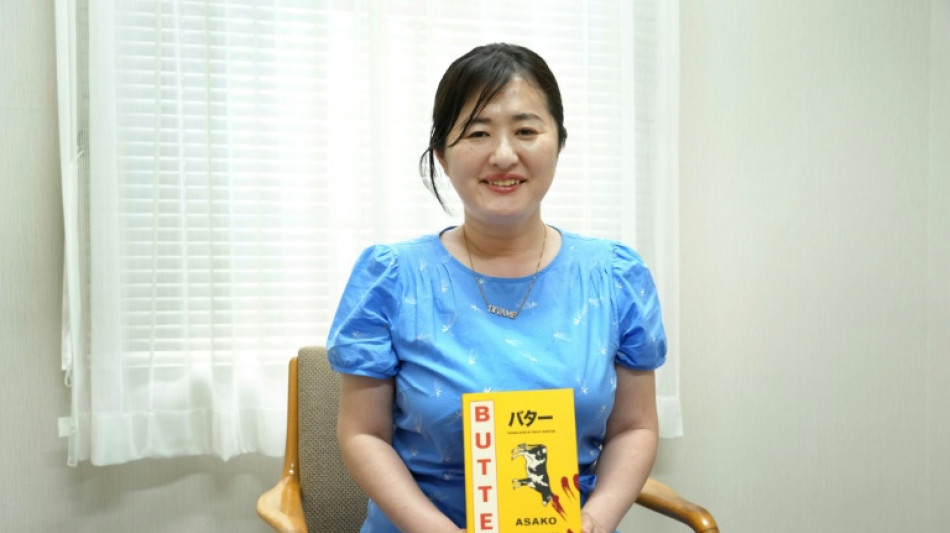
'Butter': the foodie feminist bestseller skewering sexism in Japan / Photo: Kazuhiro NOGI - AFP

Japanese writer Asako Yuzuki did not expect her novel "Butter" to capture a cult following abroad, hailed as a biting feminist critique of sexism and body-shaming.
Translated into English last year, the tale of murder and misogyny has whetted an insatiable appetite, selling 610,000 copies overseas, including 400,000 in Britain -- more than Japan -- where it won multiple awards.
Yuzuki was inspired by the real-life story of "Black Widow" Kanae Kijima, a woman sentenced to death in 2012 for poisoning three men she met on dating sites.
The sensationalised media coverage at the time largely focused on Kijima's appearance, speculating how someone described as homely and unattractive could be considered a femme fatale.
Many credited her romantic success to her homemaking prowess -- notably in the kitchen.
"When the case broke, the Japanese media mainly remembered that the suspect liked to cook and took classes ... to 'please men'," Yuzuki told AFP in an interview.
"That deeply disturbed me."
In "Butter", a journalist likewise disquieted by the portrayal of a Kijima-like character (renamed Kajii) writes to the jailed suspect, hoping to secure an exclusive interview by appealing to her gourmet tastes.
Via a letter soliciting the beef stew recipe that Kajii reportedly fed her final victim, the pair begin an intimate and life-changing relationship.
This proves a vehicle for Yuzuki to chew over the roots of misogyny in Japan, where traditional male and female roles still dominate and women are held to impossible beauty standards.
In politics and boardrooms for example, women remain rare. Japan ranks 118 out of 146 in the World Economic Forum's 2025 Gender Gap Report.
"Japan is a deeply patriarchal country. Very often, it is the father who occupies the central position within the family unit. This is the basis for laws even," Yuzuki said.
- 'Fatphobia' -
Food -- particularly butter, that artery-blocking symbol of pleasure and excess -- forms the molten core of the story.
Through sumptuous descriptions of butter-rich ramen and lavishly buttered rice, Yuzuki explores the tension between indulging appetites and the self-denial required to fulfil the societal pressure on women to stay thin.
"There is an incredible amount of adverts for weight loss, cosmetic surgery and diets. This country is obsessed with fatphobia," Yuzuki said.
It is also tough for women in Japan, where the #MeToo movement never really took off, to speak out about discrimination and sexual assault.
Shiori Ito, a journalist who took the rare step of publicly accusing a prominent Japanese TV reporter of rape -- a charge he denies -- is a case in point.
Ito's documentary "Black Box Diaries", which was nominated for an Oscar, was not released in Japan because it used material recorded clandestinely or intended for judicial use only.
"In other countries, especially the United States, from the beginning of #MeToo, many well-known journalists have seriously investigated these cases, and it is because this information was made public officially that the victims were able to be protected," Yuzuki said.
But in Japan, "women who have had the courage to speak out are reduced to the role of activists and consumed by the media within that framework," she said.
Another example is Masahiro Nakai, a boyband member and a star TV presenter accused of sexual assault. He initially disputed the facts and then apologised.
The scandal shone a spotlight on the toxic culture of young women being pressed into attending dinners and drinking parties with powerful figures.
"What strikes me is this uninterrupted chain of sexual violence, and especially that these are crimes committed within one organisation, covered up by another organisation... that of the media," Yuzuki said.
Yuzuki is convinced that change can only come from outside.
"When foreigners take up a topic, especially the English-language media, it completely changes the way it is perceived in Japan," she said.
"If the European media" continue to be interested in these issues, then "the situation could perhaps change a little."
S.Fujimoto--JT