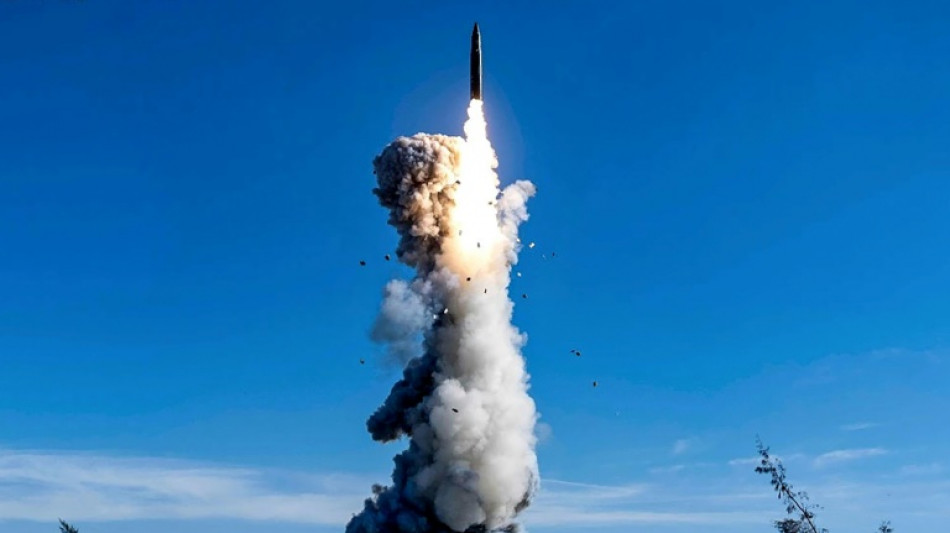
China downplayed nuclear-capable missile test: classified NZ govt papers / Photo: HANDOUT - Chinese People's Liberation Army News and Communication Center/AFP

China tried to mislead foreign governments in 2024 by playing down the importance of a nuclear-capable missile test over the Pacific Ocean, New Zealand diplomats privately warned in documents obtained by AFP.
Beijing sent shivers through the South Pacific in September 2024, when its elite Rocket Force fired a dummy warhead into the high seas near French Polynesia.
A tranche of classified government briefing notes obtained by AFP shows deep concern within the New Zealand government in the wake of the surprise launch, which China shrugged off as "routine".
It was China's first long-range missile launch over international waters in more than 40 years, the papers confirmed, serving as a blunt reminder of Beijing's potent nuclear-strike capabilities.
"We are concerned that China is characterising this as a 'routine test'," senior diplomats wrote in a memo to New Zealand's foreign affairs minister.
"It is not routine: China has not conducted this type of long-range missile test in over 40 years.
"We do not want to see this test repeated."
China's military played down the test as a "legitimate and routine arrangement for military training".
Behind the scenes, New Zealand diplomats privately decried China's "mischaracterisation".
"As this is the first time that China has undertaken such an action in the Pacific in several decades, it is a significant and concerning development," they wrote in one of the briefing documents.
AFP applied to access the heavily redacted documents -- written between September and October last year -- under New Zealand's Official Information Act.
They were classified as "Restricted", which protects government information with diplomatic or national security implications.
- Nuclear scars -
China has been seeking to cement its presence in the strategically important South Pacific, showering developing island nations with new hospitals, freshly paved roads, and gleaming sports stadiums.
But rarely has it so obviously flexed its military might in the region, where the United States, Australia and New Zealand have long been the security partners of choice.
"We have again asked China why it conducted the test at this time, and why it chose to terminate the missile test in the South Pacific," New Zealand diplomats wrote.
China's Rocket Force launched the intercontinental ballistic missile with little warning on September 25, 2024.
Photos released by China showed a projectile streaking into the sky from a secret location atop a billowing plume of smoke.
It appeared to be one of China's advanced Dong Feng-31 missiles, analysts said, a weapon capable of delivering a thermonuclear warhead.
The long-range missile splashed into a patch of ocean long designated a nuclear-free zone under an international treaty.
Pacific island nations remain deeply scarred by the nuclear tests that shook the region in the decades following World War II.
"This is the first time that we are aware of a test of a nuclear-capable missile terminating within the zone since its establishment in 1986," the New Zealand diplomats wrote.
- Forceful reminder -
China alerted the United States, the United Kingdom, France, Australia and New Zealand before the test.
But there was only a vague indication of what it would do, according to a separate batch of Australian government documents obtained by AFP.
"Beijing advised us of a planned activity the evening prior to the launch, but specific details were not forthcoming," Australian defence officials wrote in November last year.
Pacific island nations, however, were not provided with advance notice of the launch, New Zealand diplomats noted.
Following the launch, Japan publicly voiced "serious concern", Australia said the test risked "destabilising" the South Pacific, and Fiji urged "respect for our region".
Pacific nation Kiribati, one of China's warmest friends in the region, said the South Pacific Ocean should not be a proving ground for jostling big powers.
"The high seas in the Pacific are not isolated pockets of oceans... we appeal to all countries involved in weapon testing to stop these acts to maintain world peace and stability," read a government statement at the time.
China foreign policy expert Nicholas Khoo said the intercontinental ballistic missile (ICBM) test was particularly significant because it took place in the South Pacific.
"Since 1980, China's ICBM tests have taken place within Chinese territory," he told AFP.
"The test is a reminder to regional states that China is a 'full spectrum' power that has economic and military power. It is a peer with the US."
Harvard University researcher Hui Zhang said it was a forceful reminder of China's nuclear strength.
"The test shows that the Rocket Force has an operational and credible nuclear force that can help ensure China's ability to maintain a strong nuclear deterrent," he wrote last year for the Bulletin of the Atomic Scientists.
"The rare public ICBM test seems to have been specifically aimed at dissuading Washington from using nuclear weapons in a potential conflict across the Taiwan Strait."
China's Ministry of Foreign Affairs said that the "facts are clear and no one has been misled".
"The missile test is a routine part of annual military training, in compliance with international law and international norms," it said in a statement.
Y.Watanabe--JT