
Trump carves up world and international order with it / Photo: - - TASS/AFP

By casting doubt on the world order, Donald Trump risks dragging the globe back into an era where great powers impose their imperial will on the weak, analysts warn.
Russia wants Ukraine, China demands Taiwan and now the US president seems to be following suit, whether by coveting Canada as the "51st US state", insisting "we've got to have" Greenland or kicking Chinese interests out of the Panama Canal.
Where the United States once defended state sovereignty and international law, Trump's disregard for his neighbours' borders and expansionist ambitions mark a return to the days when the world was carved up into spheres of influence.
As recently as Wednesday, US defence secretary Pete Hegseth floated the idea of an American military base to secure the Panama Canal, a strategic waterway controlled by the United States until 1999 which Trump's administration has vowed to "take back".
Hegseth's comments came nearly 35 years after the United States invaded to topple Panama's dictator Manuel Noriega, harking back to when successive US administrations viewed Latin America as "America's backyard".
"The Trump 2.0 administration is largely accepting the familiar great power claim to 'spheres of influence'," Professor Gregory O. Hall, of the University of Kentucky, told AFP.
Indian diplomat Jawed Ashraf warned that by "speaking openly about Greenland, Canada, Panama Canal", "the new administration may have accelerated the slide" towards a return to great power domination.
- The empire strikes back -
Since the end of the Cold War, the United States has posed as the custodian of an international order "based on the ideas of countries' equal sovereignty and territorial integrity", said American researcher Jeffrey Mankoff, of the Center for Strategic and International Studies.
But those principles run counter to how Russia and China see their own interests, according to the author of "Empires of Eurasia: how imperial legacies shape international security".
Both countries are "themselves products of empires and continue to function in many ways like empires", seeking to throw their weight around for reasons of prestige, power or protection, Mankoff said.
That is not to say that spheres of influence disappeared with the fall of the Soviet Union.
"Even then, the US and Western allies sought to expand their sphere of influence eastward into what was the erstwhile Soviet and then the Russian sphere of influence," Ashraf, a former adviser to Indian Prime Minister Narendra Modi, pointed out.
But until the return of Trump, the United States exploited its position as the "policeman of the world" to ward off imperial ambitions while pushing its own interests.
Now that Trump appears to view the cost of upholding a rules-based order challenged by its rivals and increasingly criticised in the rest of the world as too expensive, the United States is contributing to the cracks in the facade with Russia and China's help.
And as the international order weakens, the great powers "see opportunities to once again behave in an imperial way", said Mankoff.
- Yalta yet again -
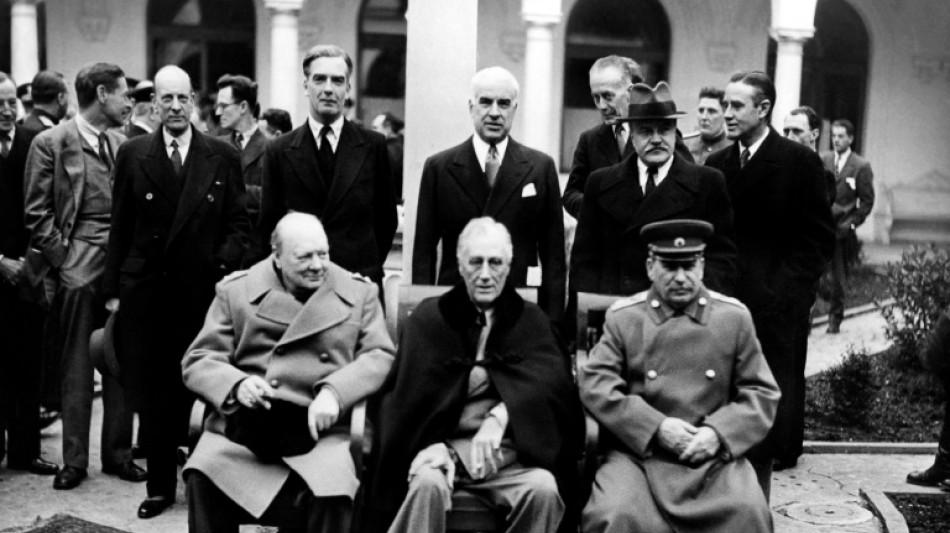
As at Yalta in 1945, when the United States and the Soviet Union divided the post-World War II world between their respective zones of influence, Washington, Beijing and Moscow could again agree to carve up the globe anew.
"Improved ties between the United States and its great-power rivals, Russia and China, appear to be imminent," Derek Grossman, of the United States' RAND Corporation think tank, said in March.
But the haggling over who gets dominance over what and where would likely come at the expense of other countries.
"Today's major powers are seeking to negotiate a new global order primarily with each other," Monica Toft, professor of international relations at Tufts University in Massachusets wrote in the journal Foreign Affairs.
"In a scenario in which the United States, China, and Russia all agree that they have a vital interest in avoiding a nuclear war, acknowledging each other's spheres of influence can serve as a mechanism to deter escalation," Toft said.
If that were the case, "negotiations to end the war in Ukraine could resemble a new Yalta", she added.
Yet the thought of a Ukraine deemed by Trump to be in Russia's sphere is likely to send shivers down the spines of many in Europe -- not least in Ukraine itself.
"The success or failure of Ukraine to defend its sovereignty is going to have a lot of impact in terms of what the global system ends up looking like a generation from now," Mankoff said.
"So it's important for countries that have the ability and want to uphold an anti-imperial version of international order to assist Ukraine," he added -- pointing the finger at Europe.
"In Trump's world, Europeans need their own sphere of influence," said Rym Momtaz, a researcher at the Carnegie Endowment for Peace.
"For former imperial powers, Europeans seem strangely on the backfoot as nineteenth century spheres of influence come back as the organising principle of global affairs."
S.Yamamoto--JT


