US midterms and the strange demise of the political center / Photo: SAUL LOEB - AFP/File

A giant Donald Trump mural on the front lawn. An anti-Biden rap video. A TV ad featuring an assault rifle and a vow to do "whatever it takes" to restore America to its "former glory."
It isn't campaigning as Lincoln or Kennedy knew it, but it worked for midwestern underdog candidate J.R. Majewski, and analysts worry it could be a glimpse of future US primary election seasons in a country that is losing its moderate political center.
Establishment Republicans in Majewski's northwest Ohio swing district -- where he is vying to win a US House seat in November's midterm elections -- spent six-figure sums trying to get more moderate rivals nominated.
But the Trump-backed air force veteran and conspiracy theorist won anyway, seeing off more favored state lawmakers after being endorsed by Paul Gosar, a far-right congressman.
In South Carolina, another Trump-endorsed hopeful, Katie Arrington, has called for disbanding the US Department of Education, President Joe Biden's impeachment and the arrest of government Covid-19 advisor Anthony Fauci.
She is challenging first-term Republican congresswoman Nancy Mace, who is out of favor with Trump after blaming him for the 2021 US Capitol assault.
The races are early fronts in a battle already playing out in Republican and Democratic primary contests across America, as establishment politicians find their hopes of representing their parties in the midterms threatened by more extreme challengers.
In Pennsylvania, state senator and election denier Doug Mastriano, who helped Trump try to overturn the state's 2020 results that favored Biden, swatted away several less controversial Republicans Tuesday to win the party's nomination for governor.
But Trump, whose status as political kingmaker is being tested, also experienced setbacks Tuesday including in Idaho, where his favorite gubernatorial candidate Janice McGeachin, who reportedly said this month that "Christ will reign in the state," lost to the incumbent.
In coming weeks Republican moderates, pragmatists and compromisers will face Trump-backed culture warriors in several races, in Illinois, Michigan, Minnesota, South Carolina and Washington.
- 'Winner-take-all' -
Across the aisle, Pennsylvania state congresswoman and community organizer Summer Lee, who identifies as a "Democratic Socialist," was narrowly leading the field after Tuesday's primary to replace retiring moderate Mike Doyle.
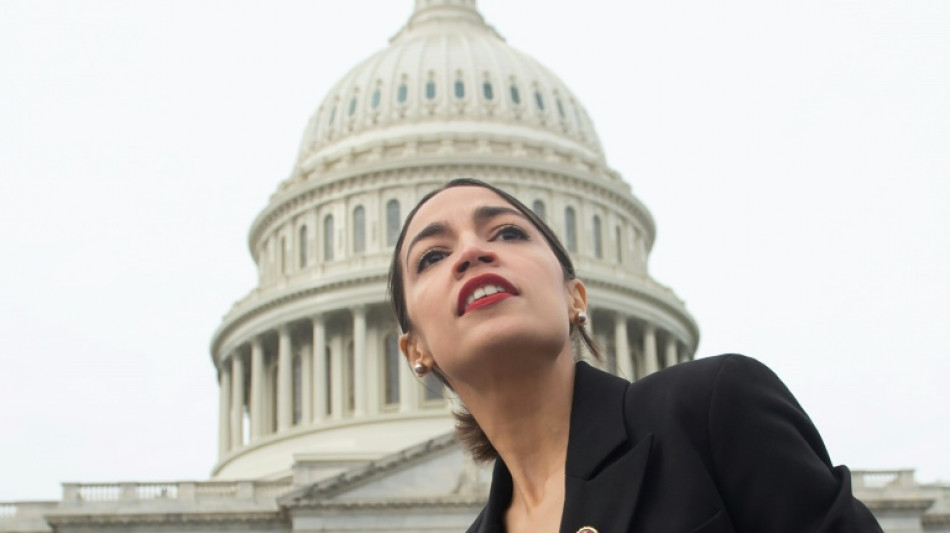
She is backed by Justice Democrats, the group that sponsored leftist New York congresswoman Alexandria Ocasio-Cortez's first campaign and is sending a new generation of leftist legislators to Washington.
Ocasio-Cortez is the most prominent member of the so-called "Squad" -- a group of staunchly progressive Democrats poised for gains in seats and influence in November despite the party's likely loss of the House of Representatives.
As many as six Squad-aligned candidates have realistic chances of winning House seats this cycle, against more middle-of-the-road Democrats.
The numbers sound small, but lawmakers on the fringes tend to have outsized influence on political discourse because they make all the noise and attract attention.
The Common Ground Committee, which campaigns to reduce incivility in politics, says it observed a coarsening of public discourse following 2008's global financial meltdown.
"There seems to be an increasing level of vitriol generated by a 'winner-take-all' attitude in Congress that actively discourages working with those across the aisle and is exacerbated by the highly polarized cable news media," co-founder Bruce Bond told AFP.
"Many things have come together to encourage polarization and people need to stop supporting it."
- 'Bell-shaped curve' -
A Pew Research Center analysis found Democrats and Republicans are further apart today than at any time in the past 50 years.
In 1972, 144 House Republicans were less conservative than the most conservative Democrat, and 52 House Democrats were less liberal than the most liberal Republican, according to the analysis.
But that common ground began to shrink, and since 2002, there has been no overlap at all. In the Senate, that overlap ended in 2004.
"The polarization has changed American public opinion from a bell-shaped curve -- where most voters and the parties were in the center -- to a bimodal curve with the center of the two parties drifting apart and ideologically purifying," political scientist David Schultz told AFP.
The professor, who teaches at Minnesota liberal arts college Hamline University, believes economic restructuring, race, social issues and technology are driving the diversification -- with Trump "merely the personification of trends already occurring."
Progressive political consultant Zee Cohen-Sanchez blames the cash that has flooded politics in recent years, incentivizing candidates to carve out controversial positions that gain attention and funding.
"Because our elections have become astronomically expensive, people seek to make fast money rather than raising money from everyday Americans," Cohen-Sanchez said.
"That's where things get dangerous."
K.Yamaguchi--JT