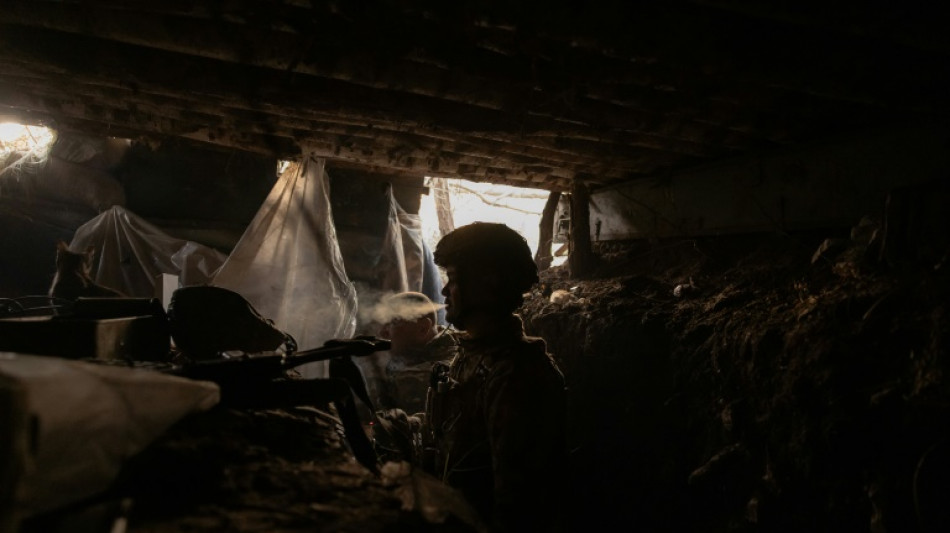
On southern front, Ukraine's struggle to pierce Russian lines / Photo: Roman PILIPEY - AFP

When Ukraine announced it had re-captured the village of Robotyne, its message to the world was that it had found a way to pierce Russian lines on the southern front.
Six weeks on, no such breakthrough has materialised and soldiers from the 65th brigade that led the assault admit they do not fully control the village.
The recapture of the small village in the Zaporizhzhia region was announced in August as a strategic victory in the counteroffensive.
Yet eight Ukrainian soldiers involved in the fighting told AFP their forces were only inching forward with heavy losses against a Russian army entrenched behind heavily fortified positions.
Speaking in an area usually closed to media, they complained of a lack of manpower, ammunition and drones.
Igor Korol, the heavily tattooed commander of the brigade's first battalion, spoke calmly but did not mince his words.
For him, the announcement of the capture of Robotyne on August 28 was primarily a PR move, since the village, occupied since early in the war, has no strategic value.
"We could have gone around it," he said, speaking to AFP in an area near the front line.
"We love big announcements, quick victories. The reality is different," said the commander who uses the call sign "Morpekh" (Marine).
- 'Death 100 percent' -
Korol said his men are still not able to move freely around the area because of Russian fire, even though they hold the territory, calling it a "gray zone".
At dawn, small groups of soldiers could be seen advancing through the coppices that dot the area to attack Russian positions.
On the day that AFP reporters visited, they were deployed on the outskirts of the next village along -- Novokropivka -- two or three kilometres away.
"Moving by day means death -- 100 percent," Korol said.
Every time there is shelling "there are victims, we lose men".
While Russian forces are no longer in Robotyne, the area is within their range so large-scale infantry operations with armoured vehicles are impossible.
The Ukrainian army has the ambitious aim of reaching the Azov Sea, cutting through the land bridge between southern and eastern regions occupied by Russia.
A victory like that could force Russia to retreat as it would cut supply lines.
- 'Surovikin Line' -
For the Kremlin, the fact that Ukraine has only managed to re-capture a few dozen square kilometres since launching a counter-offensive in June is proof of the failure of this large-scale operation.
The first main city after Robotyne is Tokmak, around 30 kilometres (20 miles) away. The sea is 70 kilometres away.
Russia has built up heavy defences including underground shelters, trenches, tank traps and minefields.
Ukrainian forces are only able to inch forwards -- and are always under enemy fire.
The Russian defences have been nicknamed the "Surovikin Line" -- after General Sergei Surovikin, who commanded Russian forces in Ukraine at the time they were built up.
The Ukrainian army broke through the first defensive lines in some places this summer but the main defences have held strong.
Autumn rains and mud and winter snow and ice in coming months will make the Ukrainians' task even harder.
The danger from the sky is also constant -- aerial bombs, shells and explosive drones rain down on Ukrainian soldiers every time they try to advance.
- 'Thicket by thicket' -
Leonid, a 44-year-old grenade specialist with the call sign "Miron", said soldiers can only advance in the "three or five minutes" between enemy barrages.
"There isn't any close-quarters combat," he said.
Russians send over "120 mm and 82 mm mortars, and 152 mm artillery, kamikazes (drones) and KABs", a type of laser-guided bomb.
"Poltava", a deputy commander of the first battalion, said the Russian army "spares nothing in terms of ammunition or bombs".
As a result, the Ukrainian advances are slow, with heavy losses.
"We advance gradually, thicket by thicket, not as quickly as we would like... It's very tough. We lose a lot of our men," he said.
Ukrainian and Russian authorities do not give any figures on military casualties.
Soldiers from the 65th brigade said Russia fires 10 shells for every "one or two" from their side. The same goes for drones.
"We are fighting against... a massive country. They have more men, more equipment," said Oleksandr, a 27-year-old soldier with the call sign "Storm".
"When they bomb the undergrowth, we take shelter wherever we can... When it's over we know we can move and if possible we move forward."
- 'Cost is very high' -
Ukraine has pushed back against suggestions from its Western supporters that its territorial gains have been insufficient.
It also baulks at voices in the United States and EU that favour reducing arms supplies.
Kyiv's view is that the troops' difficulties are due to a lack of support and delays in supplying Western weapons.
The F-16 fighter jets it has been promised would challenge Russia's aerial supremacy and its "Surovikin Line" and provide air cover for infantry advances.
Without air cover, Ukraine's military can only move very slowly.
"The price is the life of our men... and we have very few (reserves) of men," Korol said.
Mykola or "Doc", a combat paramedic, acknowledged "the cost is very high", describing evacuations of wounded men under fire.
"War is blood, sweat, dirt, stench. You don't see the smell on a screen," said the 47-year-old, who worked in a fintech company before the war.
Poltava said the hardest thing was speaking to the loved ones of soldiers killed in combat whose bodies have not been retrieved.
"They call all the time and ask when we can get the bodies out, but they are in places where I can't send anyone. It's very dangerous and we risk losing even more guys," he said.
- 'We know why' -
Even so, the men of the 65th brigade would not dream of giving up the fight.
For them, the war can only end one way -- with Russia's defeat and the recapture of all the occupied land.
"We know why we're doing this," said "Doc".
Mikhail, a 28-year-old who uses the call sign "Kapa", was among the first to enter Robotyne this summer.
Before being deployed to the southern front, he fought in the Kharkiv region in the northeast and took part in the bloody battle for Bakhmut in the Donbas.
He believes Russia decided to stop trying to advance and build up its defences after a series of retreats in autumn 2022.
"They understood they would not be able to take any more land and hold it, so they've entrenched here for the long haul," he said.
The result is that, since Russia's retreat from the city of Kherson in November 2022, there has been very little change on the front line for nearly a year.
This does not dent the motivation of the troops sent to attack the Surovikin Line, Mikhail said.
"The lads who come here, they know why they are here. They're here to work: to move the enemy, launch assaults, not to sit in a ditch."
Y.Ishikawa--JT