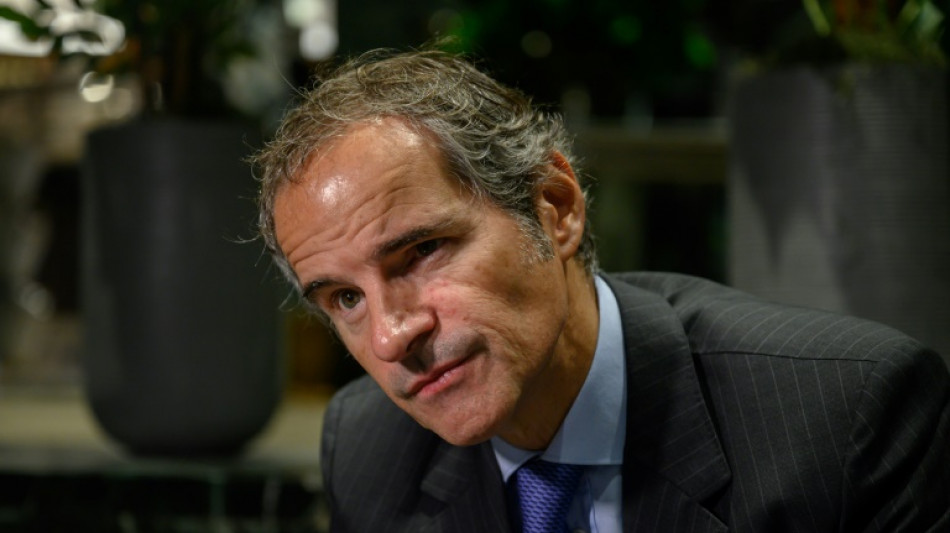
UN nuclear chief urges Iran to allow inspectors / Photo: Ed JONES - AFP

The head of the United Nations nuclear watchdog on Monday urged Iran to reconsider its decision to deny access to top UN inspectors, telling AFP that failure to cooperate will carry severe consequences.
The International Atomic Energy Agency said Saturday that Iran had withdrawn accreditation from several inspectors, a move Teheran described as retaliation for "political abuses" by the United States, France, Germany and Britain.
"We have to ask them to review this decision," IAEA chief Rafael Grossi said in an interview with AFP.
"If they do not cooperate with the IAEA, they will not get what they want: the assurances they want to see, the confirmation they want to see, the approval of the international community."
Grossi also warned that military activity has been increasing around Ukraine's Zaporizhzhia nuclear power plant, occupied by Russian forces since March 2022.
"Military operations are increasing in the area, my inspectors are telling me that the level of military activity is palpable," Grossi told AFP. "It's loud, and it's getting closer."
He added: "Every day that passes without a nuclear accident is a good day for us."
Since the start of June, Kyiv's troops have led a counteroffensive in the area near Zaporizhzhia in the east and south of the country in an attempt to retake territory held by Russia since the start of the invasion in February 2022.
Kyiv says it is vital to regain control of the Zaporizhzhia plant, Europe's largest nuclear plant, with a capacity of 6,000 megawatts, in order to supply electricity to Ukraine.
Grossi said that a direct attack on the plant or the interruption of external power supply could lead to a nuclear accident with radiological consequences.
"So, what we need to do is to guarantee... that there is no deep degradation of the situation as we see it now," Grossi said.
- 'So far so good' -
Turning to North Korean leader Kim Jong Un's recent trip to Russia and his meetings with President Vladimir Putin, Grossi expressed confidence that Moscow would not share nuclear technologies with Pyongyang.
Kim's tour of Russia's far east last week fanned Western fears that isolated, nuclear-armed Pyongyang could provide Moscow with weapons for its war in Ukraine. During the trip, North Korea's leader inspected everything from Russian space rockets to submarines.
"Personally, I don't have any indication and any reason to believe that meetings of this kind lead to proliferation risks," Grossi said.
Finally, Grossi vowed that his agency will continue checking the release of treated water from the stricken Fukushima nuclear plant in Japan, amid protests by China and concerns from the public.
"We are checking this every day. So far so good," Grossi said. "We do not take things for granted. We go and check and then we tell things as they are."
Japan began on August 24 discharging into the Pacific some of the 1.34 million tons of wastewater that has collected since a tsunami crippled the Fukushima facility more than a decade ago.
The water, equivalent to 540 Olympic pools, had been used to cool the three reactors that went into meltdown in 2011, in one of the world's worst nuclear catastrophes.
Japan insists that the discharge is safe, China banned all seafood imports from its neighbor, accusing it of treating the sea like a "sewer."
T.Shimizu--JT