Ukraine war raises spectre of conscription in Germany

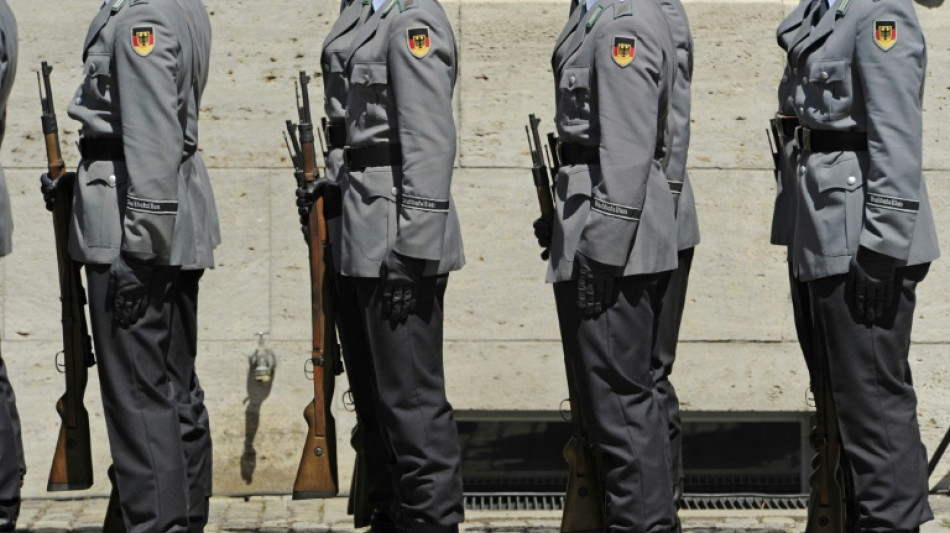
Germany scrapped compulsory military service just over 10 years ago, but the conflict in Ukraine has reignited the debate around whether young men and women should be required to fight for their country.
Conscription was introduced in Germany in 1956 with men over 18 expected to serve in the army for a year, though they could claim exemption due to moral objections.
The practice was gradually wound down and finally scrapped in 2011 as part of moves to save money, and in line with Germany's traditionally cautious approach to defence as a result of its post-war guilt.
But Russia's invasion of Ukraine last week has led to a wholesale shift in Germany's approach to its armed forces, known as the Bundeswehr, and led to renewed calls for some form of military service.
Wolfgang Hellmich, a politician for Chancellor Olaf Scholz's centre-left Social Democrats (SPD), called for an "urgent" debate on the issue in an interview with the Rheinische Post newspaper on Tuesday.
Compulsory military service would help "promote public spirit", he said, also calling for careers in the Bundeswehr to be made more attractive to young people.
- Defence spending up -
Patrick Sensburg, the president of the German Reservists' Association, has called for the reintroduction of military service through a general framework for both men and women.
This could take the form of "one year in which young people who are of age and have completed their education do something for the state and the community", he told the Rheinische Post newspaper.
Voices from the conservative CDU, now in opposition after 16 years in power under Angela Merkel, have also come out in favour of conscription.
In the state of Lower Saxony, CDU members have put together a paper calling for the reintroduction of military service as "a decisive signal for ensuring an effective military deterrence," according to Die Welt newspaper.
CDU MP Carsten Linnemann told the Bild daily he was in favour of "a year of compulsory service for young men and women after completing their schooling".
This could also take the form of a year of service in the social care sector or the emergency services, he said.
"This would strengthen the resilience of our society to crises" and promote skills that are necessary in "these persistently difficult times", he said.
However, the reintroduction of military service would require a two-thirds majority vote in the Bundestag lower house of parliament, and not all MPs are in favour.
- 'Major deficits' -
Eva Hoegl, a Social Democrat and the Bundestag's defence commissioner, has called the debate "a theoretical discussion that does not help in the current situation".
And Florian Hahn of the CSU, the CDU's Bavarian sister party, said Germany needs "technology and weapons systems", not just an increased head count.
Germany has steadily reduced the size of its army since the end of the Cold War, from around 500,000 at the time of reunification in 1990 to just 200,000 today.
But in a landmark speech on Sunday, Social Democrat (SPD) Chancellor Olaf Scholz said the world was entering a "new era". He promised an extra 100 billion euros ($113 billion) of investment in the chronically underfunded Bundeswehr in 2022 alone.
Scholz has also dramatically reversed Germany's stance on weapons exports as a result of the conflict, as well as committing to spend more than two percent of GDP on defence.
According to Joachim Krause, a professor of political science at the University of Kiel, NATO will have to "switch back to a deterrence strategy" as a result of Russia's offensive in Ukraine.
Germany will have no choice but to comply with this, he said in an interview with TV channel Sat1, which will force it to face up to "major deficits" in its armed forces.
"I think we might have to reintroduce conscription," he said.
K.Yamaguchi--JT