Tensions brew in Germany over refugee arrivals / Photo: Femke COLBORNE - AFP

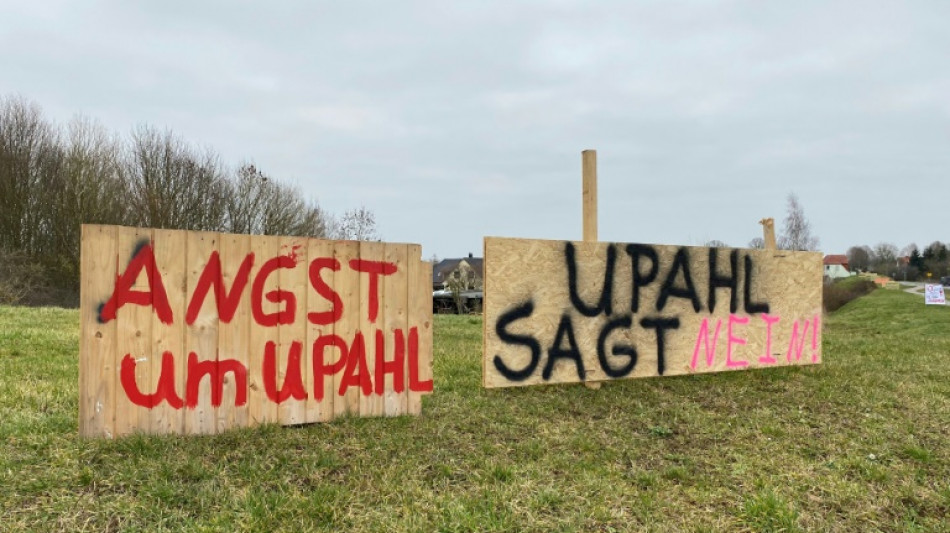
The main road through the northern German village of Upahl is lined with wooden placards, their bright letters standing out against the grey sky and muddy fields.
"Upahl says no", reads one. "Think of our children!" says another.
The signs are in opposition to a planned centre for 400 asylum seekers in the town with a population of 500.
Like many communities across Germany, the district of Northwestern Mecklenburg, where Upahl is located, has witnessed an increase in arrivals of asylum seekers and people with official refugee status.
Almost 218,000 asylum applications were filed in Germany last year -- more than twice as many as in 2020 and the biggest number since the influx of 2015-16.
In 2022, the largest number of people seeking asylum hailed from war-torn Syria and Afghanistan, followed by Turkey and Iraq.
In addition, more than a million people arrived from Ukraine. The latter were granted a special status that means they do not need to apply for asylum to be allowed to remain in Germany.
To cope with the arrivals, sports halls have been requisitioned in Northwestern Mecklenburg as temporary housing for newcomers.
- Quiet life -
But with current capacity exhausted and between 20 and 30 new arrivals every week, local officials voted in January to set up a new centre in Upahl using converted transport containers.
It is due to open in March.
"Due to the many people who have come to us (from Ukraine) plus the asylum seekers... we have a situation that we can no longer cope with," Tino Schomann, chief administrative officer for the district, told AFP.
"I need more places, more capacity," he said.
But some locals are opposed to the centre have staged several demonstrations against the plans.
"Life in Upahl is so beautiful because everything is very quiet," said Jan Achilles, 46, an environmental analyst who is also a community representative.
"When 500 people, whether refugees or Germans or whatever, are crammed together in a heap, problems arise."
Retired truck driver Bernd Wien, 66, who has lived in Upahl since 1980, has been at all the demos.
"We just want to live here quietly, to enjoy our retirement," he said.
After months of pleading from local officials across Germany for more help to deal with new arrivals, Interior Minister Nancy Faeser is hosting a meeting on Thursday to address the issue.
Ahead of the discussions, Faeser promised they would help offer an overview of the "joint humanitarian effort" required.
- Far-right fears -
In 2015-16, the far-right Alternative for Germany (AfD) party harnessed anger at Germany's influx of asylum seekers to win votes and ultimately enter parliament for the first time.
Right-wing extremists have been spotted at recent protests in Upahl and elsewhere, and fears are growing that the current tensions could provide a further boost to the far-right party.
"The general situation is ultimately far more dramatic than in 2015 due to the war, inflation, economic crises and new refugees," Hajo Funke, a political scientist at the Free University of Berlin, told AFP.
According to a recent survey by pollster INSA, around half of Germans -- 51 percent -- believe the country is taking in too many refugees.
However, the AfD's support is likely to have reached a plateau because "the fear of violent fascism is widespread among more than 80 percent of the German population", Funke said.
Upahl resident Anika Reisch, 38, has sympathy for people coming to the village "who are traumatised, who are worried about the future".
But the mother of two, who runs an insurance business around the corner from the planned new centre, still doesn't want it on her doorstep.
"It can't go well for the people who come here either. They have no privacy at all. They can't... come to terms with everything they have experienced. That can't go well for either side," she said.
M.Sugiyama--JT