The Japan Times - NATO debates raising defence spending target

EUR -
AED 4.048988
AFN 71.653352
ALL 90.233152
AMD 397.442801
ANG 1.973656
AOA 1011.960474
ARS 1704.382464
AUD 1.628051
AWG 1.984235
AZN 1.878376
BAM 1.951036
BBD 2.220877
BDT 137.145087
BGN 1.95499
BHD 0.415753
BIF 3312.570815
BMD 1.102353
BND 1.419813
BOB 12.873388
BRL 6.246268
BSD 1.102607
BTN 103.857962
BWP 15.412153
BYN 3.303388
BYR 21606.119128
BZD 2.217684
CAD 1.573224
CDF 2551.947633
CHF 0.924565
CLF 0.027875
CLP 1097.084206
CNY 7.354624
CNH 7.358449
COP 3659.778945
CRC 494.093407
CUC 1.102353
CUP 26.463016
CVE 110.401089
CZK 24.405329
DJF 195.910612
DKK 7.476493
DOP 66.917109
DZD 151.273137
EGP 58.978161
ERN 16.535295
ETB 177.534385
FJD 2.483877
FKP 0.832628
GBP 0.834294
GEL 2.855525
GGP 0.832628
GHS 12.925133
GIP 0.832628
GMD 81.574515
GNF 9764.096088
GTQ 8.429301
GYD 230.683524
HKD 8.648676
HNL 29.708842
HRK 7.531237
HTG 144.594927
HUF 364.882711
IDR 20101.848202
ILS 3.545943
IMP 0.832628
INR 103.905536
IQD 1668.962467
IRR 2109614.310597
ISK 136.615035
JEP 0.832628
JMD 174.224538
JOD 0.781612
JPY 176.073379
KES 143.361434
KGS 96.384792
KHR 4497.600695
KMF 492.752185
KPW 992.118101
KRW 1473.366503
KWD 0.34335
KYD 0.918844
KZT 491.483094
LAK 24836.013852
LBP 98715.713034
LKR 366.73942
LRD 187.400397
LSL 18.663257
LTL 3.254962
LVL 0.666803
LYD 7.104708
MAD 10.981314
MDL 20.028816
MGA 5059.800729
MKD 61.545168
MMK 2314.830962
MNT 3972.970265
MOP 8.911016
MRU 44.759659
MUR 52.494468
MVR 16.980358
MWK 1913.685217
MXN 20.433771
MYR 4.504329
MZN 70.444469
NAD 18.663252
NGN 1481.088858
NIO 40.570694
NOK 10.552253
NPR 166.167676
NZD 1.994849
OMR 0.424561
PAB 1.102607
PEN 3.75135
PGK 4.97327
PHP 70.506912
PKR 304.914924
PLN 4.405592
PYG 6843.288459
QAR 4.01725
RON 5.348511
RSD 117.465677
RUB 91.30685
RWF 1627.073053
SAR 4.160787
SBD 8.926521
SCR 15.372648
SDG 663.069392
SEK 11.106249
SGD 1.418953
SHP 0.830054
SLE 25.409646
SLL 23115.795624
SOS 631.101139
SRD 41.327623
STD 22816.481805
STN 24.472237
SVC 9.648438
SYP 14332.794295
SZL 18.663243
THB 37.34225
TJS 10.171722
TMT 3.858236
TND 3.316433
TOP 2.654202
TRY 55.49477
TTD 7.484722
TWD 36.257938
TZS 2920.045358
UAH 50.132575
UGX 4553.879273
USD 1.102353
UYU 44.690863
UZS 13271.228337
VES 1006.315196
VND 28358.582532
VUV 132.649143
WST 3.080921
XAF 655.957
XAG 0.022553
XAU 0.000284217451
XCD 2.979165
XCG 1.987211
XDR 0.779421
XOF 655.957
XPF 119.331742
YER 260.762006
ZAR 18.713826
ZMK 9922.503926
ZMW 22.543641
ZWL 354.957222
SSP 6555.153946
MXV 2.294737
  • RYCEF

    0.1000

    19.81

    +0.5%

  • VOD

    -0.2500

    16.33

    -1.53%

  • CMSC

    -0.2800

    20.12

    -1.39%

  • RBGPF

    -2.0000

    65

    -3.08%

  • RIO

    -0.2500

    94.16

    -0.27%

  • BTI

    -1.2000

    54.85

    -2.19%

  • NGG

    -0.3000

    74.94

    -0.4%

  • GSK

    -0.3500

    49.35

    -0.71%

  • BCE

    -0.4200

    20.14

    -2.09%

  • CMSD

    -0.3400

    19.93

    -1.71%

  • BP

    -0.9100

    43.52

    -2.09%

  • RELX

    0.1700

    33.24

    +0.51%

  • BCC

    -0.6200

    75.97

    -0.82%

  • AZN

    -1.9400

    164.21

    -1.18%

  • JRI

    0.0000

    10.77

    0%

NATO debates raising defence spending target
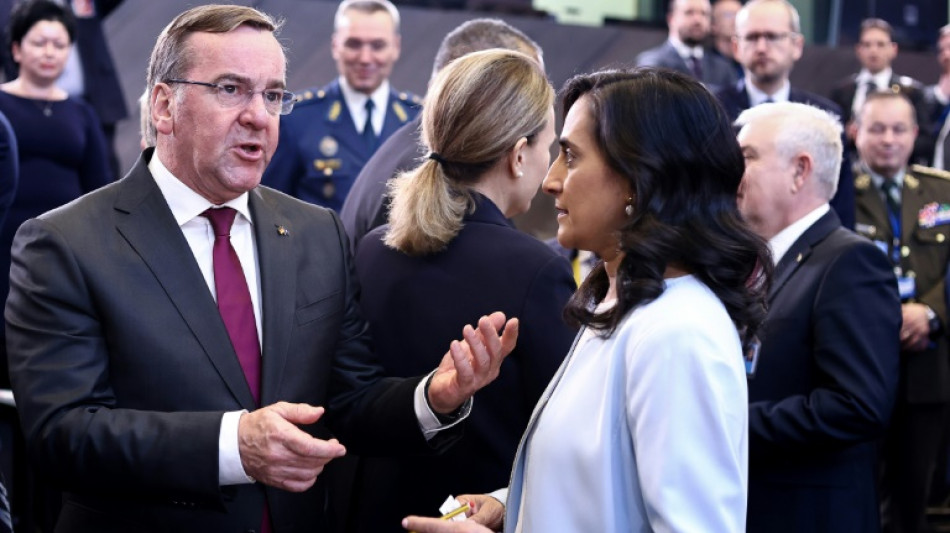
NATO debates raising defence spending target / Photo: Kenzo TRIBOUILLARD - AFP

NATO debates raising defence spending target

NATO members relaunched debate Wednesday on the thorny issue of ramping up national defence spending targets as Russia's war on Ukraine has upended security.

Text size:

Moscow's nearly year-long all-out invasion of its neighbour has seen a string of European allies commit to spending billions more on their armed forces.

Some at the US-led Western military alliance are now pushing to enshrine the increases by using an upcoming summit in Vilnius in July to raise NATO's current target of two percent of GDP.

Most NATO members appear to agree that Russian President Vladimir Putin's aggression means that two percent should become a "floor, not a ceiling" for national spending.

"I believe that simply wanting to approach the two percent target will not be enough. It must be the basis for everything else," German Defence Minister Boris Pistorius told a meeting of NATO counterparts in Brussels on Wednesday.

But some nations are reluctant to make the target too ambitious or the commitment too concrete.

"The two percent is okay, but we must also guarantee that we have some flexibility because the countries are different," said Luxembourg's Defence Minister Francois Bausch.

The Western military alliance set the two-percent guideline around 16 years ago, but the 2007-2008 economic crisis saw many cut budgets.

Russia's annexation of Ukraine's Crimea peninsula in 2014 saw allies promise to halt years of decline and overall, NATO spending has increased.

But, despite pressure from the United States for European members to spend more, as of last year only nine of the 30 allies were estimated to have made the grade.

- 'Increasers' vs 'deniers' -

A senior US official said the alliance was split into several camps

At one end were the "increasers", such as the Baltic states and Poland, closer in proximity to Russia and pushing for a more ambitious level such as 2.5 percent.

At the other were the "deniers", such as Canada, Italy, Luxembourg and Spain, which argue they are too small or that contributions such as overseas operations should be taken into account.

The official said the United States did not have a specific new figure in mind, but there was a lot to do as NATO pushes to restructure its forces, replenish depleted weapons stockpiles and modernise equipment.

"Taken together, I think the obvious conclusion is two percent is not enough," the official said.

"I'd say that's where the majority of the allies are."

Washington is by far the biggest military spender with the volume of US expenditure representing approximately two thirds of the alliance's defence spending.

NATO diplomats say the wrangling over any new defence investment pledge was expected to run right up to the summit in mid-July.

European heavyweight France also backed the two-percent minimum but said additional spending must be well focused.

"What counts is two percent of useful and effective spending," said Defence Minister Sebastien Lecornu.

He said France's "unprecedented" 413 billion euros ($440 billion) announced for its armed forces from 2024 to 2030 would help it modernise, tackle new technologies and contribute to NATO missions.

T.Ikeda--JT