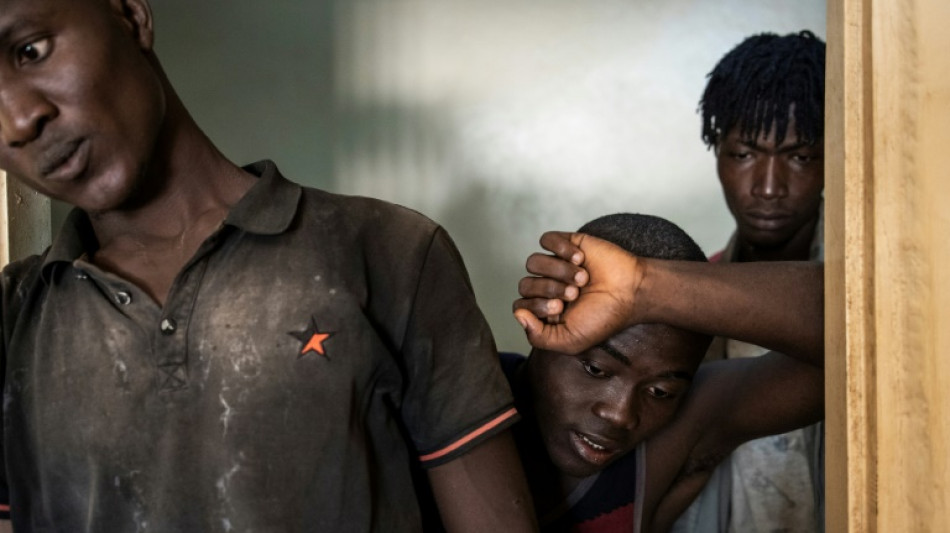
Wretched life of migrants building Senegal's city of the future / Photo: JOHN WESSELS - AFP

When Mohamed was hired at the construction site for the United Nations' new West Africa headquarters in Senegal, he was proud to say he would be working "not only for Africa, but for the world."
The 25-year-old Sierra Leonean was a plumber on the site, the centrepiece of what is intended to be a futuristic city boasting an Olympic stadium, ministries and a commuter train line running 40 kilometres (25 miles) to the capital Dakar.
But nine months ago, Mohamed's dreams evaporated when an air conditioner he was installing fell on his hands, slicing off part of a finger and damaging a thumb.
No longer so dextrous, he says he was fired without pay and unable to find steady work.
His tale is far from unique.
Young men from Sierra Leone, Guinea and even distant Nigeria have flocked to Diamniadio, lured by the vision of a decent job and pay in a stable currency. They are among thousands of labourers toiling on construction sites across the budding city.
AFP spoke to more than a dozen migrant workers.
Each recounted a life of extreme hardship, living in decrepit shared accommodation hours from the construction sites, working endless days for minimum pay, and haunted by fear of injury that could leave them penniless.
"They told us that our salary is the price of our soul… In a word, it is slavery," said Alpha, a Guinean steel erector. Like all the workers AFP met, his family name is being kept anonymous, and his first name has been changed.
The Chinese-owned firm WIETC, at the centre of many of their accusations, denied any abuse and said it stringently upheld Senegal's laws.
- 13-hour days -
Over the past decade, a once-fertile agricultural zone in Diamniadio has been replaced by massive construction sites, a project spearheaded by President Macky Sall to ease congestion in Dakar and modernise Senegal's image.
The UN office, a public-private partnership between Senegalese entities, is a dramatic 60,000-square-metre (650,000 square-feet) structure in the shape of a whirling star.
It is one of the new city's keystone projects, along with the Dakar Diamniadio Sports City, a private project that will feature a luxury hotel, restaurants and shops.
But labourers who had worked on both sites told AFP they often worked there as many as 13 hours a day, seven days a week, and were paid the equivalent of about $7 per day or less.
The Senegalese labour code stipulates one 24-hour period off per week. The minimum wage for low-skilled labourers in Senegal's construction industry ranges from 378 CFA ($0.60) to 658 CFA ($1.04) per hour.
"These are obviously inhumane conditions," said Seydi Gassama, head of Amnesty International in Senegal. "All workers should be able to work and have days off, whether they are Senegalese or international citizens."
Some said they walked as much as two hours each way to get to work.
All the workers AFP met said they had not signed any contract, and were offered no support when they were injured.
On a visit to Diamniadio late last year, AFP met Bakary, a Sierra Leonean who had been working at Sports City and bore marks from being hit in the head by equipment the day before.
He said he was sent home without pay and told to return the following day or be fired. He said his superiors did not take him to the doctor or pay for any medication.
"They are very vile and shout at and insult the workers -- even if you are exhausted they force you to do it, if you are injured they don't take care of you," said Alpha.
Others said they had been physically abused.
"Every day... they shout, shout, hit you, abuse you," said Ibrahim, a 26-year-old labourer, who like Bakary and Alpha had worked at the Sports City site.
If a worker misunderstands a manager, he said, they "will come and push you, hit you, punch you... If you punch him back, you get sacked, so when he punch, you just have to swallow it, bear it and work."
- Labour laws -
Many of the allegations touched on treatment by WIETC, which was contracted to build both the UN complex and Sports City.
In a written response to AFP, WIETC's West Africa general manager said his company had complied fully with Senegalese legislation.
All employees were declared to the Senegalese Social Security Fund, and any who were injured at work were covered for medical treatment and paid until their recovery, He Shenjian said.
As for overtime, he said evening and weekend work was "exceptional" and only occurred when workers "freely consent to participate," though the migrants interviewed said there was no choice.
Madani Tall, the developer of both sites, said he was not aware of any allegations before AFP had raised them.
He referred to the workers as day labourers, though they told AFP that their hours were logged and they were paid monthly.
"Senegalese law does not require a contract for a day labourer," Tall said.
Having itinerant day labourers, he added, "is something that is not particular to Senegal -- it's what you have on all the sites," including in the United States and Europe.
But Senegalese legal firm Geni & Kebe said the country's laws require a contract for day labourers -- and if no written contract is signed, the law considers workers to have open-ended contracts subject to statutory notice periods and other benefits.
"I do not know of a single project anywhere in the world, let alone in Senegal, that would sign a permanent working contract for (low-skilled) daily workers," Tall said.
According to the International Labour Organization (ILO), nine out of 10 workers are in informal employment in Senegal.
Tall and He confirmed there were two deaths on the UN site, one linked to an epileptic seizure and the other due to an accident on site.
A spokeswoman for a government office called the DGPU, which manages Diamniadio's development, said that what happened on the sites is not its responsibility.
A spokesman for the United Nations Office for West Africa and the Sahel (UNOWAS) directed AFP to the UN Resident Coordinator for Senegal, Siaka Coulibaly. He did not respond to three emailed requests for comment.
- 'Shame' -
Migrants said they sent as much as half of their income home to their families -- and felt guilty when they could send nothing at all.
Mohamed, the plumber, had wanted to study business administration but left high school when his father died.
Now, he cannot support his farmer mother and three sisters.
He said he would like to bring his case to the police, but worries that as an English-speaking foreigner with no documents proving his accident, he will be dismissed.
"If I go back (home), I don't have anything -- it would be a very big shame on me," Mohamed said.
"Some of my friends have married, some have settled down… I have not even got a girlfriend yet."
M.Ito--JT