The Japan Times - Cuban municipal polls close as opposition deplores pressure

EUR -
AED 4.048988
AFN 71.653352
ALL 90.233152
AMD 397.442801
ANG 1.973656
AOA 1011.960474
ARS 1704.382464
AUD 1.628051
AWG 1.984235
AZN 1.878376
BAM 1.951036
BBD 2.220877
BDT 137.145087
BGN 1.95499
BHD 0.415753
BIF 3312.570815
BMD 1.102353
BND 1.419813
BOB 12.873388
BRL 6.246268
BSD 1.102607
BTN 103.857962
BWP 15.412153
BYN 3.303388
BYR 21606.119128
BZD 2.217684
CAD 1.573224
CDF 2551.947633
CHF 0.924565
CLF 0.027875
CLP 1097.084206
CNY 7.354624
CNH 7.358449
COP 3659.778945
CRC 494.093407
CUC 1.102353
CUP 26.463016
CVE 110.401089
CZK 24.405329
DJF 195.910612
DKK 7.476493
DOP 66.917109
DZD 151.273137
EGP 58.978161
ERN 16.535295
ETB 177.534385
FJD 2.483877
FKP 0.834353
GBP 0.834294
GEL 2.855525
GGP 0.834353
GHS 12.925133
GIP 0.834353
GMD 81.574515
GNF 9764.096088
GTQ 8.429301
GYD 230.683524
HKD 8.648676
HNL 29.708842
HRK 7.531237
HTG 144.594927
HUF 364.882711
IDR 20101.848202
ILS 3.545943
IMP 0.834353
INR 103.905536
IQD 1668.962467
IRR 2109614.310597
ISK 136.615035
JEP 0.834353
JMD 174.224538
JOD 0.781612
JPY 176.073379
KES 143.361434
KGS 96.384792
KHR 4497.600695
KMF 492.752185
KPW 992.118101
KRW 1473.366503
KWD 0.34335
KYD 0.918844
KZT 491.483094
LAK 24836.013852
LBP 98715.713034
LKR 366.73942
LRD 187.400397
LSL 18.663257
LTL 3.254962
LVL 0.666803
LYD 7.104708
MAD 10.981314
MDL 20.028816
MGA 5059.800729
MKD 61.545168
MMK 2314.774623
MNT 3973.283421
MOP 8.911016
MRU 44.759659
MUR 52.494468
MVR 16.980358
MWK 1913.685217
MXN 20.433771
MYR 4.504329
MZN 70.444469
NAD 18.663252
NGN 1481.088858
NIO 40.570694
NOK 10.552253
NPR 166.167676
NZD 1.994849
OMR 0.424561
PAB 1.102607
PEN 3.75135
PGK 4.97327
PHP 70.506912
PKR 304.914924
PLN 4.405592
PYG 6843.288459
QAR 4.01725
RON 5.348511
RSD 117.465677
RUB 91.30685
RWF 1627.073053
SAR 4.160787
SBD 8.926521
SCR 15.372648
SDG 663.069392
SEK 11.106249
SGD 1.418953
SHP 0.830054
SLE 25.409646
SLL 23115.795624
SOS 631.101139
SRD 41.327623
STD 22816.481805
STN 24.472237
SVC 9.648438
SYP 14332.794295
SZL 18.663243
THB 37.34225
TJS 10.171722
TMT 3.858236
TND 3.316433
TOP 2.654202
TRY 55.49477
TTD 7.484722
TWD 36.257938
TZS 2920.045358
UAH 50.132575
UGX 4553.879273
USD 1.102353
UYU 44.690863
UZS 13271.228337
VES 1006.315196
VND 28358.582532
VUV 132.985681
WST 3.098252
XAF 655.957
XAG 0.022553
XAU 0.000284217451
XCD 2.979165
XCG 1.987211
XDR 0.779421
XOF 655.957
XPF 119.331742
YER 260.762006
ZAR 18.713826
ZMK 9922.503926
ZMW 22.543641
ZWL 354.957222
SSP 6555.09164
MXV 2.294737
  • RYCEF

    0.1000

    19.81

    +0.5%

  • VOD

    -0.2500

    16.33

    -1.53%

  • CMSC

    -0.2800

    20.12

    -1.39%

  • RBGPF

    -2.0000

    65

    -3.08%

  • RIO

    -0.2500

    94.16

    -0.27%

  • BTI

    -1.2000

    54.85

    -2.19%

  • NGG

    -0.3000

    74.94

    -0.4%

  • GSK

    -0.3500

    49.35

    -0.71%

  • BCE

    -0.4200

    20.14

    -2.09%

  • CMSD

    -0.3400

    19.93

    -1.71%

  • BP

    -0.9100

    43.52

    -2.09%

  • RELX

    0.1700

    33.24

    +0.51%

  • BCC

    -0.6200

    75.97

    -0.82%

  • AZN

    -1.9400

    164.21

    -1.18%

  • JRI

    0.0000

    10.77

    0%

Cuban municipal polls close as opposition deplores pressure
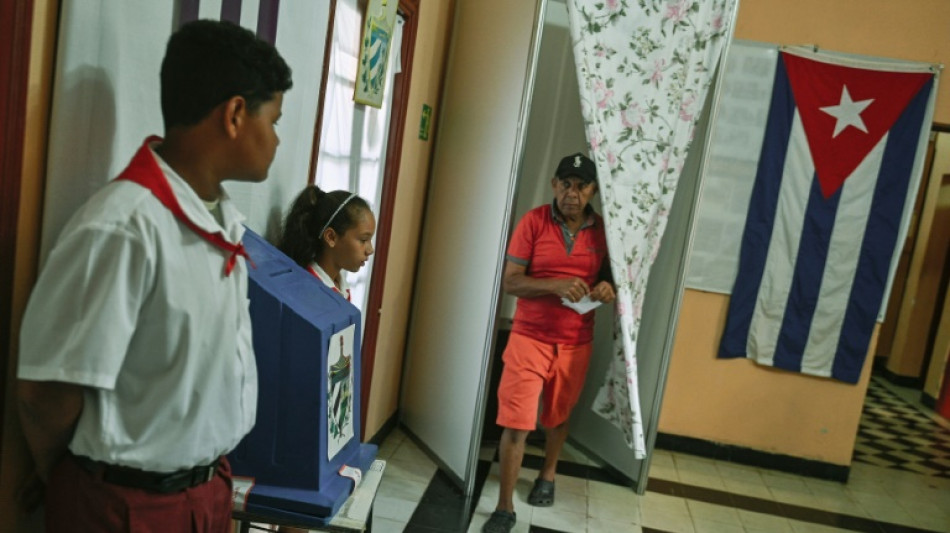
Cuban municipal polls close as opposition deplores pressure / Photo: ADALBERTO ROQUE - POOL-EFE/AFP

Cuban municipal polls close as opposition deplores pressure

Cubans voted Sunday in municipal elections amid a grave economic crisis that some feared would weaken turnout and with the opposition charging that several of its candidates faced unfair pressure.

Text size:

Polls closed at 7:00 pm (0000 GMT), one hour later than expected and after a day of voting without incident, AFP journalists reported.

Elections officials said the extension was due to requests made by polling stations and voters themselves.

As of 5:00 pm, according to the National Electoral Council, nearly 64 percent of Cuba's eight million eligible voters had cast a secret ballot, selecting more than 12,400 municipal delegates, or councilors, from the 27,000 candidates nominated by show of hands in neighborhood assemblies.

Earlier Sunday, President Miguel Diaz-Canel, fresh off a trip that took him to Algeria, Russia, Turkey and China, went with his wife Lis Cuesta to vote at a polling station in Playa, west of Havana.

He later told reporters that the electoral process confirmed the political and social stability of the island, despite the "economic suffocation" he said the United States was imposing on Cuba.

The government had mounted an intense get-out-the-vote campaign on social media, as well as in the press and on television -- both controlled by the ruling Communist Party, which oversees the election process but does not nominate candidates.

But the opposition platform known as the Council for the Democratic Transition in Cuba (CDTC), which promotes change and pluralism in the country through legal means, called on people to abstain, citing unfair pressure by the government.

- 'Political police' -

Its vice president, Manuel Cuesta, told AFP that three of the group's candidates had been prevented "by the political police" from participating in neighborhood assemblies because they appeared to have a good chance of winning.

He said a fourth candidate, Jose Cabrera, was nominated in the southeastern city of Palma Soriano but never made it to the ballot over "threats of losing his job" and other difficulties.

The Cuban government has branded opposition members as US "mercenaries."

These elections are the first step in a unique electoral system.

Councilors elected Sunday will form municipal governments that will propose 50 percent of the candidates for provincial assemblies and the National Assembly, which in turn elects the Council of State and the Cuban president from among its members.

The other 50 percent are put forward by social organizations close to the government.

In theory, the system allows any Cuban to reach parliament, but the opposition maintains that Communist Party militants have the ability to prevent any opposition member from being elected.

Adding uncertainty to the election -- the first since Diaz-Canel came to power in 2018 -- is the economic crisis that has brought shortages of food and medicine and daily blackouts to the island, fueling an outflow of migrants and potentially increasing abstentionism.

Candidates who fail to win with an outright majority this Sunday will face a runoff on December 4.

Y.Kato--JT