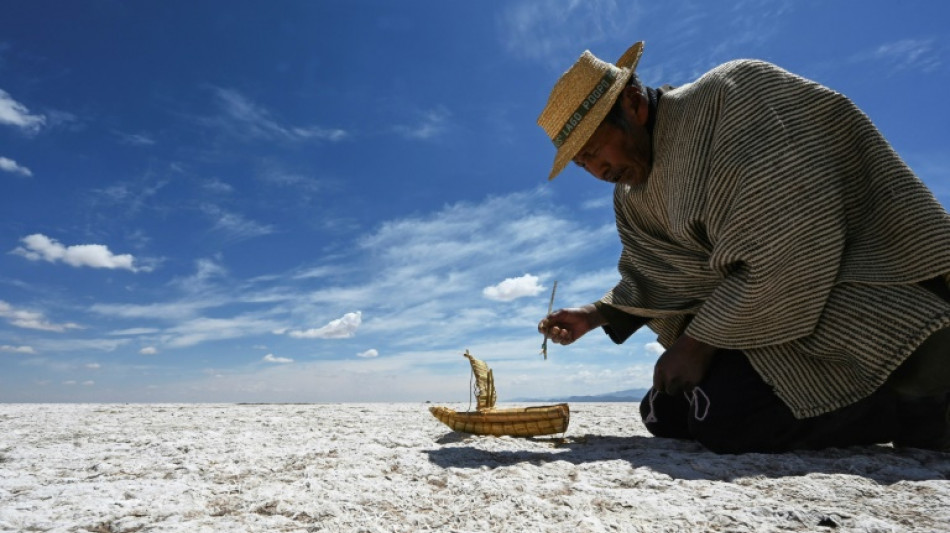
In Bolivia, Lake Poopo's 'water people' left high and dry / Photo: AIZAR RALDES - AFP

An abandoned boat rests on the cracked earth where formerly it floated. Lake Poopo, once Bolivia's second-largest, has mostly disappeared -- taking with it a centuries-old culture reliant entirely on its bounty.
Felix Mauricio, a member of the Uru Indigenous community, used to be a fisherman. Now 82, he gazes over a barren landscape and chews coca leaf to suppress the hunger pains.
"The fish were big. A small fish was three kilos," he recalls of the good old days.
At its peak in 1986, Lake Poopo spanned some 3,500 square kilometers (1,350 square miles) -- an area more than twice the size of Greater London.
But by the end of 2015 it had "fully evaporated" according to a European Space Agency timeline of satellite images tracking the lake's decline.
Scientific studies have blamed a confluence of factors, including climate change and water extraction for farming and mining in the area on the Bolivian high plains, some 3,700 meters above sea level.
"Here was the lake... It dried up quickly," Mauricio told AFP, kneeling in the dry bed and playing with a miniature wooden boat he had carved himself -- pushing it around with a wistful look, like a kid lost in an imaginary world.
Mauricio has always lived in Punaca Tinta Maria, a village in the southwestern region of Oruro.
His grandparents settled in the area in 1915 at a time when the waters of Lake Poopo lapped at doorsteps and intermittently flooded huts.
- No land either -
Mauricio's is one of only seven families left in Punaca Tinta Maria, which used to have 84 of them, according to locals.
There are only about 600 members left of the Uru Indigenous community -- which goes back thousands of years in Bolivia and Peru -- in Punaca Tinta Maria and the neighboring settlements of Llapallapani and Vilaneque, according to a 2013 survey.
"Many lived here before," said Cristina Mauricio, a resident of Punaca Tinta Maria who guesses her age at 50.
"They have left. There is no work."
Since 2015, rainfall has returned a shallow film of water to parts of the lake, but not enough to navigate or to hold the fish or water birds the Uru -- who still call themselves "water people" -- used to catch and hunt.
With none of the lake's natural offerings left, the Uru have had to learn new skills, working today as bricklayers or miners, some growing quinoa or other small crops.
A major problem is that the Uru have little access to land.
Their villages are surrounded by members of another Indigenous community called the Aimara, who jealously guard the farmland they occupy with property titles from the government.
The state has announced plans to distribute land to the Uru as well, but the community claims most of it is infertile and useless.
- 'We have been orphaned' -
What is left of the lake is largely an evaporated bed of salt the village's remaining residents had hoped would be Poopo's last gift to them.
They banded together and invested what little they managed to raise into equipment for a small plant to mine the salt and refine it.
But they hit an unforeseen snag: they could not find the $500 needed to buy bags to package the salt in.
The business has stalled.
"The Urus will disappear if we do not heed the warnings," senator Lindaura Rasguido of Bolivia's ruling MAS party said on a visit to the community in October.
She and her delegation were met with traditional dancing and poems in a language very few still speak.
"Who thought the lake would dry up? Our parents trusted Lake Poopo... It had fish, birds, eggs, everything. It was our source of life," lamented Luis Valero, the spiritual leader of the Uru people of the region.
As his five children chased each other around an unused canoe grounded outside the family's mud hut, the 38-year-old mused: "We have been orphaned."
But Mauricio, wearing a traditional poncho and a hat made of totora -- an indigenous reed from which boats used to be fashioned, still holds out hope that things will go back to how they were.
Staring at the bare soil where he once navigated through waves and wind, he told AFP the lake "will return. In five or six years' time, it will be back," he insisted, with more hope than confidence.
A 2020 study in the journal Nature Reviews Earth & Environment said global annual mean lake evaporation rates are forecast to increase 16 percent by 2100.
And according to the UN, the number of people living in water-scarce areas will rise to between 2.7 and 3.2 billion people by 2050 from 1.9 billion in the early- to mid-2010s.
Natural disasters displaced 30.7 million people within their own countries in 2020, according to the Internal Displacement Monitoring Centre.
T.Kobayashi--JT