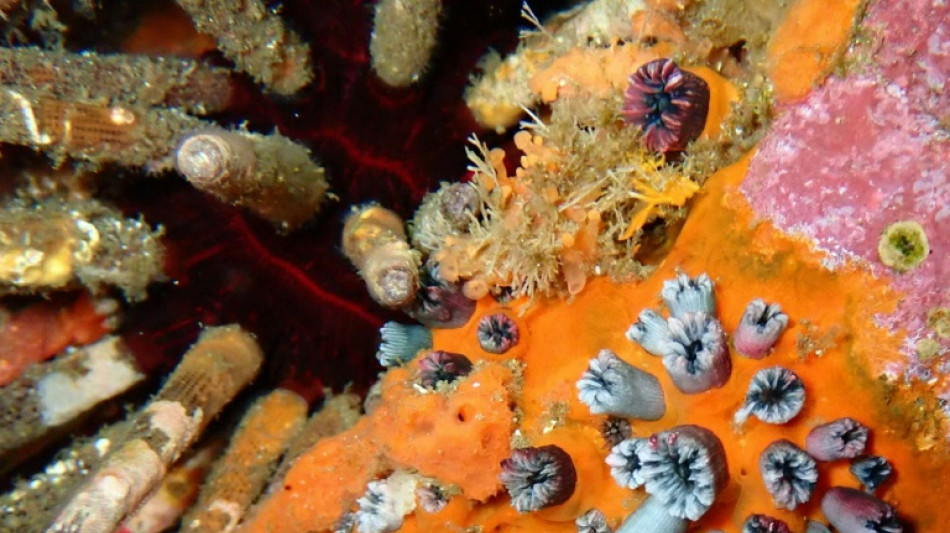
Corals show El Nino intensifying as planet warms: study / Photo: Billy Bensted Smith - Charles Darwin Foundation/AFP/File

Coral skeleton records stretching back 1,000 years show El Nino episodes are intensifying as the planet warms, carrying major implications for a future under climate change, according to a new study Thursday.
Published in Science, the research comes at a timely moment: a strengthening El Nino in the equatorial Pacific is projected to become the strongest ever recorded, surpassing other major years including 2015, 1997, and 1982.
Expected to peak towards the end of the year and bring record global heat in 2027, its consequences are already being felt from drought-hit Central America to Indonesia where it is fueling intense wildfires.
"We didn't know that before this study, but now we know that in the Eastern Pacific, these very strong El Ninos are unusual in the context of the last 1,000 years, and stand well above the pre‑industrial level," the paper's first author Julia Cole, a professor at the University of Michigan, told AFP.
Scientists broadly agree that the globalized weather impacts of El Nino stack on top of climate change -- exacerbating rainfall in some places, drought and heat in others.
But there has not been a similar consensus on whether a warming planet is itself amplifying the El Nino-Southern Oscillation (ENSO) -- the cycle of warm El Nino and cool La Nina episodes in the tropical Pacific, responsible for drastic variation in global weather patterns.
- A glimpse into the past -
Although there have been many strong El Ninos in the late 20th and early 21st century, the satellite record only goes back until the early 1980s and there is sparse ship-based data before that, explained Cole.
That is why paleoclimatologists turn to proxy data -- such as corals.
A rich collection of living and fossilized corals is present in the Galapagos Islands, the volcanic archipelago off the west coast of Ecuador, right at the heart of the eastern Pacific El Nino zone.
They grow about a centimeter or two a year and by sampling cores at the millimeter scale, the team was able to develop windows of monthly temperature records scattered across the past millennium.
This is because the chemical makeup of the coral skeleton -- the ratio of strontium-to-calcium and the different forms of oxygen inside it -- reflects the conditions under which it grew.
The findings showed the swings associated with ENSO cycles were considerably smaller in the 1000-1850 pre-industrial period, began rising in the late 19th century, and show "striking amplification" over the last 40 years.
By testing the observed changes against climate models that simulated the pre-industrial period, they were able to show the increases were larger than anything produced from natural causes alone.
- 'Immense implications' -
"That strengthening parallels global warming, so it appears to be related to the warming of the planet caused by human production of fossil fuels," said Cole.
"The implications for people are immense because El Nino is a major source of climate extremes and hazards."
"The findings reinforce the urgent need to transition away from fossil fuels to climate-safe renewable energy," Andrew Dessler, a climate scientist at Texas A&M University, who was not involved in the research, told AFP.
ENSO variability is now roughly 36 percent greater in the equatorial eastern Pacific Ocean than in the pre-industrial era, the paper found, largely because of stronger El Ninos.
The figure cannot be read as meaning El Ninos themselves are 36 percent stronger, because it measures the variability of the whole ocean-atmosphere system, in both the warm and cool directions. The research does not propose physical mechanisms for the observed changes.
Cole said she hoped the paper would fill what has been an important gap in the scientific understanding about how a warming world is impacting El Nino.
"Our corals are a time machine to the past, they're not a time machine to the future," she said. "What we can do is say the trend is happening, the trend is continuing, we see that every day now."
M.Sugiyama--JT