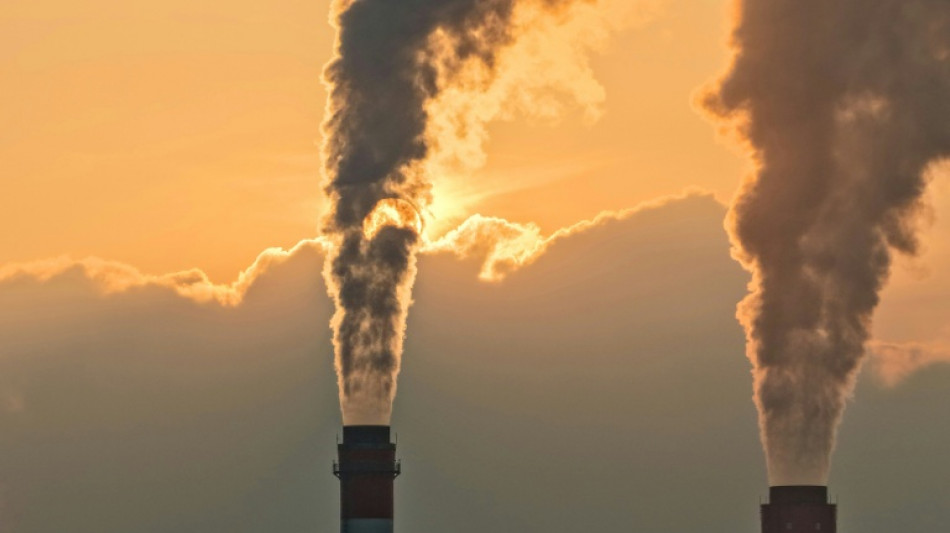
China carbon emissions 'flat or falling' in 2025: analysis / Photo: STR - AFP/File

China's emissions of planet-warming carbon dioxide were "flat or falling" in 2025, analysis showed Thursday, but progress remains fragile and it is not yet clear that emissions have peaked.
China is the world's biggest emitter of the gases that drive climate change, and has committed to peaking emissions by 2030, though some analysts expect it will do so early.
Last year, emissions fell in almost all major sectors, including power generation as China's massive renewable expansion meets growing demand, according to the analysis by the Centre for Research on Energy and Clean Air (CREA) for climate website Carbon Brief.
That mean CO2 emissions likely declined 0.3 percent for 2025.
There is some uncertainty about figure because of margins of error around some of the numbers involved, including coal consumption.
"Because the relative drop is so small, we can't say with certainty yet that it's a fall, therefore the 'flat or falling,'" explained CREA lead analyst Lauri Myllyvirta.
But the analysis suggests it is the first time that emissions have stayed flat or declined for a full calendar year at a time when energy demand was rising.
The most recent decline in emissions came during the pandemic and was linked to lockdowns.
Last year's decline extends a "flat or falling" trend in emissions dating back to March 2024 and driven partly by China's massive installation of renewable energy.
That has helped drive down emissions in the power sector despite growing demand.
Emissions across industry have also dropped, most notably in building materials, as construction slows, but also in transport with the growing uptake of electric vehicles.
Still, the progress is fragile.
Emissions from the chemical industry grew sharply in 2025, and are set to continue rising.
While the sector is still a relatively small emitter compared to other industries, it is having an outsize impact because of how fast its emissions are growing, the analysis found.
And while emissions have now been trending downwards or stagnant for almost two years, any decline is not yet substantial.
"This means that a small jump in emissions could see them exceed the previous peak level," the analysis warned.
That would scupper hopes of China peaking emissions earlier than a 2030 target, something analysts say could easily be achieved.
"Whether emissions increase or decrease by a fraction of a percent year-on-year change only has symbolic significance," Myllyvirta told AFP.
"The really significant implication is that emissions aren't rising rapidly like they did until 2023," he said.
But "they're also not falling the way that they need to for China to start making progress towards the carbon neutrality target."
There is still space for China to speed up the fall in emissions, notably further scaling up renewables.
While capacity is being added at record speed, it has not always translated into power generation, partly due to grid congestion.
Grid reforms could alleviate that and help push emissions down quicker.
Storage capacity, primarily from batteries, is also growing rapidly and could help increase the share of power generated from renewables.
Coal still dominates China's power generation, but it fell by nearly two percent last year, despite rising electricity demand, data reviewed by AFP showed this week.
M.Sugiyama--JT