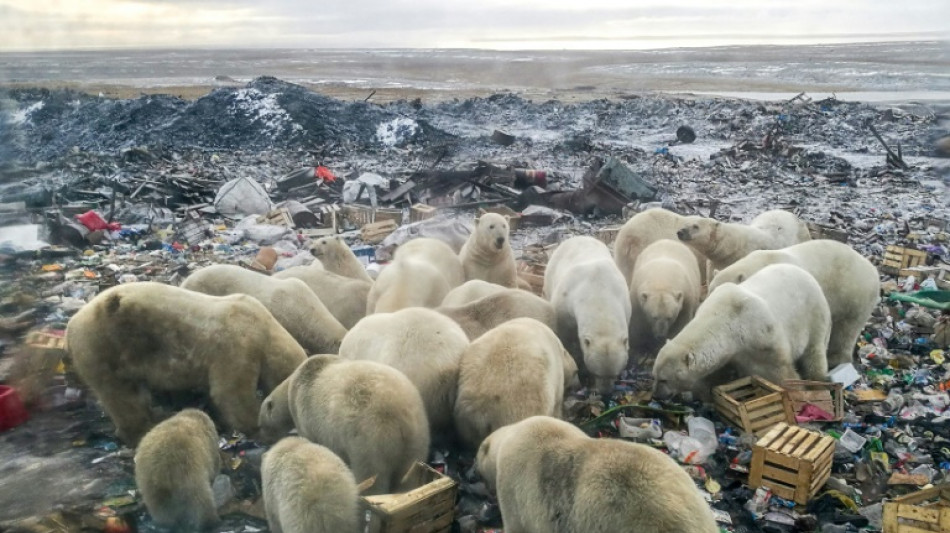
Human food waste 'threat' to polar bears: report / Photo: Alexander GRIR - AFP/File

The invasion of a remote Russian village by dozens of ravenous polar bears three years ago captured headlines around the world, with images of groups of animals gorging on rubbish in an open garbage dump.
Scientists and conservationists warned Wednesday that it was just one of a growing number of incidents showing the threat food waste poses to the at-risk animals.
Polar bears are acutely threatened by climate change, with the Arctic region warming about three times faster than the global average, meaning there is less sea ice that the animals rely on to hunt for food.
"We've been seeing this slow and steady increase in negative human polar bear interactions, fuelled largely by loss of sea ice pushing more bears onshore for longer periods and in more places," said Geoff York, Senior Director of Conservation at Polar Bears International.
In the new analysis, researchers looked at how discarded food, particularly in garbage dumps, is drawing polar bears towards human communities and into danger.
"We know from the brown and black bear world in Europe and North America that dumps are a huge problem for bears. Human food is a huge problem for bears," said York, who co-authored the report in the conservation journal Oryx.
"It's likely to get worse if it's not addressed."
- Eating plastic -
The report draws together a number of case studies in recent years and calls for greater awareness of the risks and better waste management in Arctic communities.
These include isolated incidents where one or two bears approached villages or encampments -- sometimes being shot after attacking local people -- and much larger congregations.
In Kaktovik, Alaska, the protected beach dumping site for the remnants of bowhead whales, which the Inupiat community has traditionally hunted, attracts as many as 90 polar bears from up to 160 kilometres (a hundred miles) each autumn.
The authors said the dramatic scenes in the Russian village of Belushya Guba in 2019, where more than 50 bears were drawn to an open dump on a bad ice year, were an extreme example of what can happen when sites are left unsecured.
Polar bears have evolved to eat a high fat diet, so that the weight they put on in the spring when they hunt ice seal pups will last them much of the rest of the year.
But with ice melting earlier in this crucial period, York said bears are now sometimes returning to shore without having put on enough weight and even those that do return well fed are staying on land for longer.
In this case an accessible rubbish dump can present a "bonanza of calories", he said, although dramatically less nourishing than their normal diet.
"What they don't know is they're also ingesting plastics, they're ingesting toxic materials that are also in the landfill," said York.
He added that there was also a disease risk from garbage like cat food as well as proximity to humans and other animals at the dumps.
- Uncertain future -
York said communities in the Arctic region were faced with steep costs for dealing with household waste, because the frozen and rocky ground offers limited options for landfill.
Dumping or low temperature burning are often used, but he said high temperature burning could be a better, if imperfect, approach.
Meanwhile some communities have formed patrols to chase bears from landfill sites before they get a taste for human food.
Other ideas the authors put forward include education around the issue, and the use of non-lethal deterrents like air horns and electric fences.
Given the significant threat posed to polar bears by climate change, is it worth bothering about the risks from food waste?
"I say yes, because every bear matters, especially as we're starting to see declining populations," he said.
"We have solutions. So let's do what we can while we can and make sure they have the best ride possible as they're heading into this uncertain future."
M.Yamazaki--JT