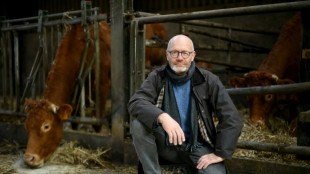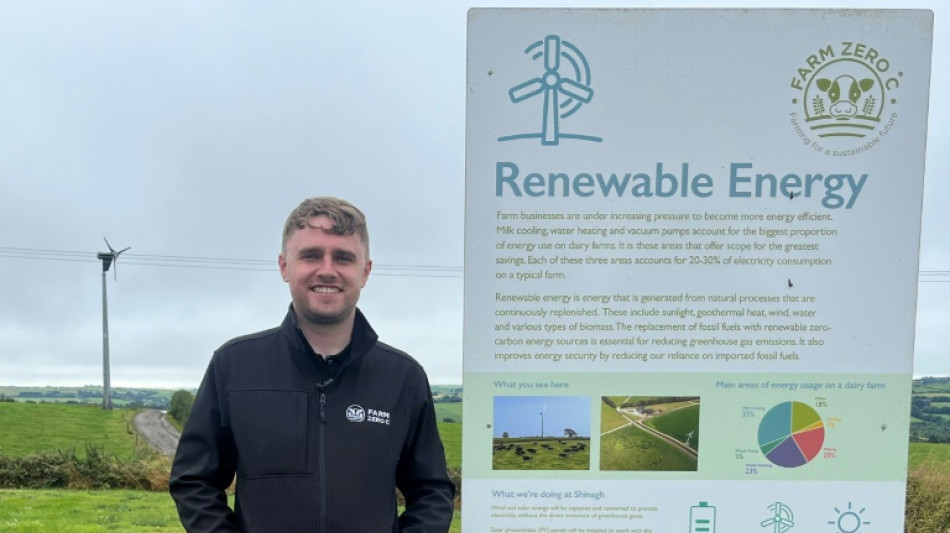
Ireland's climate battle is being fought in its fields / Photo: Peter MURPHY - AFP

On a windswept Irish farm, high-tech cow collars track animal health and solar panels glint on the milking parlour's roof, as a country famed for its lush green pastures tries to reduce its agricultural carbon footprint.
The Farm Zero C project near Bandon, County Cork, also manages grazing carefully, uses hedgerow and scrub habitats to shelter pollinators and birds, and plants legume crops to cut chemical fertiliser use, all producing measurable reductions in greenhouse gas emissions.
Around 40 percent of Ireland's total greenhouse gas emissions come from agriculture, far higher than the European Union average.
The unique Bandon initiative in the country's south could provide a model for tackling Ireland's biggest environmental dilemma: how to cut emissions on farms without drastically shrinking herds or decimating rural communities.
Ireland's pastures, long symbols of national identity and prosperity, have become flashpoints in the debate over how a small island can meet big climate promises.
Dominated by methane-heavy dairy and beef production from a seven-million-strong cattle herd, the sector produces more emissions than transport and energy combined.
"We are trying to create an economically viable climate-neutral system," said Padraig Walsh, project manager at Farm Zero C, where 250 cows are milked.
The project is a collaboration between Carbery, a dairy cooperative of more than 1,100 farmers, and "bioeconomy" researchers BiOrbic.
At the site, around 280 kilometres (175 miles) southwest of Dublin, emissions have plunged by 27 percent since the project was launched in 2021, Walsh told AFP.
Chief emission culprits are livestock farming, particularly cattle, which release planet-warming methane when they burp.
Meanwhile, fertiliser use emits nitrous oxide -- the third-most-potent greenhouse gas after methane and carbon dioxide.
- 'Farmers villainised' -
As the annual United Nations climate conference, COP30, begins in Brazil, EU 2030 targets are forcing Irish policymakers to focus on slashing emissions by 40 percent compared to 2005 levels.
If Ireland fails, it risks colossal EU fines of almost 30 billion euros ($35 billion).
At Farm Zero C -- on a site owned by the farmers' cooperative -- the target is to reach emissions neutrality.
Legume hordes like clover pull nitrogen from the air, reducing the use of chemical fertilisers, and the milking parlour is 80-percent solar- and wind-powered.
But methane still represents about three-quarters of the farm's carbon footprint, according to Walsh.
"We are looking at herd genetics, researching feed additives with our academic partners, and trialling natural diet products to reduce methane from the cows," he said.
The farm also collects quantifiable data for soil carbon sequestration.
Other farmers, researchers and policymakers regularly visit to study techniques.
Not all its measures will be picked up, but "we recommend farmers giving one or two things a go on their own farms," said Walsh.
"Farmers feel a bit villainised but have already done a lot to try to reduce emissions at their own cost. They need more help," he added.
Farms contribute greatly to rural communities and economies in Ireland, Walsh insisted.
"Around here they are all family-run businesses, and all under pressure."
- 'Climate change front line' -
Shifting attitudes in rural communities, where farming is a mainstay of life, poses a challenge.
At Ireland's annual National Ploughing Championships in County Offaly, Mary Garvey, a 47-year-old farmer from Roscommon, told AFP: "It has to be economically sustainable to farm environmentally."
The event displays age-old ways of farming and draws hundreds of thousands of visitors each year.
"Older farmers spent half their lives trying to make their land more fertile for cattle, and now are told to undo all that," Garvey said.
According to the author John Gibbons, powerful agribusiness lobbyists and government policy are the chief climate villains.
The country's dairy sector, expanded after EU milk quotas were lifted in 2015, was boosted by government incentives, leading to a leap in emissions.
Even with technological progress, emissions will not drop significantly unless herd sizes do and there is a society-wide pivot to a plant-based food system, argued Gibbons.
"Ultimately, we need a more diversified agricultural model, with fewer cattle, and more horticulture, organics and tillage," he told AFP.
Many farmers "recognise that they're on the climate change front line," said Peter Thorne of Maynooth University, lead author on a report for the Intergovernmental Panel on Climate Change (IPCC), the UN's climate science body.
"They feel it firsthand but need the help of government and markets to diversify," he told AFP.
"There is no point professors preaching from on high. We need farmers themselves to show others that this does not necessarily mean a drop in income."
K.Inoue--JT