Big leap in quest to get to bottom of climate ice mystery / Photo: Prakash MATHEMA - AFP

Stanislav Kutuzov felt the drillhead he was controlling smash into the rock more than 100 metres below him high on a glacier in the Pamir peaks of Tajikistan. The ice core samples it took could help solve one of climate science's great mysteries.
"This is the best feeling ever," declared the Russian-born glaciologist in the thin mountain air of Kon Chukurbashi.
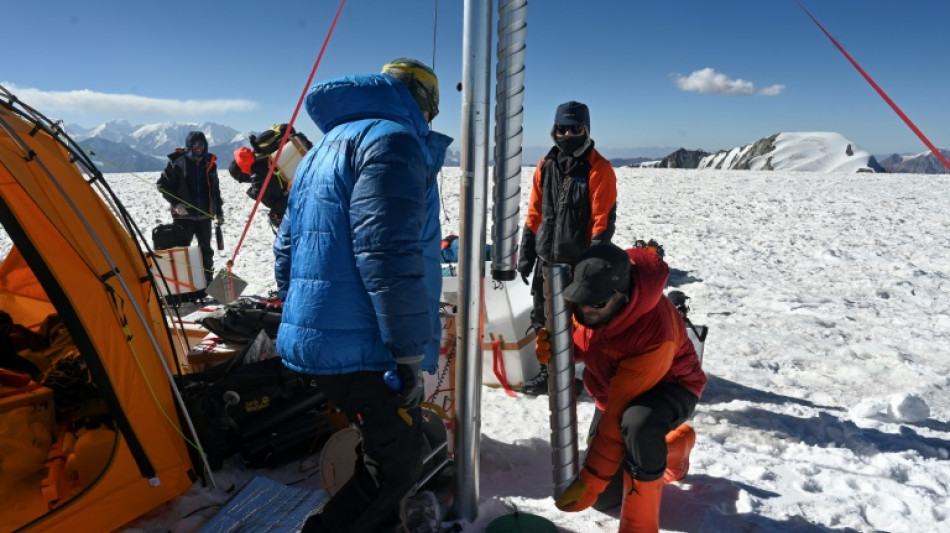
Kutuzov is one of a team of 15 scientists which AFP was exclusively able to follow on their historic mission 5,810 metres (19,000 feet) up on a snowy ridge near the Chinese border.
The expedition to recover the deepest ice samples ever extracted from the Pamir, one of the world's highest and least-studied mountain ranges, aims to give scientists access to one of the planet's oldest climate archives.
These layers of ice holding dust, compacted for centuries, perhaps millennia, may be able to tell us about the atmosphere, temperatures and snowfalls deep into the past.
The unspoken hope is that this will be the oldest ice ever extracted from the entire so-called Pamir-Karakoram anomaly zone, the only mountainous region on the planet where glaciers still seem to be resisting global warming.
The expedition in September, funded by the Swiss Polar Institute and the Ice Memory Foundation, was initially planned for the legendary Fedchenko Glacier, but it was too high to be reached by helicopter.
- Humped down the mountain -
So the team of Swiss, Japanese, Russian and Tajik scientists turned to the lower Kon Chukurbashi ice cap -- which ultimately proved to be very fruitful.
The climb had to be done in stages through a rocky moonscape, crossing a sea of spiky ice and then the snow of the domed summit with its staggering views across Central Asia. They then took a week to drill down through the ice to get the two deepest core samples, with the temperature dropping to minus 18C at night.
The team had to bring the core samples -- dozens of cylinders of ice about 50 centimetres (20 inches) long -- to the surface carefully.
They then numbered and packed the samples so they could be carried down the mountain in iceboxes and then transferred via four-wheel-drive vehicles to refrigerated trucks further down the mountain.
"The first 50 metres we did in one day," said Kutuzov, a paleoclimatologist at Ohio State University in the United States.
But at around 70 to 80 metres "we started to experience troubles with the core quality", he told AFP.
Suddenly the ice became more brittle, harder to handle, yet promising at the same time -- perhaps a sign of a period of change, said expedition leader Evan Miles, a glaciologist at the Swiss universities of Fribourg and Zurich.
They had never seen so many dust particles in ice, which slowed down the drilling.
When they got to the last three to five metres, "it just got dark brownish, sort of a yellowish colour", which told them they had potentially found very different conditions, said Kutuzov.
- Up to 30,000 years old? -
Then "we pulled up the last core of ice, which was spectacular", Miles recalled. "Really yellow ice, because it has so much sediment inside of it. Which is a really good sign for us."
Very ancient ice samples have already been collected in the region, including some from the Grigoriev ice cap in Kyrgyzstan dated at 17,000 years.
Another from Guliya on the Tibetan Plateau was estimated to be even older, but its age is disputed.
"Our ice is much colder and probably older than Grigoriev, which gives us hope," said Miles, back in the Tajik capital Dushanbe in October.
"Only laboratory analysis will confirm this, but we hope the core will be exceptional not only for the area but for the entire region -- probably 20,000, 25,000 or 30,000 years old."
- Antarctic ice cave -
Because it traps ancient air bubbles, ice is the only climatic archive of the atmosphere of the past and thus of greenhouse gas concentrations before the industrial burning of coal, oil and gas. Thanks to kilometres of ice core samples taken from the Greenland and Antarctic icecaps, we know that the climate has never been as warm as it is now for 800,000 years.
But between the two poles, there have been very few taken from places inhabited by people, "where we want to really understand how the climate system is varying naturally", said Ice Memory president Thomas Stocker.
The Pamir -- "a very special place... the roof of the world" -- particularly fascinates scientists, Stocker said, because it is a climatic crossroads, redirecting moist air from Europe towards the Indian subcontinent.
What the ancient ice of Kon Chukurbashi has to tell us about the snow, wind and dust of yesteryear may help researchers understand how today's monsoons -- on which hundreds of millions of people in South Asia depend -- might change due to climate disruption.
Which is why Ice Memory is funding the storing of the second sample core in an ice cave at minus 50C in the Concordia Research Station in Antarctica along with others from the Alps, the Andes, Greenland and elsewhere. It's part of a "race against time" before these climatic records melt away.
This means that scientists in the future will be able to study it using more sophisticated methods than we have today.
The first core will soon be subjected to molecular analysis at Hokkaido University in northern Japan. The snowflakes that fell all those centuries ago on the Pamir will finally melt and reveal their secrets.
H.Nakamura--JT