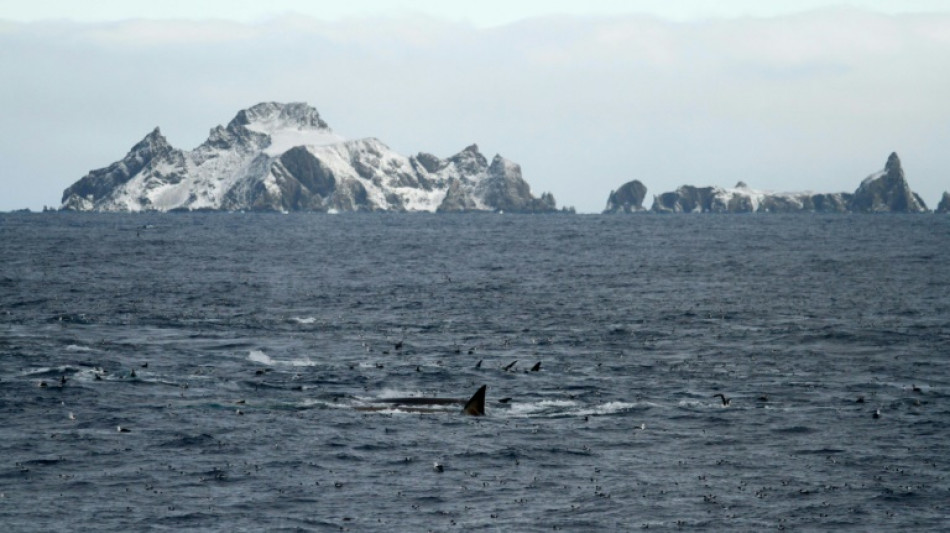
Huge groups of fin whales sign of hope for ocean giants / Photo: Sacha VIQUERAT - UNIVERSITY OF HAMBURG/AFP

For the first time since whaling was banned, dozens of southern fin whales have been filmed feasting together in a "thrilling" Antarctic spectacle, hailed by scientists Thursday as a sign of hope for the world's second largest animal.
The ocean giants are second only to blue whales in length, with slender bodies that help them glide through the water at high speed.
They could not evade industrial whaling, however, and were slaughtered to near-extinction during the 20th Century as hunters systematically shattered populations of whales across the planet.
"They were reduced to one or two percent of their original population size," said Helena Herr, of the University of Hamburg, lead author of the research published in the journal Scientific Reports.
"We're talking about a couple of thousand animals left for the whole southern hemisphere area."
While scientists say numbers of southern fin whales have been slowly rebounding since a 1976 whaling ban, there have been few sightings of these mysterious animals in large groups at their historic feeding grounds.
But in scenes that Herr described as "one of nature's greatest events", researchers and filmmakers were able to capture footage of up to 150 southern fin whales in Antarctica.
Drone footage, shot by wildlife filmmakers from the BBC, shows the fin whales swooping and lunging through the water, blasting great bursts of air as they surface, as birds wheel in the sky above them.
"The water around us was boiling, because the animals were coming up all the time and causing splashes," Herr told AFP.
"It was thrilling, just standing there and watching it."
Unofficially, the team nicknamed it the "fin whale party" as the enormous creatures feasted on swirling masses of krill.
In two expeditions in 2018 and 2019, researchers recorded a hundred groups of fin whales, ranging from small gatherings of a few individuals, to eight huge congregations of up to 150 animals.
Previously, recorded feeding groups had a maximum of around a dozen whales.
Using data from their surveys, the authors estimate that there could be almost 8,000 fin whales in the Antarctic area.
- 'Ecosystem engineers' -
Fin whales can live to around 70 or 80 years old when left alone and have just one calf at a time, so Herr said the recovery of populations is a slow process.
She said increasing numbers of southern fin whales is an encouraging sign that conservation measures can work, although she noted that other threats include being struck by boats.
The International Union for Conservation of Nature now lists fin whales as "vulnerable" and estimates the global population as 100,000, with most of these in the northern hemisphere.
More whales could also be a good sign for the health of the ocean more generally -- and even efforts to tackle climate change.
Whales feed on iron-rich krill but they also defecate in the surface waters -- returning nutrients to the ocean that help spark the growth of tiny phytoplankton, the foundation of the marine food web.
Like plants on land, phytoplankton photosynthesise using the sun's rays to turn carbon dioxide into energy and oxygen.
They are "ecosystem engineers", said Herr, who first spotted a large group of the whales by chance in 2013 during a research mission into Antarctic Minke whales.
She now plans more missions to investigate the enduring mystery of these ocean giants -- where they breed.
"We don't know where they go," said Herr, adding that much more is known about the fin whales of the northern hemisphere.
Herr's team was able to put satellite tags on four animals last year, but a mission to go back to the Antarctic with more tracking equipment has been delayed until next year by the pandemic.
- Exploitation -
This elusiveness is even more astonishing given the size of fin whales.
The animals can grow up to around 27 metres (88 feet), although Herr said that they now tend to average 22 metres, particularly after whaling that targeted the biggest creatures.
In all some 700,000 individual fin whales were killed during the 20th century for the oil in their body fat.
All populations of whales in the region were ravaged, from the biggest blue whales down to the smallest minke whales until commercial hunting was stopped in a series of agreements in the 1970s and 1980s.
"It's an example of how humanity treats resources," said Herr.
"They just exploit them as long as they can and only stop when it's not commercially valuable anymore. As long as you can make profit, it will be exploited."
M.Fujitav--JT