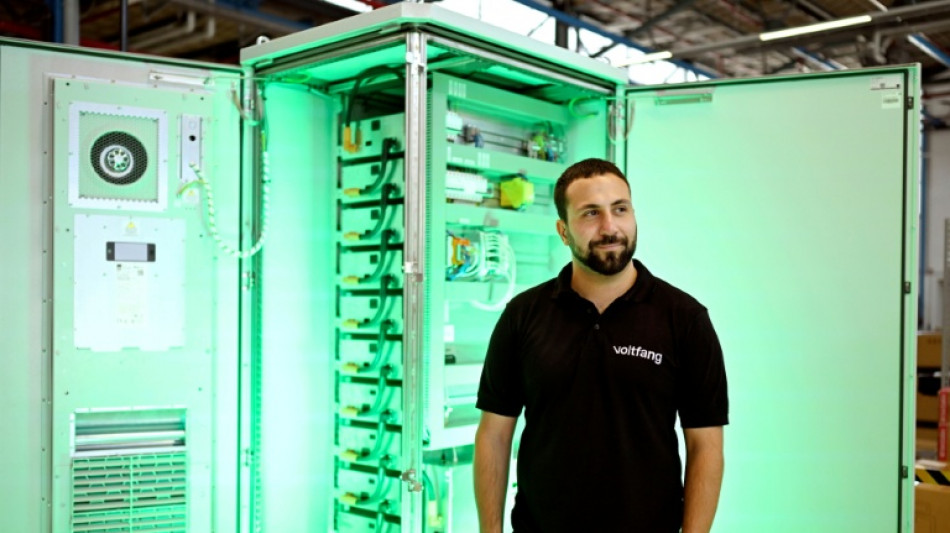
German firm gives 'second life' to used EV batteries / Photo: Ina FASSBENDER - AFP

A German company is putting used electric vehicle batteries to new use by stacking them into fridge-size units that homes and businesses can use to store their excess solar and wind energy.
This week, the company Voltfang -- which means "catching volts" -- opened its first industrial site in Aachen, near the Belgian and Dutch borders.
With around 100 staff, Voltfang says it is the biggest facility of its kind in Europe in the budding sector of refurbishing lithium-ion batteries.
Its CEO David Oudsandji hopes it will help Europe's biggest economy ween itself off fossil fuels and increasingly rely on climate-friendly renewables.
While wind turbines now dot Germany's countryside and photovoltaic panels are found on many rooftops, he says the country still needs to build up battery storage capacity.
"We want to ensure European sovereignty in energy supply by enabling renewable energy production through storage," Oudsandji, 29, told AFP.
"We can generate enormous amounts of electricity from solar and wind energy, then store it in a decentralised way all across Germany and distribute it," he said.
"This means that the more renewable energy we use, the more storage capacity we deploy, the less we need fossil gas or oil."
Inside the site, technicians receive used EV batteries and test them to determine their remaining lifespans.
Those still found to be in good condition are reconditioned for their "second life" and fitted inside cabinets the size of large refrigerators -- effectively huge power banks for excess electricity.
Among the first customers is the discount supermarket chain Aldi Nord, which wants to store power from its rooftop solar panels for later use.
- Clean energy push -
Voltfang, founded in 2020 by three university engineering students, aims to produce enough systems by 2030 to store a capacity of one gigawatt-hour (GWh) of electricity per year, enough for 300 homes.
It is one of many small steps meant to help Germany's decades-old "Energiewende", or energy transition.
Last year, renewables covered nearly 60 percent of electricity produced in Germany, and the target is 80 percent by 2030.
One problem for solar and wind is what to do on days when the sun doesn't shine and the wind doesn't blow.
Such "dark lulls", most common in winter, have at times forced Germany to temporarily import power produced by French nuclear reactors or Polish coal plants.
To guarantee a secure supply, conservative Chancellor Friedrich Merz's government plans to build around 20 new gas-fired power plants by 2030.
The Greens and environmental groups have denounced this as a step backwards in German climate policy and fear the country will not meets its goal of carbon neutrality by 2045.
- Circular economy -
Europe's battery sector is still nascent but expected to grow fast.
"In our opinion, small-scale distributed energy assets such as battery storage will play a major role to create efficient energy systems," said Marc Sauthoff of the business consultancy Roland Berger.
The stationary storage market is growing exponentially in Germany: about six GWh of capacity were installed at end-2024, up from 2.5 GWh in 2022, he said.
Voltfang hopes to be profitable by next year, Oudsandji said, though he conceded there are hurdles.
For one thing, the supply of used EV batteries is still small, given that most vehicles have been on the road for only a few years.
Also, new batteries, produced mainly in China, are becoming more efficient and less expensive, making it harder to compete against them with refurbished models.
Oudsandji acknowledged that testing and refurbishing old batteries "is more complex" than simply buying new ones.
"But the big advantage is that it is more sustainable," he said. "It is cheaper and allows us to create a circular economy, thus ensuring Europe's independence in resource supply."
H.Hayashi--JT