'Food on table' outweighs health risks for Philippine e-waste dismantlers / Photo: Ted ALJIBE - AFP

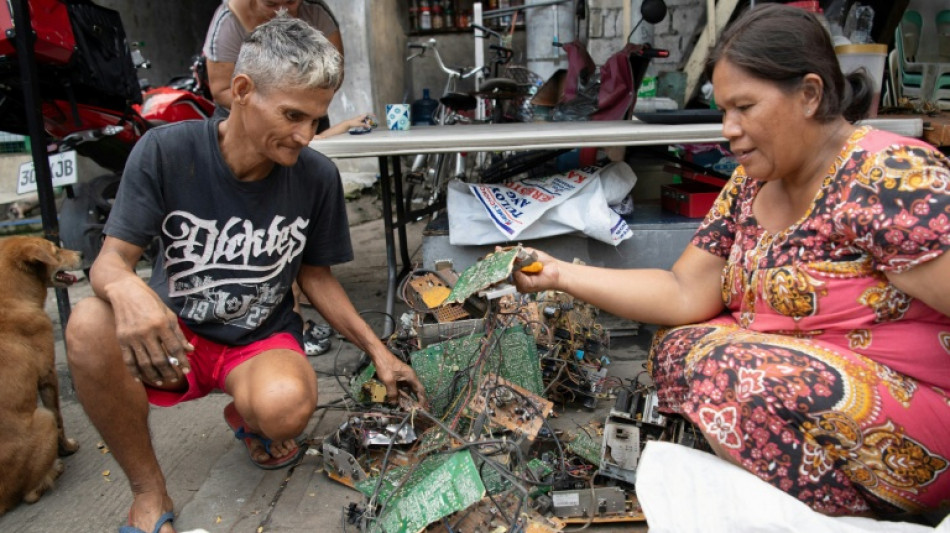
Dexter Barsigan has spent the past 13 years making a living with his bare hands and a pair of pliers, stripping scrapped laptops and air conditioners for metal he can sell to junk shops in the Philippines.
But since his hands began aching and his vision started to blur three years ago, there have been days he can only watch his wife and nephew do the job for him.
The 47-year-old father of three is a "mambabaklas", the Filipino word for informal dismantlers who scavenge electronic waste for the nickel, aluminum and copper inside.
"Dismantling helps us put food on the table. It provides the money to send my kids to school," Barsigan told AFP while sitting along a kilometre-long stretch of Onyx Street, home to hundreds of fellow "e-waste" dismantlers.
Their work frequently involves burning away rubber wire casings, releasing a toxic brew of chemicals including lead, mercury and cadmium into the air.
Both the Philippine government and the Basel Convention, a global waste management treaty signed by 191 countries, consider e-waste hazardous.
"It poses serious threats to human health and the environment," said Irvin Cadavona, a hazardous waste management officer with the environment department, citing health risks ranging from cancer and neurological diseases to respiratory illnesses and birth defects.
The World Health Organization said last year exposure to e-waste chemicals can lead to incidents of asthma and reduced lung function in children, while pregnant women are at higher risk for stillbirths and premature delivery.
"It's very hard to recycle these (chemicals). When you dismantle (e-waste), you must intricately break it down. It can be very hazardous," Gelo Apostol, an environmental health specialist from Ateneo de Manila University, told AFP.
Exposure to the substances can lead to anemia, kidney and thyroid diseases, and nerve damage, he said.
The Philippines is among the top e-waste generators in Southeast Asia, according to the United Nations' Global E-waste Monitor, accounting for 540 million kilograms (about 600,000 tons) in 2022.
Dismantlers who work at the country's accredited facilities are required to follow stringent guidelines.
But their informal counterparts lack the training, regulations and protective equipment needed to properly protect themselves.
"I strongly believe that some Filipinos are getting sick because of the exposure to e-waste," Cadavona said.
- Burning rubber -
Barsigan, who doesn't wear a mask while working, prefers dismantling computer circuit boards with aluminum and copper because they fetch as much as P470 ($8) per kilo.
But circuit boards have especially high concentrations of toxic metals that can cause nerve damage when breathed in, Apostol said.
While illegal, Onyx Street's e-waste dismantlers also routinely burn wires to extract copper, which is faster than peeling them by hand.
Rosana Milan, physician-in-charge at Manila's Pedro Gil Health Center, said her clinic has diagnosed half of the 12,000 people living along the street with respiratory issues, most of them children.
"It's very risky for the babies, the toddlers and even the school children… they're sitting beside their father while the father is... burning the rubber," Milan told AFP.
"Mostly they have pneumonia, upper and lower respiratory illness, even if they have vaccines."
Dismantler Sammy Oligar said his one-year-old grandchild had been diagnosed with pneumonia that a doctor attributed to pollution caused by the burning.
"The smoke would enter from our window and the child would inhale it," Oligar told AFP, adding that many of his neighbors were dealing with lung illnesses.
- 'What are we waiting for?' -
Medicins du Monde (MdM), a French humanitarian organisation providing gloves, masks and safety orientations for the dismantlers of Onyx Street, is calling for the recognition of informal e-waste workers.
"Health is clearly not their first priority. Their priority is to have food on the table," Eva Lecat, general coordinator of MdM, told AFP.
"If (their work) was legal and recognised and regulated, there would be ways to protect people and communities."
Cadavona, the waste management officer, said the informal nature of the picker-junkshop relationship made it "very hard" to establish formal recognition for the community.
Apostol, the faculty researcher, said an "evidence gap" created by the lack of studies specific to dismantlers might be contributing to a lack of urgency.
"But remember, many of the chemicals found in e-waste already have extensive studies on their health effects," Apostol said.
"What are we waiting for? To have nationwide data of people who died from e-waste before we take action?"
Worried he will be unable to afford treatment, Barsigan told AFP he has avoided doctors, instead putting ointment on his hands and taking a cheap, over-the-counter pain reliever.
Once his hands feel a little better, he said, he will put them back to work.
"If I stop dismantling, it's as if I have also given up the hope of a better life for my children."
M.Ito--JT