'Lungs of the Earth': the Indonesians fighting for peatland / Photo: STR - AFP

Indonesian environmentalist Pralensa steered his boat through a shallow canal in the marshy peatlands near his village, an environment he fears may soon disappear.
His oar stirred up rich organic material in the brackish water, evidence of the layers of plant matter that make peatlands vital carbon dioxide stores and key to biodiversity.
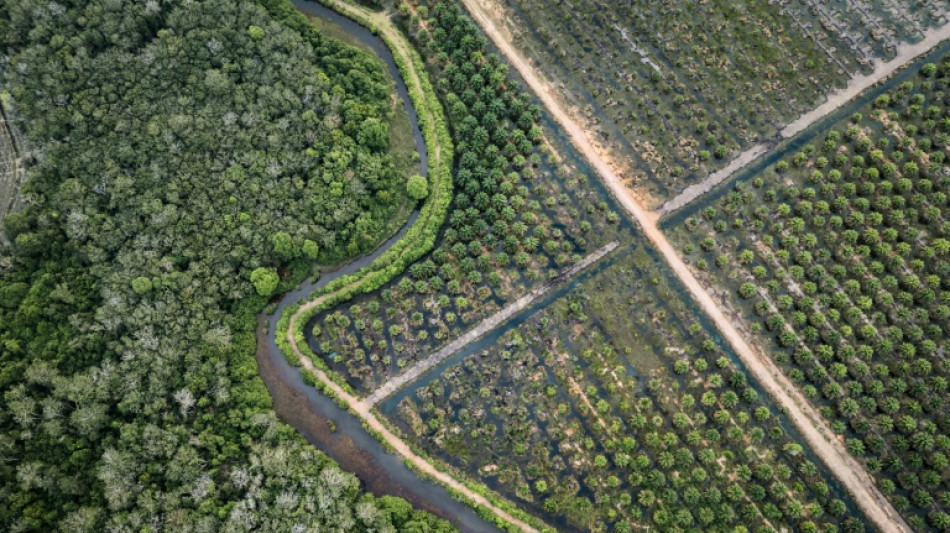
Indonesia has more tropical peatland than any other country, but it is also quickly losing this poorly understood ecosystem.
That affects local residents and wildlife but also has global impacts, because converted peatland can release vast quantities of planet-warming carbon dioxide.
Just 18.4 percent of Indonesia's peatlands remain "undisturbed", a 2023 study found with vast tracts now palm oil or timber plantations.
Pralensa worries a similar fate awaits much of the swampy peatland around his village of Lebung Itam in South Sumatra.
Locals say palm oil firm Bintang Harapan Palma has already begun digging canals to drain the peatlands for planting.
"We protested... we told them this is a community-managed area," said Pralensa, who, like many Indonesians, uses a single name.
"According to them, they already have rights to this land."
Bintang Harapan Palma did not respond to AFP's request for comment.
Peatlands are an in-between place -- seemingly neither water nor land -- an environment that slows plant decomposition and forms carbon-rich peat.
Covering just three percent of the world's surface, they hold an estimated 44 percent of all soil carbon.
Indonesia's peatlands are home to endangered orangutans, as well as economically important fish species. They also help prevent flooding and drought, lower local temperatures and minimise saltwater intrusion.
For Pralensa, peatlands are no less than a "spiritual bond".
"From the moment that we exist, that we're born, we are aware of this peatland. We encounter it every moment of every day," the 44-year-old said.
- Catastrophic fires -
Indonesia's peatland has long been converted for agriculture, drained of the water that is its lifeblood, with severe consequences.
Dry peat is highly flammable, and fire can smoulder underground and reignite seemingly at will.
Peatlands were a leading cause of Indonesia's catastrophic 2015 fires, which burned through an area about 4.5 times the size of Bali and cost the country some $16.1 billion, or about two percent of GDPaccording to the World Bank.
The blazes sparked calls for action, including a moratorium on new peatland concessions.
Government regulations adopted the following year banned several damaging activities, including burning and drying out peatland.
The environment ministry did not respond to questions submitted by AFP.
"Weak oversight and law enforcement in Indonesia allow the exploitation of peatlands to continue," said Wahyu Perdana at peatland preservation NGO Pantau Gambut.
And fires still happen "almost every year," said Rohman, a farmer in Bangsal village, around two hours west of Lebung Itam.
Like Lebung Itam, it is ringed by plantations on converted peatland.
Bangsal residents could once rely on vast wetlands to feed their distinctive buffalo, which dive beneath the water to graze.
Fish traps supplied additional income, along with small rice paddies.
Now, buffalo are hemmed in by plantations, while fish are affected by walls that keep the plantations dry, and fertilisers and herbicides flushed outby rain.
- 'We must protect nature' -
Plantation infrastructure prevents water from subsiding properly when the rains end, complicating rice planting
And then there is the seasonal haze.
"It's difficult to do anything" when it descends, said Rohman, with visibility sometimes dropping to just a few metres.
Everything from "economic activity to children playing and learning is very disrupted".
Rohman, 53, was one of several plaintiffs from Bangsal and Lebung Itam who filed a landmark lawsuit over the fires.
They argued three companies with nearby timber plantations on peatland bore legal responsibility for the health, economic and social impacts of local fires.
Filing the suit was not an easy decision, said Bangsal schoolteacher Marda Ellius, who alleges a company named in the case offered her money and help for her family if she withdrew.
"I kept thinking that, from the beginning, my goal here was for the environment, for many people," she said.
"I chose to continue."
AFP could not reach the companies named in the suit. Major firm Asia Pulp & Paper (APP), which buys from the three companies, did not respond.
This month, a local court rejected the suit, saying the plaintiffs lacked standing.
"The pain cannot be described," plaintiff Muhammad Awal Gunadi said of the ruling.
"It was tough because we were facing corporations.
The group has pledged to appeal, and Bangsal's villagers are lobbying local government for a new designation to protect their remaining peatland.
Healthy peat is "like the lungs of the Earth," said Bangsal resident and buffalo farmer Muhammad Husin.
"Hopefully, if we protect nature, nature will also protect us."
H.Takahashi--JT